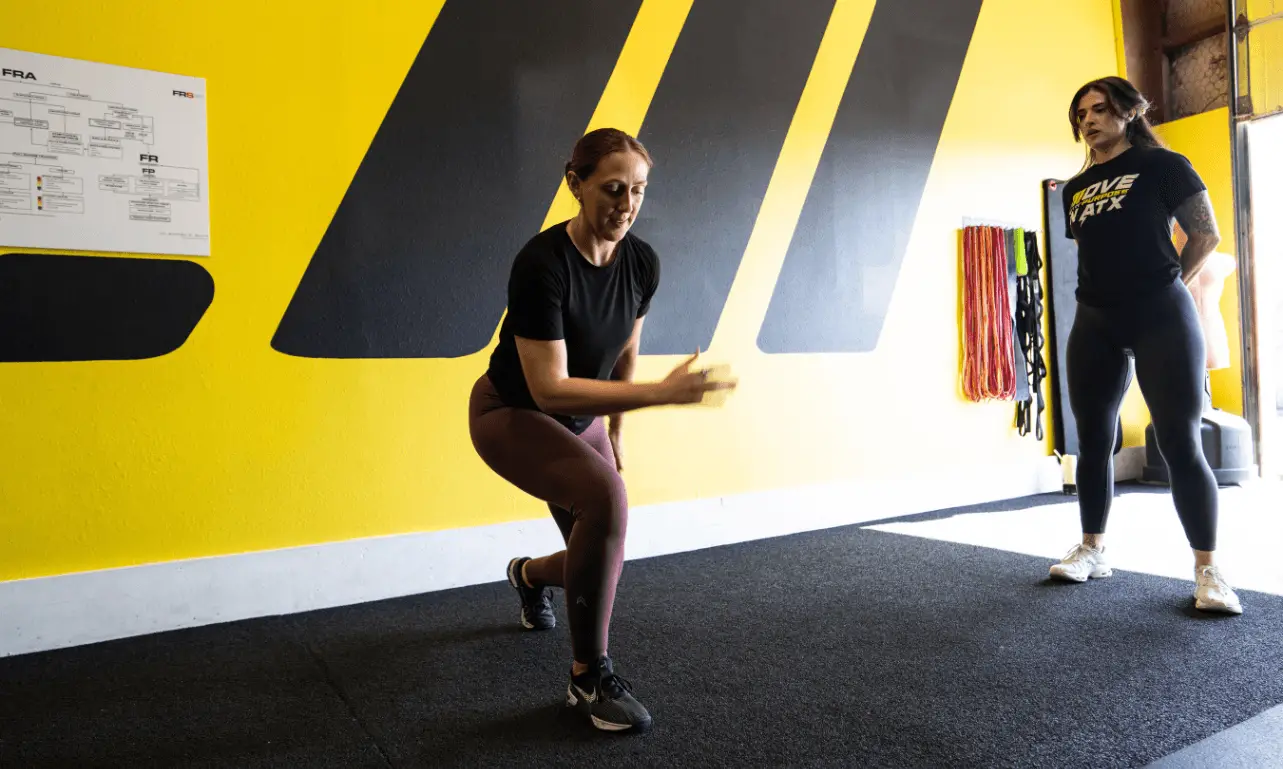
Co-written by Stacia Evans & Brian Cassady at Motive Training
A Note Before We Begin
This isn’t medical advice; every woman’s body, history, and hormonal picture is different. If you’re new to exercise or navigating perimenopause or menopause, talk with your healthcare provider before changing your routine.
Now, here’s why this topic matters so much for the women we work with every day.
Why Bone Density Has Become a Top Priority for the Women We Train
More and more women in their 40s and 50s are being told by their doctors to monitor their bone density—not because anything is wrong, but because women are simply at a higher risk for bone-related injuries as they age. Hip fractures, in particular, are significantly more common in women than in men, and they can dramatically affect mobility, independence, and long-term health.
What many women don’t realize is that this risk doesn’t suddenly appear at 65. It begins earlier—especially during the transitional years of perimenopause and menopause, when natural hormonal changes make bone loss more likely. You don’t need to be an endocrinologist to understand the impact:
Women lose bone faster, earlier, and more significantly than men—and proactively strengthening it through intentional training can make a world of difference.
This isn’t about fear.
It’s about opportunity.
The more we understand how bone health shifts with age, the earlier we can take steps that genuinely move the needle—and that’s exactly why adding controlled, joint-friendly impact to your routine can be so powerful.
Why Jumping Matters for Women in Midlife
Jump training is one of the most effective and underutilized tools for improving and maintaining bone density—especially during midlife.
Here’s the simple reason why it works:
Bones respond to two major types of stimulus:
- Load → from strength training.
- Rate of force → from impact, such as landing.
Most women get the first once they start lifting weights consistently. Very few ever get the second—and that’s where jump training fills the gap.
When your body experiences a quick, controlled burst of force through the feet and legs, bone cells respond by reinforcing the structure of the bone. These small, fast-loading impacts are especially helpful for areas most at risk for age-related loss:
- hips.
- femoral neck.
- tibia.
- spine.
You don’t need height.
You don’t need intensity.
You don’t need to feel like an athlete.
You only need intentional, repeatable impact, delivered in a way your body can absorb and adapt to safely.
The Perimenopause & Menopause Advantage
Women in perimenopause and menopause are actually ideal candidates for jump training—when it’s introduced safely and progressively. This is the stage of life when bone density naturally declines more quickly, which means your bones respond especially well to the right kind of stimulus. Light, controlled impact gives them exactly that: just enough force to encourage strength and resilience without stressing your joints. When paired with strength training, it becomes one of the most effective ways for women to support long-term bone health.
Jump Training Can Feel Accessible—When It’s Taught the Right Way
Some women may avoid jumping because it feels intimidating or unfamiliar—and that’s completely understandable if the only examples you’ve seen are explosive, high-impact movements.
But that’s not what your bones need.
And it’s not what we teach.
Effective, joint-friendly jump training looks like:
- step-off landings.
- tiny pogo hops.
- heel drops.
- low-level bounds.
- assisted jumps using support.
- directional hops (side, diagonal, slight rotations).
- med-ball slams.
- controlled power swings.
- small hops that shift force through different vectors.
These variations are easy to learn, scale, and recover from. They give your bones exactly what they need—consistent, varied impact—without stressing your joints.
This style of training is especially valuable during perimenopause, when the body benefits from both consistency and variability to stay strong and adaptable.
Women Want to Get Strong—Not Get Hurt
As a women’s personal trainer, I see a common theme: many women worry that strength training or impact work might lead to injury. They’ve been told to “be careful,” avoid jumping, or stick to gentle exercise as they get older—and while that advice is usually well-intentioned, it often creates unnecessary fear around the very movements that actually build strength and resiliency.
Here’s the truth:
Impact isn’t the problem. Poorly coached impact is.
When women are taught how to land softly, control their bodies, and progress at a pace that feels safe, jump training becomes a confidence builder—not a risk. It brings back a sense of athleticism and capability that many women haven’t felt in years.
Women deserve to feel:
- strong.
- adaptable.
- athletic.
- grounded.
- capable.
And when jump training is introduced thoughtfully, it supports all of these qualities—and the benefits carry into everyday life.
Potential Transition
Now that we’ve covered the why, I’m handing things over to Brian Cassady, CSCS and FRC Mobility Specialist, who’s going to break down the how.
Brian will dive into:
- Why mobility and joint prep make jumping safer.
- How vector-based training strengthens bones from multiple angles.
- How to progress impact training without joint stress.
- How to build elastic strength in your 40s, 50s, and beyond.
- How to use landing mechanics to make jumping feel smooth and pain-free.
His approach to movement quality and joint-specific control is exactly what makes impact training accessible for the women we work with every day.
Brian, take it from here.
My Background
I have worked in the health and fitness industry for 7 years, with 3 of those years focused on strength and conditioning for athletes of all ages, from 5 years old to the collegiate level, and the other 4 years on ‘gen pop’ or adult fitness. I have helped people manage and develop power training from pre-adolescence through retirement. This is all based on my experience as a coach, my education, and the tactics and techniques I have developed along the way, with guidance from my peers and mentors.
Important Factors in Jump Training
There are a few factors that, no matter the age, will define how effective, safe, and overall beneficial a jump training protocol will be:
- What movement capacities are required to jump.
- What systems are we training with jump training.
- How to manage load and progress training.
- Understanding jumping and landing mechanics.
This must be explained and understood simply and cohesively so that both the coach and the client understand the goal, how to execute it, and why it is so beneficial. This will also help us avoid the mistakes we can easily make in the pursuit of power development and jump training.
What We Need to Understand First
Below, I will provide a brief breakdown of what power is and where jump training fits in power development.
The Force-Velocity Curve
The figure below shows a graph with two lines: the bold line shows a spectrum from speed to max strength, and the dotted line shows max power. This graph shows that in the middle, in the 30-70% force range, we can produce the maximum possible power by moving a weight at 30-70% of our maximal strength as fast as we can.
The right side of the bold line shows Max Strength (85%+), where most of our true strength training lies. The other side of the line is Speed (<20%), and this is where our jump training and plyometric work lands; this is where we will be focusing today.
What is Power?
Power, from a physics standpoint, is Force multiplied by Velocity. Yes, in athletics, this is very important, since more power is usually required to competitively gain the edge over an opponent. Still, from a human physiological development perspective, power is a tool that we can use to create adaptation within the human body.
The tissue inside your body (bones, tendons, ligaments, muscles) all respond and react to power as a stimulus, and will adapt accordingly. If you demand more power out of a tissue, it will adapt and develop the resiliency to accept, transfer, and deliver that power. The trick here is to do it in the right amount and safely.
Why Use Power?
If tissue adaptation is all about stimulus, then why not just pick up heavier objects to get a higher strength stimulus?
This is a good point, and normal strength training, working into the right side of Figure 1, is important for healthy and strong tissue development.
But in power training, when moving objects (like our body weight), with intent as fast as possible, we are capable of producing an even higher and more specific stimulus on the musculoskeletal system than pure strength training is, and the development of specifically the bones tendons ligaments and tissues becomes a higher focus due to the transfer of the force through the entire system.
Joint Mobility and Tissue Capacity Will Make Jumping Safer
Functional Range Systems (FRS) is a great tool to help build resiliency and capacities of important joints required for safe jump training. There are many ways the human body will adapt to solve a movement problem, and in FRC, we call these compensations. In plyometrics and jump training, it may just be called ‘bad form’.
The issue is that in jump training, sometimes the only way people will look to address the ‘bad form’ is by drilling that movement over and over. This is where FRS can help: through a simple assessment, we can determine whether someone is incapable of the joint capacities required to carry out a ‘good form’ rep for a jump.
What Joint Capacities Help with Jumping?
From the ground up, it is going to be helpful to have the following:
- Full control and articulation of the ankles.
- Knee extension and rotation.
- Hip extension and rotation (internal and external).
Having said that, many people can start a jump protocol with little to no issues, even without full access to these joints. The human body is amazing at adapting and solving movement problems. As long as there are no huge pains or concerns with form, it is okay to begin jump training lightly at this stage.
What Systems are We Working with Jump Training?
I am going to put the systems we are training into two categories:
- Tissue adaptations.
- Neurological adaptations.
Without going too deep into the weeds of how these adaptations occur at the cellular level, I want to talk about the mechanisms by which we obtain these adaptations and what steers the stimulus for them.
Tissue Adaptations
Tissue here means anything from bone to tendons and ligaments to muscles. This can be described as ‘Bioflow’ in FRS, but it generally means just about everything in the musculoskeletal system. Bioflow describes the musculoskeletal system as having ‘tissue continuity,’ meaning that all the different types of tissues are just varying degrees of the same tissue, spanning from the white stuff (tendons, ligaments, bones) to the red stuff (muscles). This is important to understand because tissue generally responds to stimuli in the same way.
Tissue Adaptations to Jump Training
The major goal for jump training is to build tissue resiliency through increased tensile strength, increased thickness, and elasticity. This is done by increasing the power output both created by and received by the tissue. This means not just being able to jump up well, but also being able to safely and effectively receive the ground and control your own body in space.
Neurological Adaptations
Jumping is a skill. Teaching full-body coordination can be a challenge, and, as with most things in the human body, it is best to begin on the simple side, gradually progressing to the complex.
When learning to jump, the brain-to-body connection between neurons that innervate the muscles involved grows and adapts, and jumping is a full-body movement.
Thankfully, there are tactics to help develop both tissue and neurological adaptations simultaneously.
Where to Start?
I always begin dynamic movement training, including jump training, medball velocity training, sprint training, etc., with the 8 Vector System.
This is a great tool that does not require any equipment or a large amount of space to start teaching the body to work 3-dimensionally, receiving forces from all angles. 8 Vector training is great for both tapping into the neurological stimulus of high variability training as well as methodically increasing the tissue’s capacity for force absorption and development.
The 8 Vector System
The 8 vector system is the idea that, from a central base stance, you can create movement in 360 degrees of motion. Having those degrees of motion broken into 8 different vectors allows you to manage the load of training and variability. You can begin working on movement types at each line of movement, understand where weaknesses, including physical and neurological limitations, are, and train those.
This needs to be done at very low intensity to start, and slowly progress.
A Progression I Follow for Each Vector
Here is the progression I follow for each vector of movement, and this will give you a good way to progress and regress movements in other areas of jump training.
- Steps.
- Lunges.
- Lunge drop catches (catching at the bottom of the lunge quickly).
- Two-leg jump (both feet together, or broad jump).
- Leap (jump off one leg, land on the other).
- Two-leg jump to land on one leg.
- Single-leg jumps (staying on the same leg).
These should also be progressed by varying depth, length, and speed. This is a great place to start before you ever need to jump on or off a box. Intent is always the most important here, and understanding why you’re jumping and at what intensity is essential.
Jumping and Landing
This is a full-body movement. The arms, shoulders, and spine are also involved in this “lower body” power training. From the ground up, we want to be in control of our body, and this is a skill that takes time, which is why the 8 vector training is so important to start with. As we age into our 40s and 50s, this is still possible, safe, and important to do; we just need to scale intensity.
The lower body needs to be springy, landing mostly on the forefoot, with a quarter squat at the bottom of the jump. The torso will stay relatively upright without excessive hip flexion, and the torso angle will match the shin angle.
Jumping
When jumping out, throw your arms in the direction of the jump, and find triple extension in the ankles, knees, and hips as you are leaving the ground. This is where we can intentionally be explosive and find as much power transfer through the body concentrically. This part is pretty straightforward, and as long as we can keep everything relatively in line and coordinate our timing, this should be easy to progress and develop.
Landing
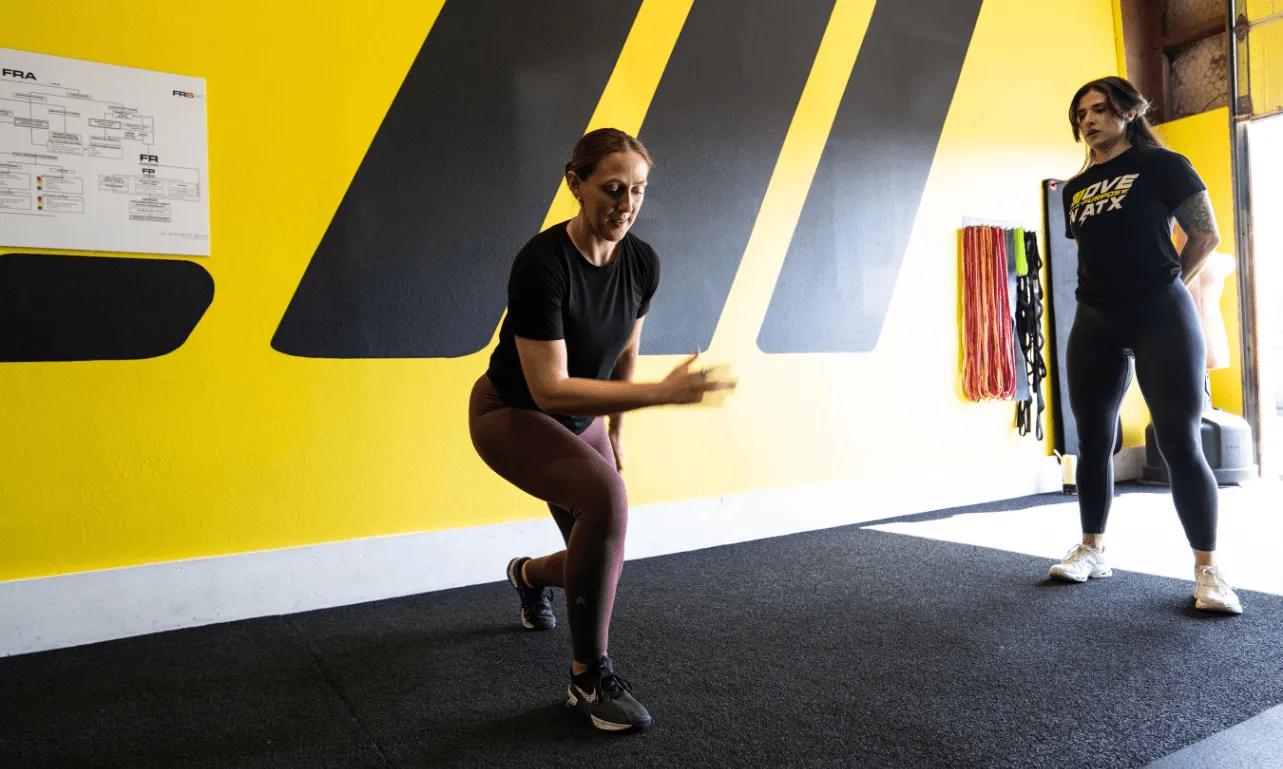
The landing part of the jump is arguably more important. This is the eccentric portion of the exercise, when we are receiving the ground, and having to slow our body weight down in a controlled manner.
This is where you can find most of the adaptation and stimulus. When trying to land properly, you want to first know where your ‘bottom position’ is, which is where you would jump out from, and try to get there as quickly as possible.
Your ability to absorb the ground quickly and make the time from when your feet touch the ground to when you have completely stopped the downward momentum of your landing as short as possible will increase the force that is put through the musculoskeletal system.
We want to start soft and slow to learn the pattern, but over time learning to be quick and explosive when landing. Consequently, being able to get back off the ground quickly will increase our force output, thereby enhancing adaptations in our muscles, bones, tendons, and ligaments, giving us a stronger, more dense structure.
FAQ: Jump Training for Bone Density in Your 40s and 50s
Do I need to jump high for this to work?
No. Bone responds to repeatable impact and force rate. Low-level hops, step-off landings, and heel drops can be enough when performed consistently and progressed slowly.
How often should I do impact work
A common starting point is 1-2 short exposures per week, paired with strength training. The best dose depends on recovery, joint tolerance, and training age.
What if jumping bothers my knees, hips, or back?
That’s usually a scaling and entry-point issue, not a reason to write impact off completely. Start with lower amplitude drills, slower landings, and joint prep to build capacity.
Closing
Bone health is trainable. Strength training builds the foundation, and controlled impact fills a gap most women never address. When jumping is taught with joint prep, clean mechanics, and smart progression, it becomes one of the most practical tools for long-term resiliency in midlife.
Written by

Brian Murray, FRA, FRSC
Founder of Motive Training
Motive Training is a coaching studio in South Austin built around assessment, joint health, and strength you can use. Train with us in the studio, come to a KINSTRETCH class, or work through the progressions in KINSTRETCH Online.