Austin is a cycling city.
From long Hill Country climbs to Greenbelt trail sessions and aggressive group rides, cyclists here put serious mileage into their hips and knees. And most of the time, the body tolerates it well.
Until it doesn’t.
The tight hip that never quite loosens up.
The knee that aches after long efforts.
The low back stiffness that lingers the day after a ride.
Most riders respond the same way. They stretch.
But stretching rarely addresses why the joint became irritated in the first place.
Mobility training does.
Why Cyclists Develop Hip and Knee Pain
Cycling is beautifully repetitive. That’s part of its appeal.
It’s also the problem.
Every ride reinforces the same range of motion. The hip flexes and extends in a narrow band—the ankle cycles through a limited arc. The spine holds a sustained posture for long periods of time.
When movement stays in one lane long enough, the body adapts to that lane. Rotational capacity decreases. Extension may become limited. Certain positions get strong while others get neglected.
Over time, force stops distributing evenly.
The knee often becomes the joint that absorbs what the hip can no longer manage. The lower back picks up slack when the hips lack rotation. Tightness shows up as a protective strategy, not as a muscle length problem.
That’s why simply stretching the quads or hamstrings rarely solves recurring cycling pain.
The issue isn’t short tissue.
It’s limited joint capacity.
Is Mobility Training Different From Stretching?
Yes, and the distinction matters.
Stretching increases tolerance to length. It teaches the nervous system that a position is safe enough to relax into. That can feel helpful in the short term.
Mobility training builds strength and control inside a range.
That difference is everything for cyclists.
On the bike, you don’t just visit positions. You produce force inside them. If your hip lacks rotational strength or your ankle lacks controlled motion, your body compensates under load. The compensation may not be obvious at first, but over thousands of pedal strokes it becomes stress.
Inside our Mobility Training system, the focus is not on passive range. It’s on usable range. The kind you can control when fatigue sets in and effort increases.
That’s what protects joints long term.
The Joints That Matter Most for Cyclists
For riders training in Austin, three areas consistently show up as limiting factors.
The hips are first. Cycling demands sustained hip flexion, but most cyclists lose internal rotation and extension strength over time. When that rotational capacity shrinks, torque shifts toward the knee.
The ankles are next. Limited ankle control alters pedal mechanics subtly but consistently. The stress rarely stays local.
The thoracic spine plays a quieter but equally important role. Long hours in a forward posture reduce rotational options. When the spine stiffens, the hips and lower back compensate.
These are not flexibility problems. They are control problems.
This is why assessment matters.
Why a Movement Assessment Changes Everything
If you are serious about eliminating recurring pain or improving performance, guessing is inefficient.
A structured Functional Range Assessment allows us to measure active and passive joint capacity. We look at where rotation is limited, where control breaks down, and where closing angle restrictions exist.
For cyclists, the gap between passive and active range often predicts irritation patterns. When a joint can be pushed farther than it can be actively controlled, compensation becomes likely under load.
That gap is where we focus.
Not where something merely feels tight.
Can Mobility Training Improve Cycling Performance?
Yes, and not in a vague way.
When hips rotate better, force transfers more cleanly. When ankles move with control, power delivery becomes smoother. When the spine regains rotation and extension capacity, posture holds longer under fatigue.
Performance gains don’t always come from pushing harder. Sometimes they come from removing mechanical limitations.
Cyclists who integrate structured mobility work often notice improved comfort first. Performance improvements follow because efficiency improves.
The goal is not to turn cyclists into gymnasts.
The goal is to expand joint options so the body does not run out of them mid-ride.
Why Austin Riders Need to Think Long-Term
Austin’s terrain is not flat. Climbs demand extension strength. Trail riding demands rotational control. Long summer rides demand endurance in compromised positions.
If you ride multiple times per week, stress accumulates quietly.
Mobility training becomes preventative infrastructure. It protects the joints that cycling repeatedly loads.
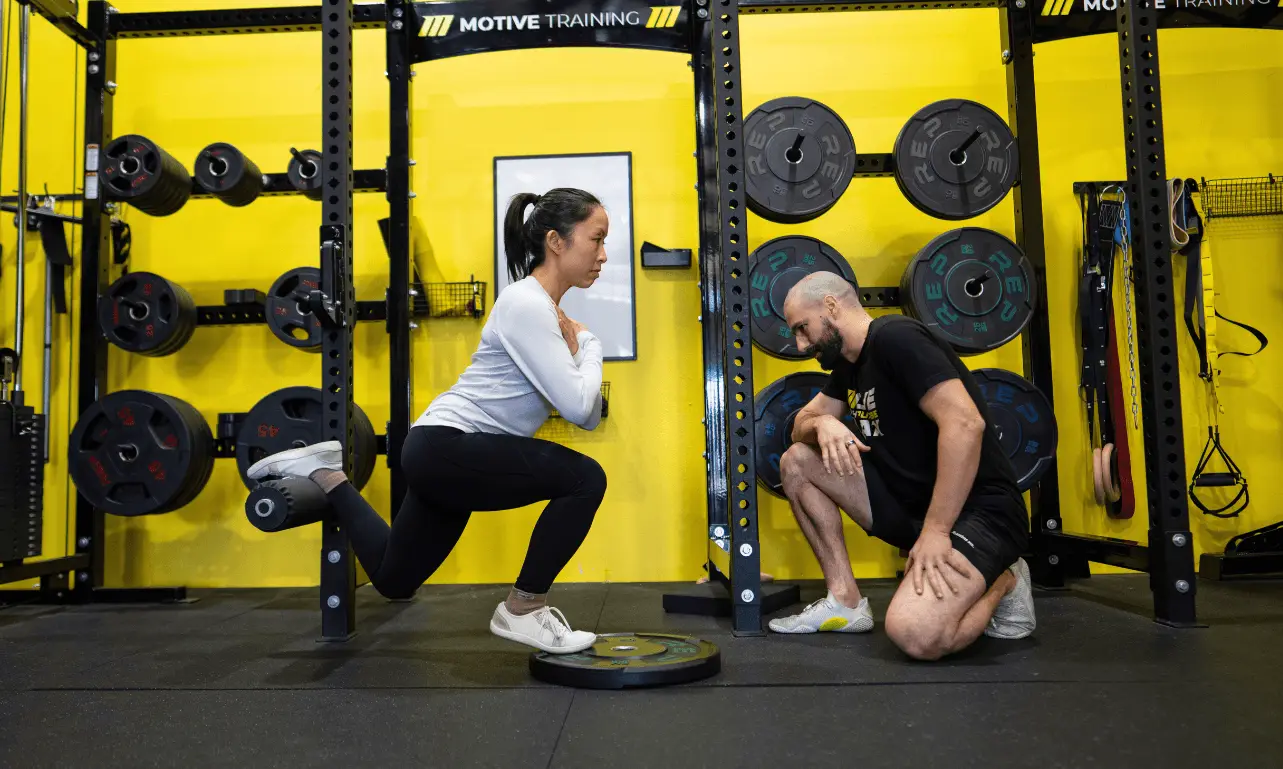
That is why we integrate mobility into both our KINSTRETCH classes and individualized Personal Training Programs. It is not a warm-up. It is part of the plan.
The Bottom Line
Cycling does not create pain on its own.
Limited joint capacity under repetitive load does.
Stretching can feel helpful, but without strength and control, it rarely changes the long-term pattern. Mobility training addresses the joint directly. It builds range that you can actually use.
If you are searching for mobility training for Austin cyclists, start with assessment. Build from there.
Ride longer.
Recover faster.
Protect your joints for the miles ahead.
Written by

Brian Murray, FRA, FRSC
Founder of Motive Training
Motive Training is a coaching studio in South Austin built around assessment, joint health, and strength you can use. Train with us in the studio, come to a KINSTRETCH class, or work through the progressions in KINSTRETCH Online.