If you work in tech, odds are your body has taken a hit, and it probably happened slowly enough that you didn’t notice until something small gave it away. Standing up after a long sprint review and needing a few steps before your hips feel normal. Checking a blind spot and realizing your neck turns less than it used to. A first run on Lady Bird Lake after a heavy quarter that leaves your back stiffer than your legs.
Austin has one of the densest tech workforces in the country, and most of that workforce spends eight to ten hours a day in some version of the same position. Hips bent to about ninety degrees, upper back rounded toward a screen, shoulder blades drifting forward, head sitting a few inches ahead of where it started the morning. The body adapts to that position the same way it adapts to anything else you do for hours a day. That adaptation is the problem mobility training is built to solve.
What a desk job does to your joints
Joints keep the range they use. When a hip spends most of the day flexed and almost none of it extended or rotating, the nervous system gradually treats the unused range as range it doesn’t need to protect or control, and access to it shrinks. Muscle and connective tissue around the joint follow along over months. I wrote more about the tissue side of this in what sitting does to your body, but the short version is that sitting is a very consistent training stimulus, and you’ve been doing it longer than any program you’ve ever followed.
The hips lose extension and rotation first. The thoracic spine (your mid and upper back) loses its ability to rotate and extend segment by segment, so it starts moving as one stiff block. The shoulder blades settle into a forward position and lose some of their ability to tip back and rotate up when you reach overhead. The neck ends up doing extra work to keep your eyes level with a screen that sits a little too low.
There’s a second loss that gets less attention. Walking is the rotational workout most people forget they’re supposed to be getting. Every step asks the pelvis and the upper trunk to rotate in opposite directions, thousands of times a day, and that counter-rotation is how the hips and spine stay organized with each other. A desk job removes most of that volume. So the position takes range away, and the job also takes away the movement that would have been putting some of it back.
Where any one desk worker’s pain comes from is a separate question. Restrictions in the hip often show up as low back complaints, and a stiff upper back often shows up at the neck, but sorting out your specific case takes an assessment. What’s predictable is the pattern of range that goes missing.
Ergonomics help, up to a point
A good chair, a monitor at eye level, and a standing desk all make the day more comfortable, and I’d keep all of them. What they can’t do is put rotation back into a hip or extension back into an upper back. A standing desk swaps one static position for another, and most people end up leaning on one leg by mid-afternoon anyway. The best position for your joints is the next one, and a joint only keeps range it gets taken through, under some kind of demand, on a regular basis.
That’s where mobility training comes in. It’s active training: you produce and control the movement, and you build strength at the ends of your range so the nervous system has a reason to give that range back. Foam rolling and passive stretching can feel good after a long day, and they have a place. Teaching a joint to work somewhere new takes contractions and load at the end of its range.
How we start: measure first
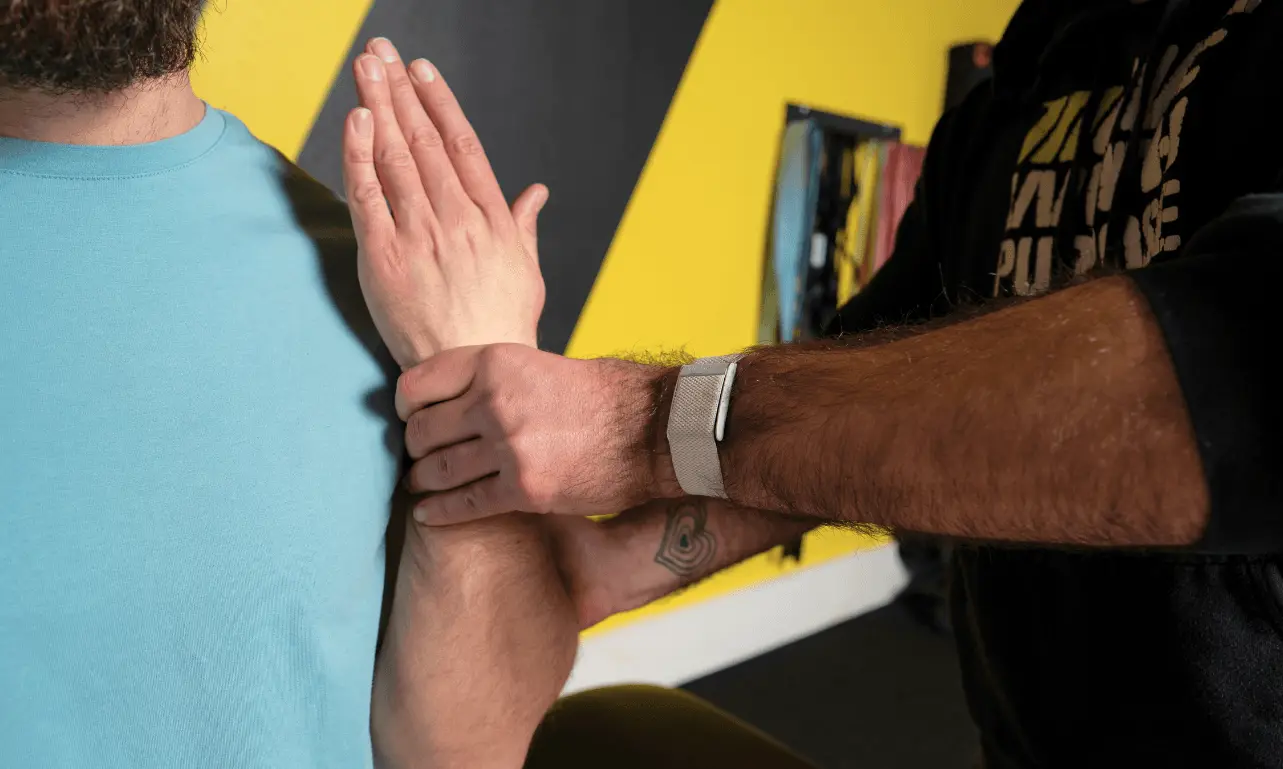
Every desk worker we see is a little different, so we start by measuring. Most new clients come in through the Motive Movement and Mobility Assessment, where we look at how each major joint moves on its own, active and passive, side to side. Two people with the same job title can have completely different restrictions. One loses hip rotation and keeps a mobile spine; another has hips that rotate fine and an upper back that barely moves.
From there we build the plan. For most tech workers, some version of the following shows up.
Hip rotation and repositioning
Hips that spend all day flexed lose rotation first, especially internal rotation. We use modified 90/90 setups, progressive angular isometrics (PAILs and RAILs), and controlled rotation drills to rebuild that range and the ability to produce force at the end of it. The isometrics matter here. Holding a position at the edge of your range and then contracting hard into it, and away from it, gives the nervous system evidence that you can control that range, which is a big part of why it lets you keep it. Our guide to PAILs and RAILs goes deeper into how those contractions are programmed.
Spinal segmentation
A spine that moves as one block puts more of the load on whichever segments still move, which for a lot of people is the lower lumbar spine and the base of the neck. So we teach people to move the spine one piece at a time. It starts with segmental cat-cows, where the goal is to articulate each vertebra in sequence, and most people find a stretch in the middle of the back that won’t budge on the first few tries. That’s useful information. From there it progresses into loaded rotation and flexion and extension work, so the upper back can carry some of the motion the low back has been covering for.
Scapular control
Rounded shoulders change how the neck and upper spine move. When the shoulder blades sit forward, the arm loses room overhead, and the muscles at the top of the shoulder and the base of the neck end up holding positions they weren’t built to hold all day. Scapular CARs, wall slides, and end-range shoulder isometrics are staples in our programming for desk workers, and we usually pair them with cervical CARs so the neck gets taken through its full range on purpose instead of only in the direction of the screen.
The common thread across all three is control. These drills feel good, and the deeper value is that they change the map your brain keeps of each joint.
What to do between sessions
Training a couple of times a week builds the range. What you do at your desk the other days decides how much of it sticks. The most useful habit we hand desk workers is short and boring: a few slow controlled articular rotations for the hips, spine, shoulders, and neck, two or three times a day. Five minutes before standup, five minutes after lunch, five minutes when you close the laptop. Taking each joint through the full circle of its range, slowly enough that you can feel where it gets rough, keeps that range in use and doubles as a quick check on how you’re doing.
Beyond that, change positions often. Stand for a call, sit on the floor for part of the evening, take the long way to the coffee machine. Every position change is a small vote for the range you’re trying to keep.
The Austin piece
We see the same pattern over and over. Someone moves to Austin for a big tech job. They love the weather, the trails, and the food, and a year or two in they feel worse in their body than they did before the move. It’s a strange combination: a city built for being outside and a job that keeps you in a chair. The summer heat adds to it, since plenty of people trade outdoor miles for the couch from June through September.
Scheduling is usually the real constraint for this group, so the studio runs early mornings, lunch hours, and after work. Our mobility coaching in Austin is built around that, for people working in an office downtown or remote from South Austin. For anyone who wants a recurring practice on top of one-on-one work, or instead of it, a KINSTRETCH class takes every major joint through this kind of training in a small group, and it fits a desk worker’s week well because it doesn’t need a project goal to justify it.
How fast this comes back
Faster than most people expect, as long as the training stays specific and consistent. Range that went missing over years of sitting usually starts coming back within weeks once a joint is being asked to use it again under some load, and strength through that range follows. People notice it in ordinary places first. Turning to back out of a parking spot. Getting up off the floor. A walk around Lady Bird Lake where the hips swing freely and the back stays quiet the whole way.
If you want to find out which of your joints sitting has taken the most from, the assessment is where that starts. You’ll leave knowing where your range is, where it’s missing, and what we’d train first to get it back.
Written by

Brian Murray, FRA, FRSC
Founder of Motive Training
Motive Training is a coaching studio in South Austin built around assessment, joint health, and strength you can use. Train with us in the studio, come to a KINSTRETCH class, or work through the progressions in KINSTRETCH Online.