Most athletes train with intensity. Very few train from information. Around Austin you’ll find runners logging miles at Lady Bird Lake, cyclists grinding Hill Country climbs, lifters chasing numbers in South Austin gyms, and recreational athletes competing in everything from pickleball to jiu-jitsu. Almost all of them have a program. Almost none of them started that program with a joint-by-joint assessment, and that gap is bigger than it sounds, because a training plan built without knowing how your joints actually move is a plan built on assumptions.
What a real movement assessment actually measures
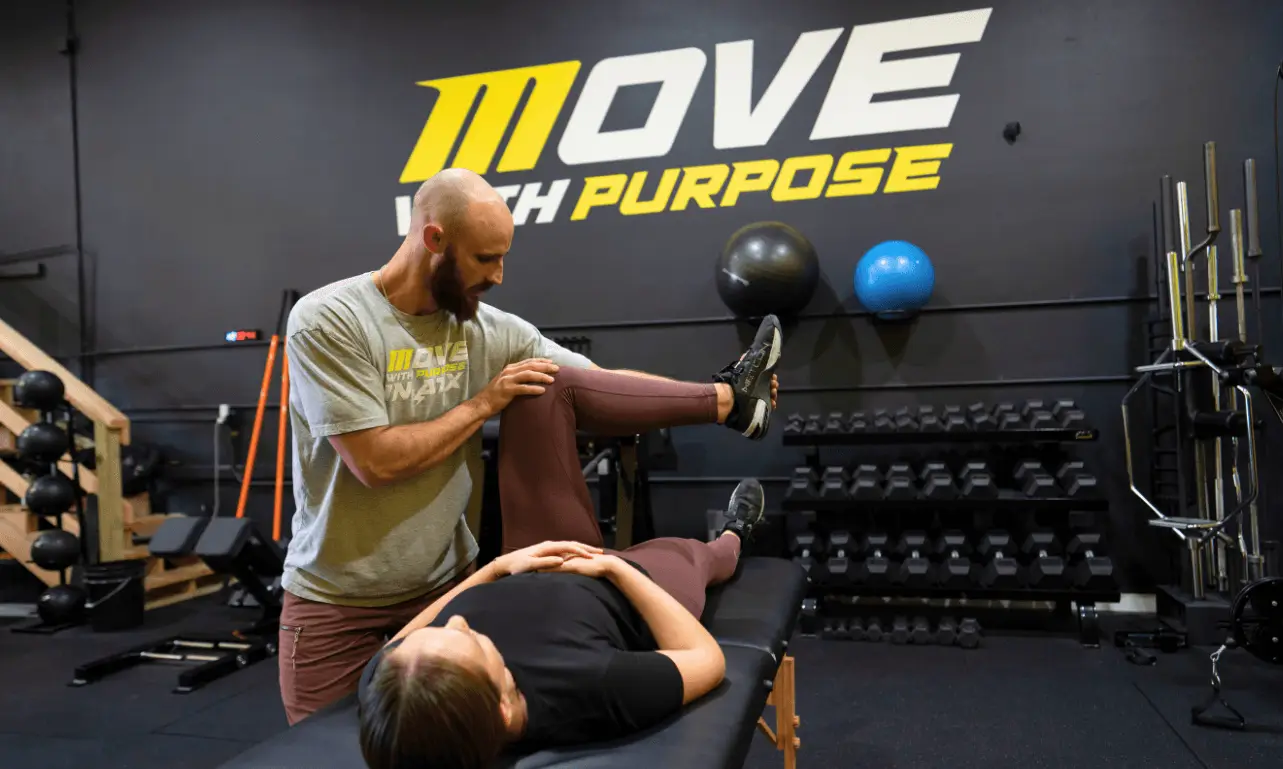
A structured movement assessment isn’t watching someone squat once and calling it good. It evaluates joint function directly: how much range of motion you can actively control at each joint, how much passive range exists beyond that, and where the gap between the two shows up. Inside our system that happens through a Functional Range Assessment, and the goal is simple. We’re not guessing where mobility is limited. We’re measuring it, joint by joint, and that changes what programming can actually target.
Why most athletes skip this step
There’s a cultural default toward intensity over information. If something feels tight, stretch it. If something feels weak, lift heavier. If something hurts, modify the movement around it. What rarely happens is a systematic look at joint capacity before any of that starts.
That default misses how athletic performance actually gets produced. Performance is force transfer, and force transfer depends on joint integrity along the whole chain. If hip rotation is limited, torque that should stay at the hip shifts down to the knee, which is exactly the mechanism behind a lot of non-contact knee strain in runners and field athletes. If the ankle lacks dorsiflexion control, compensation travels upward into the knee and hip. If the spine loses segmental rotation, load distribution across the trunk becomes uneven, and something downstream ends up absorbing more than its share. Training harder on top of those blind spots doesn’t fix them. It reinforces them, because more volume through a compensating joint just means more reps of the compensation.
The gap between passive and active range is what predicts problems
Every joint has two numbers worth knowing. Passive range is how far a joint can be moved with assistance, gravity, a partner, your own body weight leaning into it. Active range is how far you can move it yourself, under your own control. When passive range meaningfully exceeds active range, that difference is unowned territory: motion your tissue can reach but your nervous system hasn’t been given a reason to trust.
That distinction matters most under fatigue or high output, which is precisely when technique degrades and the body drifts toward the outer edges of what’s available. If you can’t actively control those end positions, that’s where compensation patterns start, and compensation held under fatigue long enough tends to become irritation. Athletes in that position don’t need more random stretching aimed at feeling looser. They need ownership of the range they already have, which is why the end-range training we build into programming focuses on building strength in specific positions rather than increasing tolerance for them.
How assessment changes programming
Once you know exactly which joints are limited, programming stops being generic and starts being specific. If hip internal rotation is restricted, that becomes a direct target instead of a vague “work on hip mobility” note. If ankle dorsiflexion lacks control, it gets prioritized instead of buried in a general warm-up. If thoracic rotation is asymmetrical side to side, that asymmetry gets addressed directly rather than trained around.
The sport-specific version of this looks different depending on what someone’s actually doing. For runners, it often means building rotational hip capacity, since a hip that can’t internally rotate under load tends to hand that demand to the knee with every stride. For cyclists, it’s frequently hip extension: the pedal stroke never asks the hip to fully extend, so the flexors adaptively shorten over years of riding, and that shortening pulls on the lumbar spine long before it ever shows up as a complaint about the hip itself. For lifters, it’s usually joint-specific closing angle limitations, a shoulder or hip that hasn’t been taught to control its own end range, addressed before more load gets stacked on top of it. The performance improvement that follows isn’t about doing more. It’s about removing the inefficiency that was quietly taxing every rep already.
Durability, not injury prevention, is the honest framing
Athletes usually ask about injury prevention, and durability is the more accurate way to describe what’s actually on offer. Building active range and joint control doesn’t make injuries disappear. It expands what the system can tolerate before something gives, which is a different claim and a more honest one. In a city built around consistent activity, that distinction matters. The goal isn’t to eliminate risk. It’s to keep training and competing consistently instead of cycling through the same recurring flare-up every few months.
Why this differs from a standard movement screen
Most gym-based movement screens evaluate patterns: squat depth, overhead reach, lunge mechanics. Those patterns are useful, but they’re downstream expressions of joint function, not the function itself. A joint-specific assessment works upstream of that. Instead of asking if your squat looks clean, it asks if the hip joint itself rotates the way it needs to. Instead of modifying an overhead press because it feels off, it tests if shoulder rotation and capsular control are the actual limiting factor. Patterns compensate. Joints tell you what’s really there, and that distinction is the difference between training around a limitation indefinitely and actually closing it.
Where this leaves you
Intensity without information is guesswork with good effort behind it. A structured assessment gives you measurable data on joint capacity, and from there programming gets to be precise instead of generic. Cleaner joint control produces cleaner force transfer, and cleaner force transfer is what durability and performance are actually built from. If you’re training seriously in Austin, starting with an assessment instead of another workout plan is the more direct path to both.
Written by

Brian Murray, FRA, FRSC
Founder of Motive Training
Motive Training is a coaching studio in South Austin built around assessment, joint health, and strength you can use. Train with us in the studio, come to a KINSTRETCH class, or work through the progressions in KINSTRETCH Online.