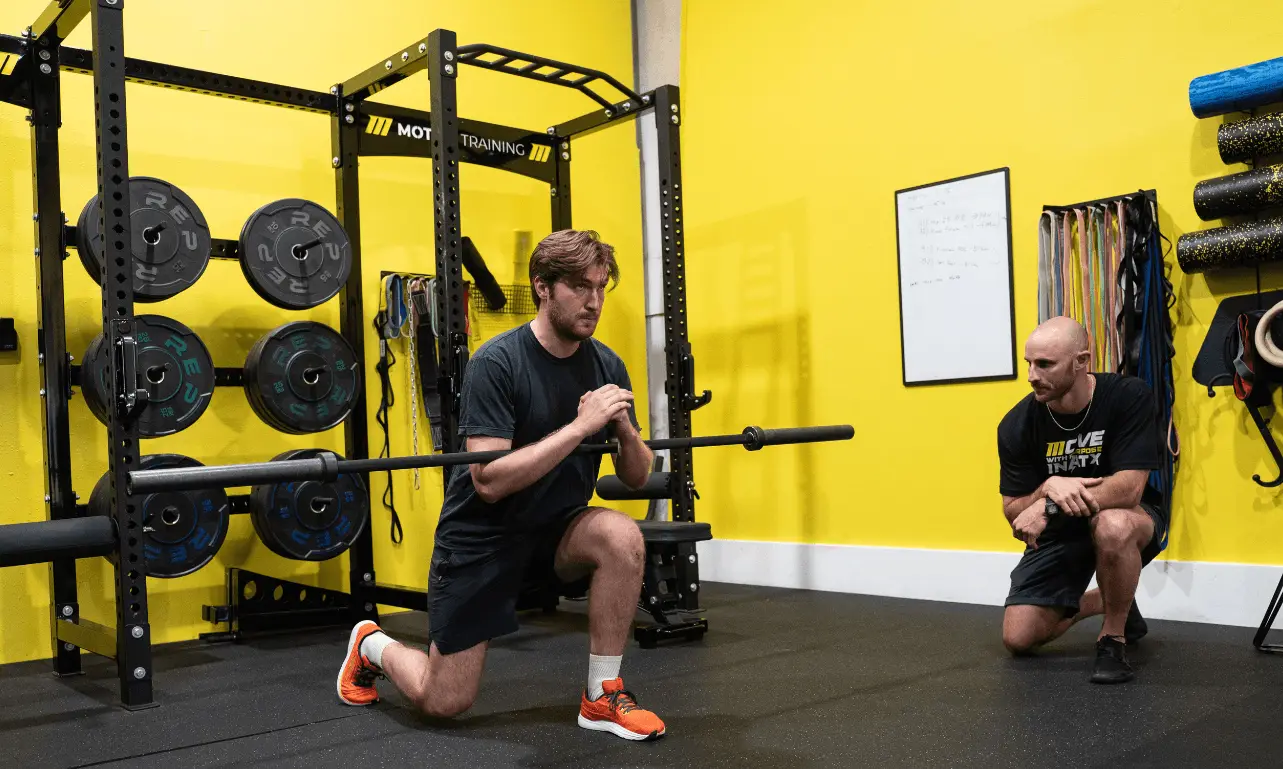
Yes. Planet Fitness runs small-group training sessions it calls PE@PF, short for Physical Education at Planet Fitness, and they come with every membership. The more useful question, for most people typing this into a search bar, is what those sessions will do for them and for how long. That answer depends on where you are starting, so this piece covers what PE@PF includes, what it does well, and the point where people usually need something the format was never designed to give them.
What PE@PF includes
According to Planet Fitness, most clubs run somewhere around 11 to 14 small-group sessions a day, members can attend as many as they like, and you sign up through the PF app or at the front desk (1). The trainers are employed by the club, and the company requires each of them to hold a personal training certification along with CPR and AED certification (1). Members can also book a session where a trainer builds them a program to follow on their own (2).
The sessions happen on the gym floor. A trainer walks a small group through machines, cardio equipment, and simple strength work, and the lineup changes from club to club, so the app is the only reliable way to see what yours offers. Studio formats like spin or yoga are not part of PE@PF. If a room with an instructor and a playlist is what you had in mind when you searched for classes, that is worth knowing before you sign up.
What it does well
For someone who has never trained, the hardest part is walking in. Planet Fitness built its whole business around that problem, and PE@PF is the most useful piece of it. A trainer shows you how the machines adjust, where the seat goes, what a reasonable first workout looks like, and you get that help for the price of a membership that starts at $15 a month (3).
Machines are a sensible place for a beginner to start, too. The path is fixed, the skill requirement is low, and the weight goes up in small increments. A person who shows up twice a week for a few months and learns their way around the floor has built a habit, and in my experience the habit is most of what a beginner needs early on.
Where it stops producing change
The format is built for a group, so the programming has to fit everyone in the group. That means nobody measures anything about you before you start. Nobody checks how your hips rotate, asks about the knee you tweaked in college, or records what you did last month so this month can build on it.
Early on, that barely matters. A body that has not trained in years responds to almost any consistent work, and the first few months of progress come fairly easily. After that the easy adaptation runs out. Further progress depends on specifics about you: which loads should go up, which positions you cannot reach yet, and what should be left alone for now. A session that rotates a whole group through the same circuit has no way to make those calls.
Machines also choose the path for you. That is part of what makes them approachable, and it is also why they can hide a problem. At the bottom of a leg press, for example, a hip that has run out of flexion hands the rest of the range to the lower back, and the machine keeps moving along its track while it happens. The same mechanism sits behind a lot of back pain after squats. A fixed path also gives you very little practice at the things daily life asks for, like getting up off the floor, carrying something awkward up the stairs, or turning quickly to catch a kid.
So how do you know you have hit that point? Usually the workouts have stopped feeling different from one week to the next, and the weights you use have not moved in a couple of months. Sometimes it shows up as the same ache after the same exercise with nobody asking why. Some people just want to learn free weights and realize nobody is watching their form.
What the next step can look like
The cheapest upgrade is often a few sessions with a qualified coach who writes you a program, which you then run at the gym you already pay for. That is a legitimate way to use a $15 membership, and it beats quitting by a wide margin.
If you are in South Austin and want the fuller version, the starting point at Motive is the Motive Movement & Mobility Assessment, a 90-minute session that measures how each joint moves and how much of that range you control, so your training gets built from what we find. It costs a good deal more than a membership. It is built for the person who has already learned that showing up was the first part of the job.
And if cost is what drew you to Planet Fitness in the first place, our KINSTRETCH classes are pay what you can. They run in small groups with a coach watching each person, and they are a reasonable way to find out what training built around your joints feels like before you commit to anything else. If you would like to talk it through, book a free call.
References
- Planet Fitness. PE@PF Explained: Planet Fitness Classes that Offer Fun, Small Group Training.
- Planet Fitness. Free Fitness Training, PE@PF.
- Planet Fitness. Membership options.
Written by

Brian Murray, FRA, FRSC
Founder of Motive Training
Motive Training is a coaching studio in South Austin built around assessment, joint health, and strength you can use. Train with us in the studio, come to a KINSTRETCH class, or work through the progressions in KINSTRETCH Online.