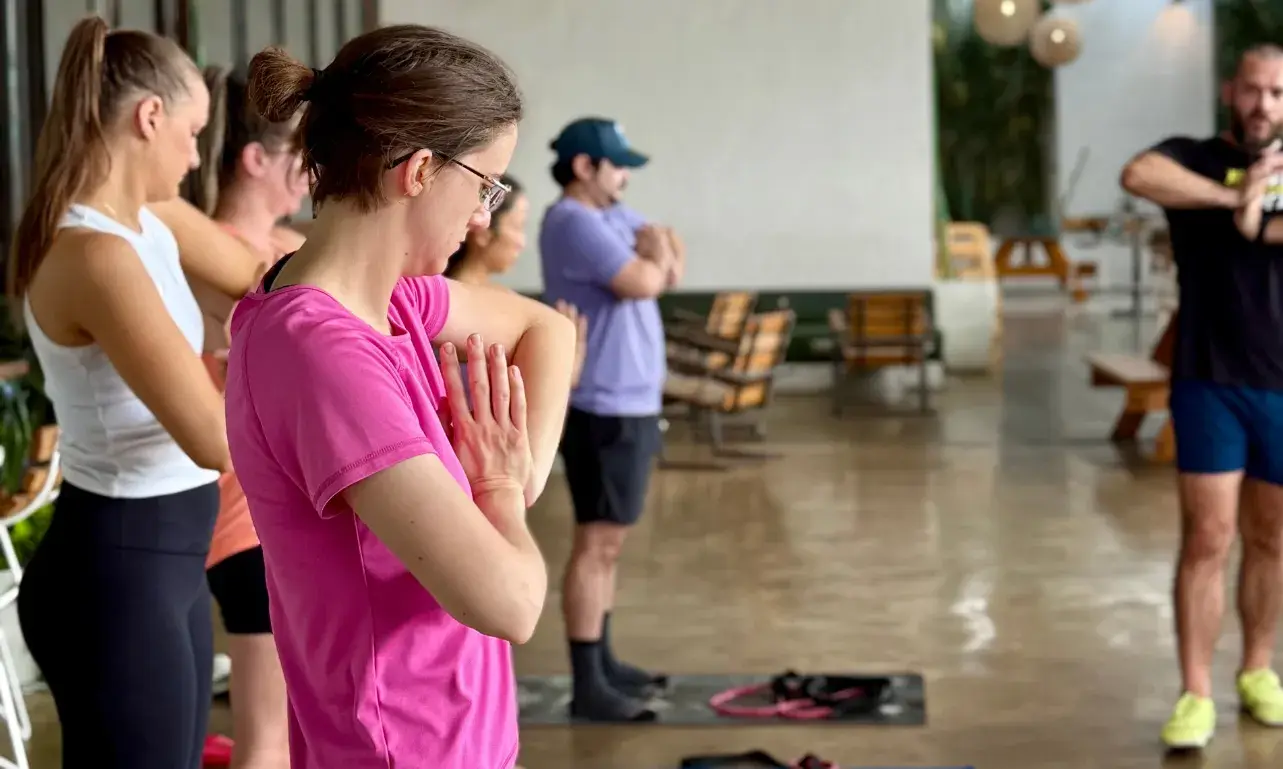
What is Functional Range Conditioning
Motive Training has always been a movement-focused gym. Over the last couple of years, we pushed that further by integrating Functional Range Conditioning (FRC®) into how we assess and coach.
FRC is a joint health and mobility system that helps people improve, maintain, and use their range of motion with more control. The goal is not to chase flexibility. The goal is to take motion you can access passively and turn it into motion you can own actively.
That distinction matters.
A joint can have range on paper and still feel unstable, painful, or inconsistent when you load it. FRC gives us a framework for understanding that gap and closing it with targeted inputs.
Passive range vs usable range
Passive range is what you can access with help, gravity, or momentum.
Usable range is what you can control, produce tension in, and return to under load.
Usable range is where training lives.
Joint health is trainable
A lot of fitness culture works around joint limitations. People learn to avoid positions; they learn to train around pain; they learn to keep the same movement patterns because they get the job done.
FRC flips that. It treats joint function as something you can improve directly.
If a shoulder cannot reach overhead without compensation, the answer is not always to avoid overhead work forever. Sometimes the answer is to improve the shoulder’s ability to do the thing it cannot do. That is how you build options.
What makes FRC different from mobility and stretching trends
Mobility has become a buzzword, and stretching has been the default prescription for tightness for decades. The problem is that most people are not missing information. They are missing a system.
A stretch can create a sensation. It can even change range temporarily. But if the nervous system does not trust that range, it will not use it when it matters. That’s why so many people feel better after stretching and then feel right back where they started when they squat, run, press, or sit at their desk.
FRC is different because it treats mobility like a trainable quality, not a warm-up.
Instead of chasing looseness, it builds capacity. It treats joint function as something that can be assessed, improved, and maintained with progressive inputs. That is why FRC tends to produce changes that last longer than a temporary “loosened up” feeling.
Why feeling looser is not the same as getting better
A lot of people confuse reduced sensation with improved function.
If you stretch your hips and your squat feels smoother for five minutes, that does not automatically mean your hips gained usable range. It might just mean the nervous system backed off the protective tone temporarily. That can be helpful, but it is not the same thing as owning the position.
Training changes what the body can do reliably. FRC is built around reliability.
The passive-to-active gap and why it drives compensation
The passive-to-active gap is one of the simplest explanations for why people keep hitting the same walls.
You might be able to pull your leg higher with your hands than you can lift it yourself. You might be able to push your shoulder overhead with assistance, but not control it without compensation. That gap matters because your brain chooses controlled options under load.
When you load a joint that has passive range but limited active control, your body finds a workaround. The workaround might be a spine position, a ribcage flare, a knee collapse, or a shoulder hike. It’s not that your body is broken. It’s that it is adapting to the options it trusts.
FRC closes that gap by building control, strength, and tissue tolerance at the edge of range.
The core principles of Functional Range Conditioning
FRC is a system, but it’s also a set of principles that guides how we coach.
Workspace first
Your workspace is the range a joint can access and control.
If you do not have enough workspace, the body borrows movement from somewhere else. If you have workspace but do not control it, the body avoids it when things get heavy or fast.
This is why joint-specific work matters. You cannot always pattern your way out of joint limitations. Sometimes you have to address the joint directly.
Controlled inputs
FRC places a high value on controlled effort.
A joint does not just need range. It needs the ability to produce tension within that range. That means building strength at end ranges, building stability in awkward positions, and teaching the nervous system that those positions are safe and repeatable.
This is where a lot of mobility programs fall short. They chase motion without building ownership.
Progressive loading
Mobility training works best when it looks like training.
FRC uses progressive, measurable inputs to improve joint function. That does not mean every mobility session is brutal. It means the body adapts to what it is asked to handle.
Range that is never loaded is range that is unlikely to stick.
If you want a deeper look at one of the core tools we use for end-range training, PAILs/RAILs is one of the simplest ways to understand how we build tension at the edge of range.
You do not need to be a physical therapist to assess movement
Personal trainers are within scope to assess how someone moves. That does not mean diagnosing injuries. It means identifying what a joint can do, what it cannot do, and what it does to compensate.
At Motive Training, we use the Functional Range Assessment (FRA®) to look at movement on a joint-by-joint basis, from the neck down to the toes.
That gives us two things.
- A clear starting point.
- A plan that matches the person’s actual movement options.
If someone presents with symptoms that require medical diagnosis, we refer out. Training works best when everyone stays in their lane.
Assessments guide programming
The assessment is not a formality. It drives decisions.
Once we have baselines, we coach inputs that improve joint function, then we re-check what matters. That process keeps training honest. It also prevents the common trap of doing random mobility drills with no connection to a real outcome.
You will still lift. You will still train. The difference is that the prerequisites come first.
What “mobility” means inside the FRC system
In FRC, mobility refers to usable movement across a joint under nervous system control. Training mobility means converting passive range into active range and making that range more resilient.
That is why FRC often includes.
- Controlled articular rotations (CARs).
- Progressive and regressive angular isometric loading.
- End-range strength work that teaches your body to trust new positions.
The building blocks you will see inside FRC training
FRC is not one exercise. It’s a set of tools that solve specific problems.
Controlled Articular Rotations (CARs)
CARs are controlled joint circles performed slowly and intentionally through your largest available range.
Most exercises train joints in limited planes. CARs explore the entire workspace of a joint. They help you.
- Maintain and expand range over time.
- Improve control at the edges of range.
- Create better joint input, which tends to support long-term joint health.
CARs also give us usable information. If a joint cannot move cleanly through a workspace, that matters for programming.
Here’s our CARs playlist, which walks through the joints and how we coach them.
PAILs/RAILs and end-range strength
PAILs/RAILs is a method of building tension at the edge of a range.
It is not passive stretching. It is progressive effort designed to teach your body to produce force where it usually feels weakest or least controlled. This matters because the edges of your range are often the areas your body avoids during real training.
End-range strength makes new mobility stick. Without it, you often gain range temporarily and lose it as soon as life and training ask more of you.
If you want the full breakdown, here is our guide on PAILs/RAILs.
Isometrics and tissue tolerance
A lot of joint issues are not just range problems. They are tolerance problems.
A tissue can have the range, but it lacks the ability to handle load or time under tension in that position. Isometric training is one of the most direct ways to build capacity without needing a lot of movement complexity.
FRC uses different types of isometrics depending on the goal, but the theme is consistent: build strength and control in positions you want to keep.
Who is Functional Range Conditioning for
FRC is for anyone who wants more options in their body.
It is especially useful if:
- You feel stiff, tight, or “stuck” in specific joints.
- You keep running into the same limitations in training.
- You have a history of joint irritation that flares with certain movements.
- You want mobility that carries over into strength work, sport, and daily life.
- You are tired of guessing and want a clear plan.
This does not mean you have to be broken to benefit from it. The best time to build joint capacity is before your body forces you to.
How FRC fits inside real strength training
We do not disregard standard strength training. We coach squats, hinges, carries, presses, and everything you would expect in a real training program.
The difference is sequencing.
If your joints do not have the prerequisites for a pattern, we do not force the pattern. We build the prerequisites, then earn the movement back with better mechanics and better options.
FRC does not replace strength training. It improves your ability to express strength.
Why the joint capsule matters
The joint capsule and its surrounding tissues adapt to what they experience. When those tissues are trained with intent, the joint tends to become more resilient and more capable across a wider range.
That matters for longevity. It also matters for performance because movement options expand what you can do under load.
What results tend to look like
People usually notice changes in a few ways:
- Certain ranges stop feeling “blocked.”
- Movements feel smoother and less compensatory.
- Training becomes more consistent.
- Joints tolerate more volume and load without flaring up.
- The body feels more capable in positions that used to feel sketchy.
Those outcomes are not magic. They are the result of addressing limitations directly and progressively.
CARs foundations inside KINSTRETCH Online
If you want a structured place to start, we also teach CARs Foundations inside KINSTRETCH Online. It’s the same idea, just organized into a progression so you can build consistency without guessing.
If you want to stop guessing, start with joint baselines
FRC gives structure to what many people call mobility work. It turns it into something you can assess, train, and revisit.
If you want help applying this to your body and your goals, start with an assessment and a plan instead of another random routine. Schedule with us and we’ll map out what your joints can do today, then build what comes next.
Written by

Brian Murray, FRA, FRSC
Founder of Motive Training
We’ll teach you how to move with purpose so you can lead a healthy, strong, and pain-free life. Our headquarters are in Austin, TX, but you can work with us online by signing up for KINSTRETCH Online or digging deep into one of our Motive Mobility Blueprints.