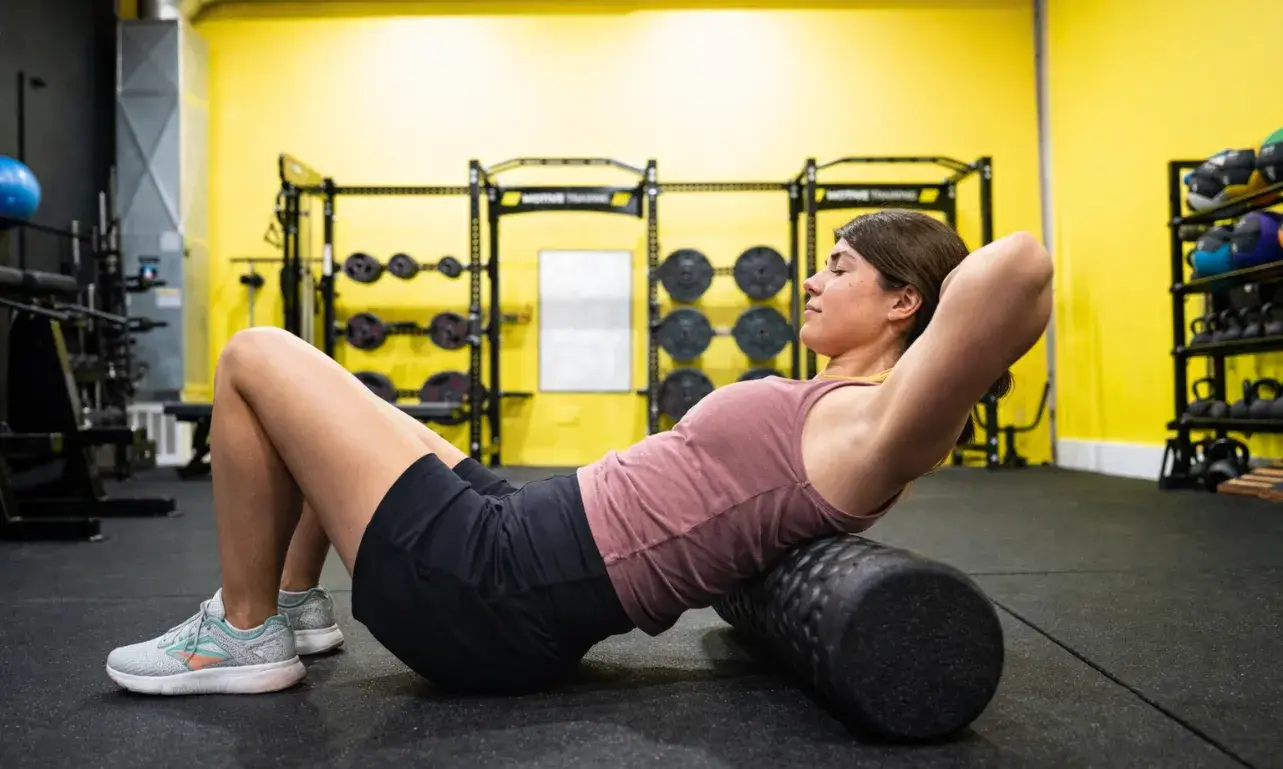
Walk into almost any gym before class and you’ll see people rolling—quads, IT bands, thoracic spine, calves—moving back and forth over a foam cylinder like they’re preparing for something.
This has become so normalized that most people don’t think to question it. Rolling is just what you do before you move. It’s the mobility work.
The problem: it’s not mobility training in any meaningful sense of the term, and the research is unambiguous on this. The confusion is understandable—rolling feels productive, it produces a temporary sensation of release, and it has become deeply embedded in fitness culture. But getting clear on what foam rolling actually does determines how you spend limited training time.
To be direct from the start: foam rolling is not a bad tool. It has legitimate applications. The issue is treating it as equivalent to the work that actually builds lasting joint capacity. Those are different physiological processes, and confusing them is why a lot of people spend significant time rolling and still feel chronically stiff.
What Foam Rolling Actually Does
Foam rolling acutely reduces muscle stiffness, increases short-term ROM, and decreases delayed onset muscle soreness. These are genuine, reproducible effects. The limitation is their duration: systematic reviews find that ROM gains from foam rolling return to baseline within 10 to 30 minutes.
The mechanism is reasonably well understood. Pressure from a foam roller creates mechanical deformation of tissue, stimulates mechanoreceptors in the skin and fascia, and produces a neurological response that temporarily reduces protective tone in the targeted area. The result is a brief window of reduced stiffness and increased perceived mobility.
A 2015 systematic review found foam rolling significantly increased ROM in the short term. A 2017 meta-analysis confirmed pre-exercise rolling improved ROM acutely without the strength reduction associated with prolonged static stretching—a meaningful advantage before training. These are real, useful effects.
For recovery, the evidence is similarly supportive in a narrow scope. Foam rolling has demonstrated consistent effects on reducing DOMS and accelerating perceived recovery between sessions. For athletes training at high frequency, that’s a legitimate application.
What the research doesn’t show is lasting structural change. A systematic review examining long-term foam rolling outcomes found no significant improvements in ROM when rolling was the only intervention. The window of effect is real. It is also short.
Rolling is a bit like warming up a car engine on a cold morning. The car runs better for the first stretch of road. Warming the engine doesn’t rebuild the transmission. For that, you need different work.
The Neurological Problem Foam Rolling Can’t Solve
The primary governor of range of motion is the central nervous system—not tissue stiffness. The brain limits available ROM in areas it perceives as lacking muscular control. Building lasting mobility requires training neuromuscular control at end range, which is a fundamentally different process than reducing tissue tension.
This is the core limitation.
Research consistently shows that people have 10 to 15 degrees more passive ROM than their nervous system will allow them to actively access. The brain applies protective braking before the structural limit of the tissue is reached—not because the tissue can’t go there, but because the CNS has no evidence that the joint can be controlled at that position. No muscular support has been demonstrated there. The brain treats it as unsafe and limits access accordingly.
Foam rolling addresses tissue tension. It does not address this neurological constraint. It can temporarily reduce the stiffness that makes end range uncomfortable to approach, but it doesn’t send the signal the nervous system actually needs: that the joint has active muscular control at the new position.
This is why someone can spend 10 minutes rolling their hip flexors and still feel tight the moment they sit back down, or step under a barbell. The rolling reduced protective tone briefly. The brain’s assessment of what that joint can safely do was not updated.
Changing that assessment requires something different: actively moving into end range under muscular control, and building isometric strength at those positions so the nervous system has evidence—not just momentary relief—that the range is usable. This is what CARs, PAILs, and RAILs do that foam rolling structurally cannot.
Where Soft Tissue Work Actually Earns Its Place
Foam rolling and other soft tissue modalities are most effective in two roles: pre-training preparation and recovery between sessions. Used this way, they complement mobility training. Used as a substitute for it, they produce diminishing returns and a persistent sense of never quite getting ahead of the stiffness.
Before training, reducing tissue stiffness and temporarily increasing available range gives you slightly better access to the positions you’re about to train. That brief window is useful—not because the rolling built anything, but because it cleared some noise so the actual training can work more effectively.
After training or competition, rolling’s effects on DOMS and perceived recovery are well-supported and practically meaningful. If you’re training multiple times per week, rolling between sessions can help you show up more prepared for the next one.
Manual therapy—massage, myofascial release, instrument-assisted soft tissue work—occupies a similar space. These modalities have real effects on tissue quality, neural tone, and perceived movement. They’re not mobility training, but they’re legitimate tools in a complete approach to joint health, particularly when used alongside structured movement work rather than instead of it.
The distinction that matters: soft tissue tools change the conditions under which you train. Training—specifically end-range isometric loading—changes the nervous system’s model of what is safe and available. Both have value. They are not interchangeable.
What Mobility Training Actually Requires
If rolling isn’t mobility training, what is?
In the FRC framework, mobility training requires two things the nervous system actually responds to: controlled movement through available range under active muscular effort, and isometric loading at end range that demonstrates the joint can be supported there.
Controlled Articular Rotations (CARs) accomplish the first. A CAR takes a joint through its full available range under active muscular control—not passively, not with momentum, but with deliberate contraction throughout the arc. Done correctly, CARs reinforce the neurological map of joint position and maintain the health of the joint capsule. Practiced consistently, they preserve and gradually expand available range by keeping the nervous system engaged with those positions. We go deep on the details in why the details matter with CARs—the difference between drawing a circle in space and actually training the joint is significant.
PAILs and RAILs accomplish the second. At the end of an available range—a hip stretch, a shoulder position, an ankle stretch—a PAIL is a sustained isometric contraction pushing into the stretch, and a RAIL is a sustained isometric contraction pulling out of it. Together they build genuine strength at positions the nervous system has been protecting. When the brain receives evidence that a joint has muscular support at a new range, it stops braking movement there. The range becomes owned, not borrowed.
This is the mechanism that makes KINSTRETCH different from a typical group stretch class. The work looks slow and quiet from the outside. Internally it’s demanding in a way that produces lasting neurological change, not just temporary relief.
A Practical Framework
You don’t have to choose between soft tissue work and mobility training. They serve different purposes and complement each other well when used in the right order.
Before training: A short CARs routine is more valuable than rolling as a primary warm-up. CARs actively engage the nervous system with the ranges you’re about to train. If you want to include rolling, use it briefly before your CARs—not instead of them.
After training or on recovery days: Rolling, massage, and other soft tissue work can reduce soreness and improve perceived recovery. Follow it with a short CARs routine to keep the joints neurologically engaged even on lower-intensity days.
As dedicated mobility sessions: PAILs and RAILs require focused effort and adequate recovery time. Two to three sessions per week inside a structured KINSTRETCH class produces meaningful change in 8 to 12 weeks for most people, and the online sessions run the same progressions for anyone training outside Austin, with the full class library there to work through at your own pace. This is where lasting mobility is actually built.
The people who make the most progress are the ones who get clear on this distinction and stop waiting for the rolling to fix what only training can address.
Frequently Asked Questions
Does foam rolling break up fascia or scar tissue? No—and this claim, once widely repeated in fitness culture, has been largely abandoned by the research community. The mechanical forces required to actually alter fascial architecture are far greater than a foam roller can produce. The effects of rolling are primarily neurological—reducing protective tone—not structural. This doesn’t make rolling useless, but it does reframe what you should expect from it.
Should I stop foam rolling entirely? Not necessarily. If you’re using rolling for pre-training preparation or DOMS reduction, the research supports those applications. The change worth making is to stop treating rolling as your primary mobility strategy and start treating it as one tool among several—one with a short window of effect that doesn’t build anything lasting on its own.
How long do the effects of foam rolling last? Systematic reviews find that ROM gains from foam rolling typically return to baseline within 10 to 30 minutes. This makes timing relevant: rolling is most useful immediately before training, not as a standalone session earlier in the day.
What’s the difference between foam rolling and KINSTRETCH? Foam rolling temporarily reduces tissue stiffness through mechanical pressure and neurological tone reduction. KINSTRETCH is an active joint training system that builds neuromuscular control at end range through CARs and PAILs/RAILs. One clears the path temporarily. The other builds the road. They address different aspects of movement quality and are not equivalent interventions.
I’ve been rolling for years and still feel stiff. Why? Because rolling doesn’t address the neurological constraint that governs long-term range of motion. The stiffness you feel is the nervous system protecting ranges where it hasn’t yet verified muscular control is available. No amount of rolling changes that assessment. What changes it is training end range under active muscular control—which is precisely what CARs and PAILs/RAILs are designed to do.
If you’ve been rolling for years and still feel stiff, this is why—and there’s a better approach. Book a free strategy session to find out what your joints actually need.
Written by

Brian Murray, FRA, FRSC
Founder of Motive Training
Motive Training is a coaching studio in South Austin built around assessment, joint health, and strength you can use. Train with us in the studio, come to a KINSTRETCH class, or work through the progressions in KINSTRETCH Online.