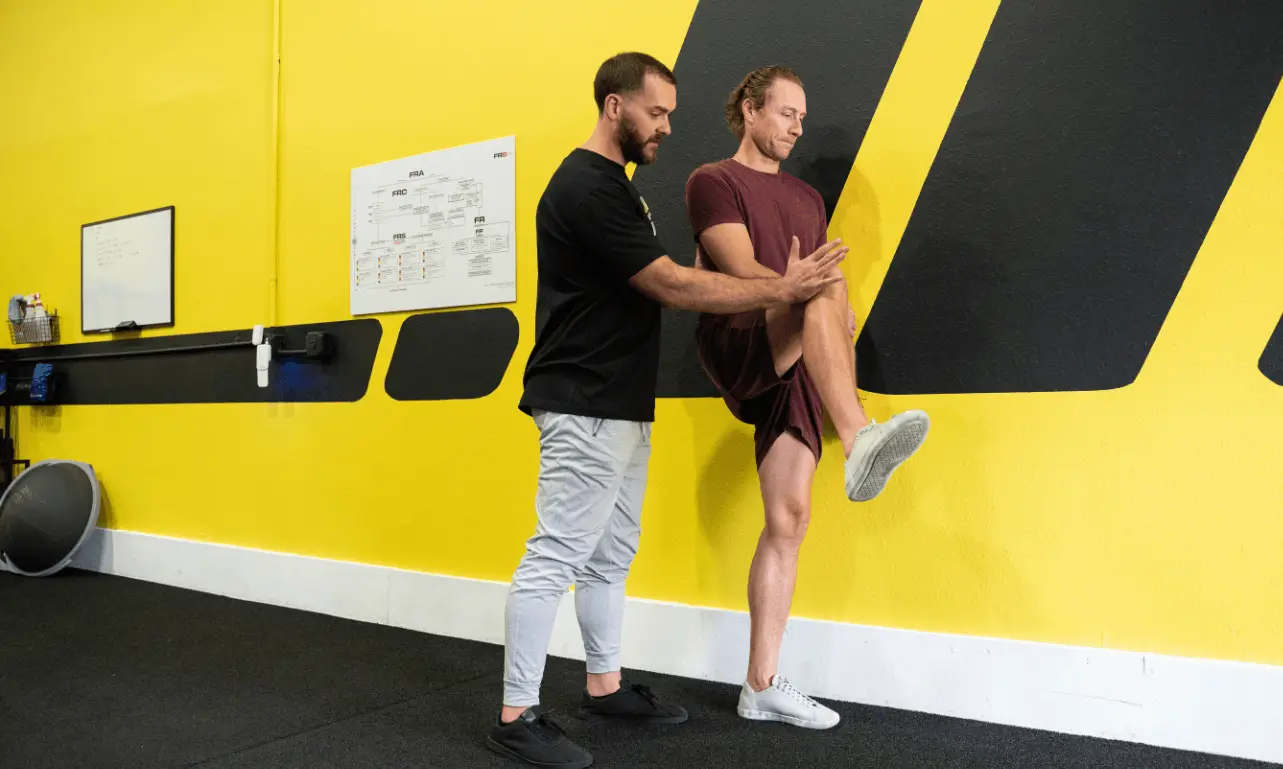
Every KINSTRETCH class at our studio opens the same way. Before anyone gets into a long hold or picks up a block, the room spends several minutes taking one joint at a time through the biggest circle it can make while the rest of the body stays still. People new to class tend to file it under warm-up. It does a lot more work than that, and it’s the piece of our system that shows up everywhere else, from the assessment to how a strength program gets written.
What a controlled joint rotation is
In Functional Range Conditioning, a controlled joint rotation is called a CAR, short for controlled articular rotation. You take a single joint through the outer edge of its rotational range, slowly, under your own muscular control. The part people underestimate is keeping everything else quiet. To keep a hip rotation in the hip, you build tension through the trunk and the standing leg so the pelvis and lower back can’t pitch in. FRC calls that whole-body tension irradiation. Skip it, and a hip circle turns into a pelvis-and-spine circle that looks far bigger than anything the hip can produce on its own.
The joint-by-joint technique lives in our CARs guide. This piece is about why the rotation sits at the front of how we train.
Why rotation in particular
Most of the joints people worry about are built to rotate. The hip and shoulder are ball-and-socket joints, the spine turns segment by segment, and even the knee carries a small amount of rotation through the shin. Gym training tends to move those joints in one plane. A squat takes the hip deep into flexion and almost never asks what the hip can do in internal rotation once it gets down there. Over years, the directions you never visit shrink, and you don’t notice because nothing in your week asks for them.
A rotation visits all of it in one pass. Out at the edge of the circle, the joint capsule and the tissue around it take stress from every direction in turn, and moving there under control is an input those tissues rarely get from a normal training week. I wrote more about what that kind of loading is intended to do at the tissue level in what training does inside the joint.
I’ll be straight about the evidence here. Research on CARs as a specific intervention is thin. Most of the support comes from the broader literature on active range and end-range strength, plus what coaches see across a lot of bodies over a lot of years. I laid out where that evidence stands, and where it runs out, in Is FRC Evidence-Based.
What a rotation shows a coach
A slow rotation is also the fastest look I can get at a joint. Watching someone circle a shoulder, I’m looking for the spot where the arc flattens, the spot where it suddenly speeds up, and any moment the ribcage flares to help the arm finish overhead. A flat spot is a direction the joint can’t travel under control. When the speed jumps, control usually dropped out and momentum carried the arm through, and a flaring ribcage means the spine is lending the shoulder range it doesn’t own. Side-to-side differences matter too, since most people have one hip or shoulder that draws a noticeably worse circle than the other.
None of that is a diagnosis. A pinch at the front of the hip partway through a rotation can come from several places, and we don’t know which until we test further. The Motive Movement and Mobility Assessment works in that order. Rotations tell us where to look, and passive and active range testing tells us what we’re looking at.
Where it fits in a program
The rotation decides where the work goes. If someone’s hip loses its path heading into internal rotation, their programming starts building internal rotation range and strength at that joint, usually through long holds with contractions at the end of the range, before we stack a loaded deep squat on top of it. Strength training stays in the plan the whole time. The rotation just tells us which positions are ready to carry load and which ones need more time.
It also stays in the program as a daily check. A rotation that looked rough in March and looks clean in June is the plainest progress marker we have, and it costs a client two minutes. Intensity scales with the day. Someone about to train hard gets their rotations at a lighter effort, and someone whose whole session is the mobility work can crank the tension up.
In class, KINSTRETCH progresses rotations over weeks. We add positions that make the rotation harder to keep isolated, add load at the wrist or ankle once the path is clean, and slow the whole thing down until the slow version is honest.
Doing them on your own
Pick the joint that bothers you and run a few slow rotations once a day. Slower is harder and tells you more. Keep the rest of your body still enough that the circle belongs to the joint you’re working. Within a couple of weeks you’ll start noticing the same rough patch on the same part of the circle, day after day, and that patch is the most useful piece of information you have about that joint right now. If it’s still there in a month, it’s worth having someone look at it with you, and you can book a time with us here.
Written by

Brian Murray, FRA, FRSC
Founder of Motive Training
Motive Training is a coaching studio in South Austin built around assessment, joint health, and strength you can use. Train with us in the studio, come to a KINSTRETCH class, or work through the progressions in KINSTRETCH Online.