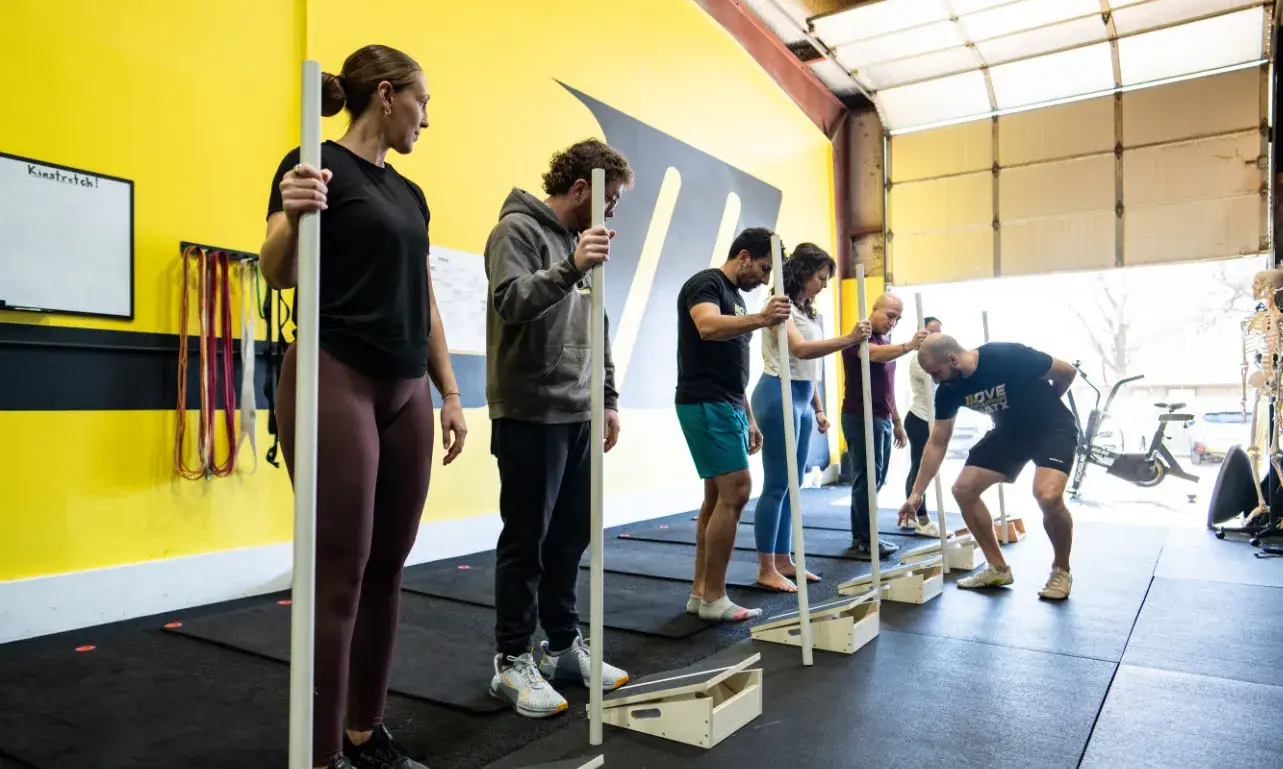
If you’ve heard of KINSTRETCH but aren’t sure what actually happens in a class, you’re not alone. The name doesn’t explain itself, and most descriptions online either oversimplify it into “a mobility class” or go deep into methodology in a way that’s hard to connect to what the experience actually feels like. Neither version helps someone decide if it’s worth trying.
This is a straightforward explanation of what KINSTRETCH is, what a beginner should expect walking into their first session, why it feels different from other mobility work, and who it tends to help most. If you’ve been curious but uncertain, this should give you a clear enough picture to make a decision.
What Is KINSTRETCH?
KINSTRETCH is a movement training system that develops active joint control—the ability to produce and manage movement at the edges of your range of motion. It is built on the principles of Functional Range Conditioning (FRC), developed by Dr. Andreo Spina, and it trains the nervous system to own the range of motion the body already has, rather than simply lengthening tissue to go farther.
The distinction matters because most people come to KINSTRETCH with a stretching frame of reference. Stretching, in the conventional sense, is passive—you hold a position and let tissue lengthen, often with gravity or a strap doing the work. KINSTRETCH is not that. Every position in class requires active muscular engagement. You are not relaxing into range. You are building control within it.
That shift—from passive lengthening to active control—is what makes the practice feel different from anything most people have tried. It is also why people who have stretched consistently for years and still feel stiff tend to respond well to KINSTRETCH. The stiffness usually isn’t a tissue problem. It’s a neurological one. The nervous system limits access to range it perceives as unstable. KINSTRETCH gives it a reason to open that access up.
Do You Need to Be Flexible to Start?
No. KINSTRETCH is performed at your personal end range—whatever that is right now. A beginner with limited hip mobility and someone with a dance background will both be working at their own edges during the same class. The practice scales to where you are, not to a fixed standard of what range you’re supposed to have.
This is one of the most common misconceptions about the class. People assume they need to be flexible first, or that they’ll feel behind everyone else if they can’t touch their toes. Neither is true. What KINSTRETCH trains is control at end range—and everyone, regardless of how mobile they currently are, has an end range to work with.
If anything, highly flexible people sometimes have more urgent reasons to start. Flexibility without active control is actually a risk factor for injury. The joint can reach a position, but the nervous system has no established pattern for managing it under load. That gap—between passive range and active control—is exactly what KINSTRETCH is designed to close. It’s the same concept explored in detail in the mobility vs. flexibility guide, and it’s the foundation the entire practice is built on.
What Happens in a KINSTRETCH Class?
A KINSTRETCH class is structured, not improvised. There is a clear system behind the sequencing, and while classes vary based on the focus—hips, spine, shoulders, or a full-body session—the format has consistent elements a beginner can expect.
Controlled Articular Rotations (CARs)
Most classes open with CARs. These are slow, deliberate movements that take a joint through its full available range of motion under active muscular control. Hip CARs, shoulder CARs, cervical CARs—each one serves two purposes simultaneously. It lubricates the joint capsule and signals the nervous system to map the available range. It also functions as a self-assessment: restrictions and asymmetries that might otherwise go unnoticed show up clearly in CARs, often before they develop into something that requires attention.
For a beginner, CARs can feel surprisingly difficult. Moving slowly through full range while maintaining full-body tension elsewhere is genuinely demanding. That difficulty is informative. It tells you something about where your active control currently ends.
PAILs and RAILs
The core of most KINSTRETCH sessions involves Progressive and Regressive Angular Isometric Loading—PAILs and RAILs. This is where the real work happens, and it’s the element that separates KINSTRETCH most clearly from conventional stretching.
A PAILs contraction is performed at the end of a passive stretch. You contract the stretched muscle—the one being lengthened—at its limit. This isometric contraction signals the central nervous system that you have force production capability in this position, which directly overrides the protective reflex that limits active range. After the PAILs contraction, a RAILs contraction follows: you activate the muscles on the opposite side of the joint to actively pull yourself deeper into the range. Together, they teach the nervous system that end range is a safe place to operate.
For a beginner, the instruction to “contract harder at the end of a stretch” can feel counterintuitive. You’ve been told to relax into stretches your whole life. The opposite approach—building tension at the limit—is the mechanism that actually produces lasting change.
End-Range Lifts and Holds
Alongside PAILs and RAILs, classes often include end-range lifts: movements that require you to actively produce range rather than settle into it passively. A hip lift-off from a 90/90 position, for example, asks you to pull your hip into flexion under its own muscular effort at the end of available range. These movements are often small in amplitude and large in neurological demand.
A beginner will frequently find that what looks like a modest movement is genuinely hard to do. That’s the point. The nervous system is being asked to produce movement in territory it hasn’t been trained to manage.
What Does KINSTRETCH Feel Like for a Beginner?
Honest answer: humbling, in a productive way. Most beginners expect to feel a deep stretch. What they actually feel is muscular fatigue in unfamiliar places, a kind of focused effort that’s different from conventional strength training, and often a surprising amount of shaking or trembling during isometric holds.
The shaking is normal. It’s the nervous system working at its current capacity limit. It doesn’t mean something is wrong. It means you’re working in a range where muscular control hasn’t been trained before.
What beginners usually don’t feel is soreness in the conventional sense. KINSTRETCH doesn’t create the kind of delayed muscle soreness that follows heavy lifting. What some people notice is a kind of neural fatigue—a sense of having worked hard without being able to point to a specific muscle that was the culprit. That’s accurate. The work is largely neurological.
Most beginners also report that their joints feel noticeably different afterward—less compressed, more available. That’s a real effect of CARs on joint fluid distribution and of the nervous system releasing some of its habitual guarding once it’s been given evidence that end range is manageable.
Who Benefits Most from KINSTRETCH?
KINSTRETCH tends to produce clear results for a fairly specific set of people.
People who feel chronically stiff despite regular stretching. If you’ve been consistent with stretching for months or years and nothing has changed, the problem is almost certainly neurological rather than structural. KINSTRETCH addresses the cause rather than the symptom.
People coming out of injury or physical therapy. Once the acute phase is managed and you’ve been cleared to train, KINSTRETCH rebuilds joint control in ranges that were avoided during injury and early rehab. It complements the work a physical therapist does and fills the gap that standard personal training often can’t address. The post-rehab bridge is one of the most common entry points for new KINSTRETCH clients at Motive.
Desk workers dealing with persistent hip, shoulder, or neck restriction. Eight or more hours of sustained posture creates predictable restriction patterns. Passive stretching provides temporary relief. KINSTRETCH builds active control in the ranges that desk posture consistently avoids—hip extension, thoracic rotation, cervical control—which produces changes that last beyond the end of class.
Athletes who want to move better, not just train harder. Regardless of sport, the limiting factor in most athletic movement is not strength in familiar ranges—it’s control at the edges. A runner’s hip extension, a cyclist’s thoracic rotation, a lifter’s overhead position: these are all end-range problems. KINSTRETCH trains the nervous system to access and manage those positions under load.
Anyone who wants to move well for a long time. Joint range of motion decreases progressively with age, and most of that loss is neurological—the nervous system’s map of joint position becomes less detailed without regular training stimulus. Daily CARs and consistent KINSTRETCH practice maintain that map in a way passive stretching alone cannot. The mobility training after 60 guide covers this in more detail for older adults.
How Often Should a Beginner Do KINSTRETCH?
For most beginners, two sessions per week is enough to produce measurable change in active range over 6 to 8 weeks. Daily CARs—which can be done independently in 10 to 15 minutes—are the most valuable habit a new practitioner can build and can be practiced every day without recovery concerns.
The PAILs and RAILs work is more demanding on the nervous system and benefits from a day of recovery between sessions. Two to three times per week is the practical range for most people with full training schedules. More is not necessarily better, particularly at the start—quality of engagement at end range matters more than volume.
Progress in KINSTRETCH tends to be nonlinear. Many beginners notice meaningful changes in the first two to four weeks, then hit a period where improvement feels slower. This is normal. The nervous system adapts in stages, and consistency across months produces compounding results that short bursts of intensity do not.
KINSTRETCH vs. Yoga vs. Stretching: What’s the Difference?
These three practices get grouped together frequently, and the distinction is worth understanding clearly.
Yoga primarily develops passive flexibility through held static positions. Some yoga styles incorporate active engagement, and the practice offers real benefits for breath, awareness, and general movement. But yoga is not designed around neurological end-range training, and it does not systematically develop active joint control. The KINSTRETCH vs. yoga comparison covers this in more depth for anyone moving between the two practices.
Conventional stretching increases stretch tolerance—the nervous system’s comfort with the sensation of being stretched—but does not build muscular control in new ranges. ROM gains from static stretching are real but tend to regress without ongoing maintenance because no active control has been developed in the new territory.
KINSTRETCH uses passive range as a starting point, then builds active control within it through isometric loading and end-range strengthening. The gains are more durable because they are neurological, not just tolerance-based.
What to Expect in Your First Few Classes at Motive
At Motive Training in South Austin, KINSTRETCH classes run in tracks that focus on different joint regions across the week. A beginner doesn’t need to arrive with a specific problem in mind. The class structure will reveal what’s limited and give you something to work with regardless of where you’re starting.
A few practical notes for your first session: wear comfortable clothing that allows full hip and shoulder range, plan to work on the floor for most of the class, and don’t expect to look polished. The movements are unfamiliar. The effort is real. The learning curve levels off quickly once the basic patterns make sense, which usually happens within two or three sessions.
If you want a clearer picture of your specific restrictions before starting, a Functional Range Assessment maps your active joint control joint by joint and gives the class programming a more precise starting point. It’s not required to begin—but for people with a known history of injury or chronic restriction, it’s worth having before the first session.
If you prefer to start online, KINSTRETCH Online gives you access to the same class structure from anywhere, with the same methodology and the same progression framework.
FAQ
Is KINSTRETCH good for beginners with no mobility training background?
Yes. The class is designed to meet you at your current range, not at a prescribed standard. Beginners with limited mobility often progress faster than people with established but passive flexibility, because there are no ingrained habits to retrain—just new patterns to build from the start.
How is KINSTRETCH different from a regular stretch class?
A regular stretch class asks you to hold positions passively and let the tissue lengthen. KINSTRETCH asks you to contract at end range, build tension in unfamiliar positions, and actively pull yourself into new range. The mechanism is different, which is why the results are different.
Will KINSTRETCH help with back pain?
For many people, yes—particularly back pain that is connected to hip restriction or thoracic immobility. KINSTRETCH addresses the joint-level restrictions that often drive back pain indirectly. The KINSTRETCH for back pain page covers this more specifically, and conquering back pain with FRC explains the underlying mechanism in detail.
How long before I notice results from KINSTRETCH?
Most people notice something meaningful within the first two to four sessions—not dramatic structural change, but a shift in how joints feel and how much range is available after class. Durable change in active range typically develops over six to twelve weeks of consistent practice.
Can I do KINSTRETCH if I have a current injury?
It depends on the injury and its stage. For acute injuries that are still being managed clinically, check with your physical therapist first. For stable chronic conditions or injuries that have been cleared, KINSTRETCH is often appropriate and beneficial. If you’re unsure, a strategy session before your first class is the right starting point.
What should I wear to a KINSTRETCH class?
Comfortable, flexible clothing that doesn’t restrict hip or shoulder movement. Most of the work happens on the floor, so fitted or stretchy bottoms tend to work better than loose shorts. Bare feet or socks—no shoes needed.
Key Takeaways
KINSTRETCH is active joint training, not passive stretching. Every position requires muscular engagement, and the goal is building neurological control at end range, not simply going farther.
You do not need to be flexible to start. The class works with whatever range you currently have and builds active control from there.
The primary tools are CARs, PAILs, and RAILs. CARs assess and maintain joint health daily. PAILs and RAILs expand active range and build the end-range strength that makes new mobility durable.
Results develop over weeks of consistent practice. Most beginners notice a shift within the first few sessions. Meaningful change in active range accumulates over six to twelve weeks.
KINSTRETCH is well suited for people who feel chronically stiff, are coming out of injury, spend long hours at a desk, or want to maintain joint health over the long term.
If you’re ready to try it, KINSTRETCH classes at Motive Training in South Austin run throughout the week across different joint tracks. Book a free strategy session if you want to talk through your situation before your first class.
Written by

Brian Murray, FRA, FRSC
Founder of Motive Training
Motive Training is a coaching studio in South Austin built around assessment, joint health, and strength you can use. Train with us in the studio, come to a KINSTRETCH class, or work through the progressions in KINSTRETCH Online.