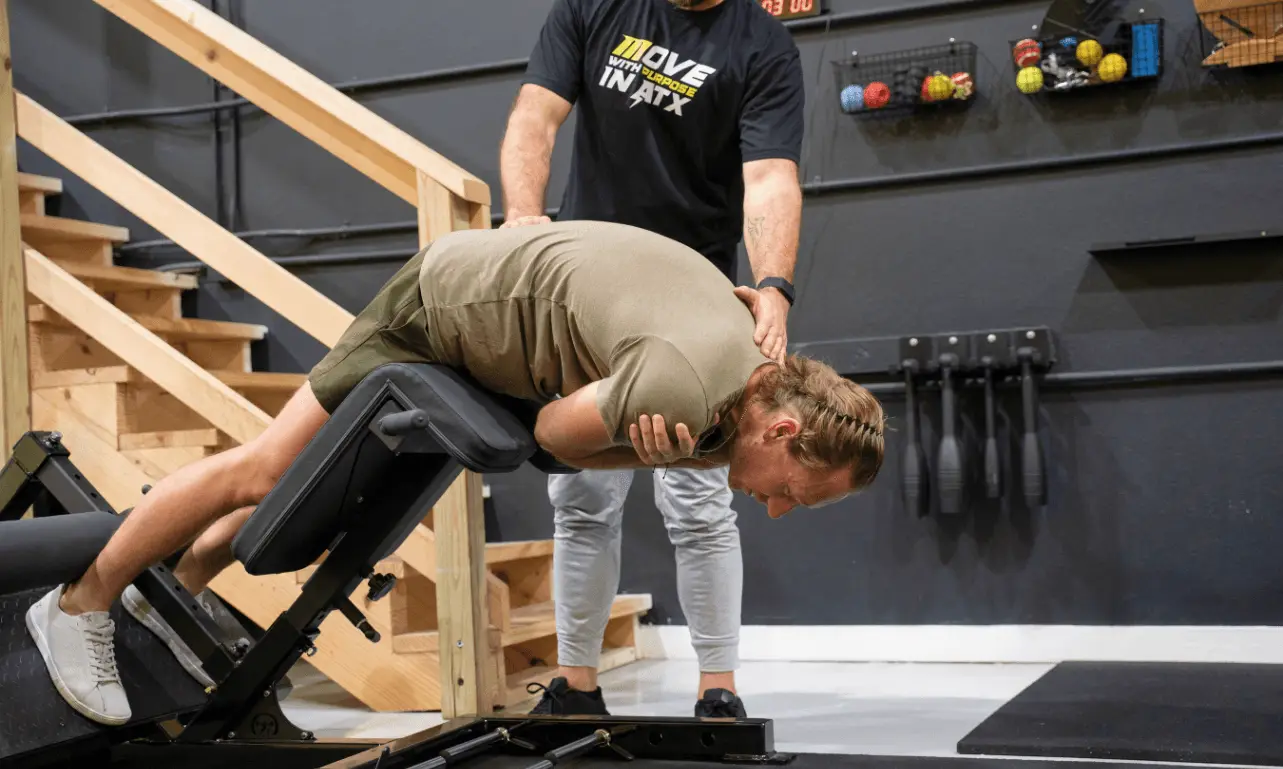
Someone walks in holding a shoulder a little higher than the other one, or favoring a knee on the way down into a squat, and the story is almost always the same: this is just what training feels like now. Discomfort has become proof of effort somewhere along the way, and most people carry it around like a receipt. No Pain = More Gain is the credo we built to correct that, and it means the opposite of what it sounds like on first read. Pain was never the price of progress. It was the notice that progress had stalled somewhere upstream.
What Pain Is Doing
The nervous system’s first job is protection, not performance. Long before a joint gets anywhere close to real tissue damage, the brain starts narrowing what’s available to it: less range, more guarding, tighter control around the area it doesn’t trust. Andreo Spina’s framework for FRC calls this neurological primacy, and the working idea behind it is straightforward. The nervous system, not the tissue, is the one drawing the line on how far you’re allowed to go, and it draws that line well before actual structural risk shows up. In FRC’s model, the gap between what a joint can move through passively and what the brain will let you access under your own control can run ten to fifteen degrees. That gap is the whole story.
So when someone grits through a pinch in the shoulder because they’ve been told discomfort is the cost of doing business, they’re not proving anything to their body. They’re confirming its suspicion. Every rep completed through pain tells the nervous system it was right to guard here, and the next rep gets a little more resistance for it. Do that for months and the guarding stops being a response to anything specific. It becomes the operating setting.
This is the part that gets missed in gyms that still run on the old model. Pain isn’t the injury. It’s the nervous system’s best guess about where an injury is headed if nothing about the input changes. Override the guess with willpower often enough and you tend to prove it right eventually, just later and worse than it needed to be.
The Workspace Problem Underneath Most Pain
Before we load anything at Motive, the question isn’t how to get around the pain. It’s why the joint doesn’t have the room to do the job being asked of it.
Most of what shows up as pain in training traces back to a joint being asked to produce motion it doesn’t have available. A hip with limited internal rotation will still find a way into a squat, usually by pulling extra motion from the low back to finish the job the hip couldn’t. A shoulder that can’t fully elevate will still get a bar overhead, usually by recruiting the neck and upper traps to cover the shortfall. The rep gets completed either way. The joint that was supposed to be doing the work just isn’t the one doing it, and whatever’s covering the gap eventually files a complaint.
This is the entire premise behind the Functional Range Assessment: map what’s available at each joint, in both directions, before deciding what that joint is ready to load. Skip the mapping and you’re coaching a guess. Do it first and a surprising amount of “unexplained” pain stops being unexplained.
Building the Range Instead of Working Around It
Once we know where a joint is short on range, the work becomes closing the distance between what it can access passively and what it can control once weight gets added. That distance is the entire logic behind PAILs and RAILs: loading a joint at the outer edge of a stretched position so the nervous system gets direct evidence that there’s strength waiting there, not just length. A joint that has length without control hasn’t gained anything durable. It’s borrowed range, and borrowed range tends to disappear the moment real load shows up and asks for it.
KINSTRETCH and FRC work is designed to build that kind of joint-by-joint control before pattern complexity gets stacked on top of it, which is part of why a Motive warm-up often looks more like a mobility class than a typical one. It isn’t wasted time before the real training starts. It is the real training, aimed at the layer underneath the lift. A squat only ever gets as good as the hips underneath it, and no coaching cue in the world fixes a joint that hasn’t earned the range it’s being asked to move through.
None of this makes the training soft. We load hard, and we load heavy, once a joint has proven under isometric and controlled conditions that it can handle it. The sequence is the whole point. Capacity comes before intensity, not instead of it, and skipping that order is usually how someone ends up back in a gym like ours after their last approach quietly stopped working.
Pain as Something You Track
We treat pain the same way we treat strength: as a number that should be trending somewhere, not a fixed condition to accept. If someone comes in with a shoulder that can’t tolerate an overhead press without pinching, and eight weeks later that same shoulder is pressing clean under real load, that’s not luck. That’s a joint that closed the gap it started with.
Progress that requires pain to arrive at isn’t progress worth keeping. It’s a loan against a joint that hasn’t agreed to the terms yet, and the bill comes due eventually. The standard is simpler than that and considerably less dramatic: find the joint that isn’t doing its job, give it back the range and control it’s missing, and let everything downstream get to work harder once it’s earned the right to.
Written by

Brian Murray, FRA, FRSC
Founder of Motive Training
Motive Training is a coaching studio in South Austin built around assessment, joint health, and strength you can use. Train with us in the studio, come to a KINSTRETCH class, or work through the progressions in KINSTRETCH Online.