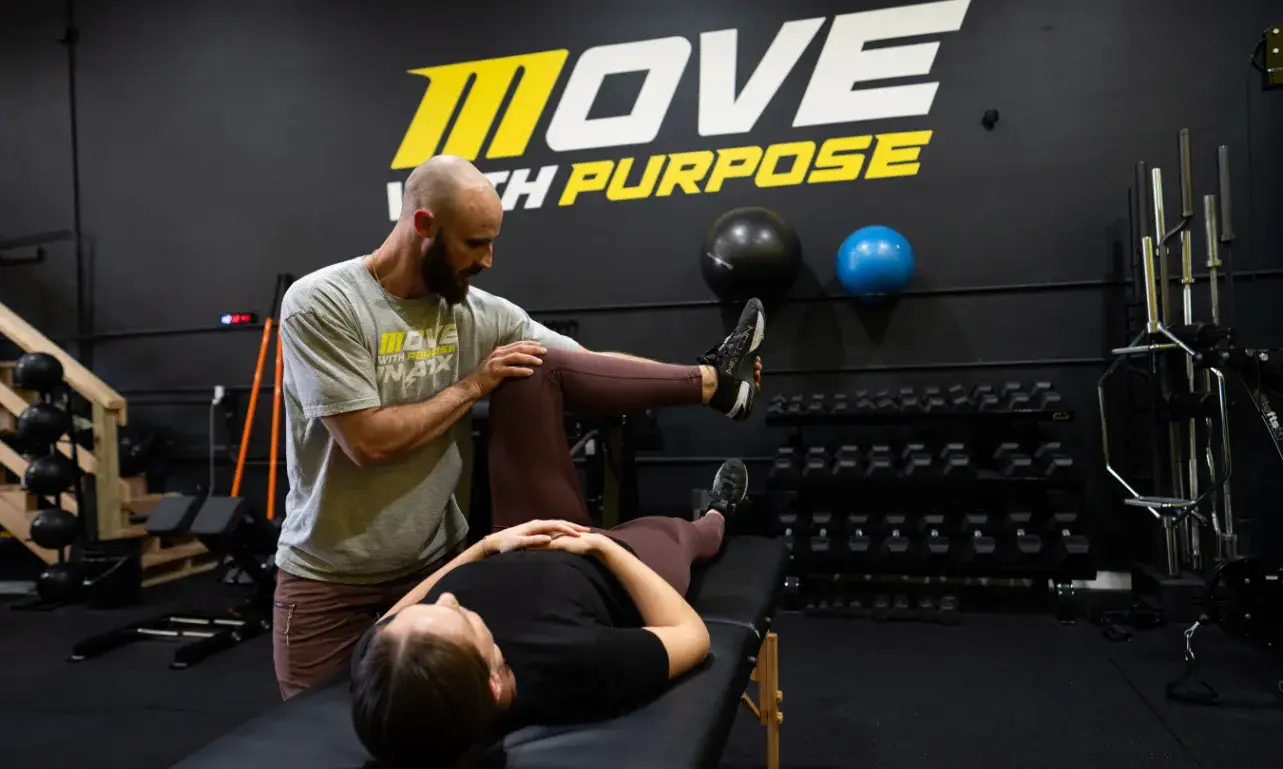
Most people know there’s a difference between a personal trainer and a physical therapist. What they’re less sure about is which one they actually need—and when. That uncertainty is especially common after an injury, when someone has made it through rehab but doesn’t feel fully capable yet, or when chronic pain has been sitting in the background long enough that it’s started to feel like a permanent condition.
The question isn’t just academic. Seeing the wrong provider at the wrong time can slow your progress, cost you money, or in some cases make things worse. And there’s a third scenario that doesn’t get talked about enough: what happens in the space between the two, after PT has done its job but before a person is ready to train normally again. That gap is where a lot of people fall through.
This article explains what each profession actually does, where their scope ends, and how to make a clear decision about which direction makes sense for your situation.
What Does a Physical Therapist Do?
A physical therapist is a licensed medical professional who diagnoses and treats movement disorders, manages acute and post-surgical rehabilitation, and addresses pain at its clinical source. They work within the medical system, can bill insurance, and in most states can see patients without a physician referral. Their training is a three-year doctoral program following a bachelor’s degree.
Physical therapists are the right call when something has gone wrong—acutely or chronically—and the cause needs to be identified and managed clinically. That includes post-surgical rehab (rotator cuff repair, ACL reconstruction, hip replacement), acute injury management, nerve-related pain patterns like sciatica, and movement disorders that require differential diagnosis.
A physical therapist can perform manual therapy, dry needling, and joint mobilization. They can determine if your hip pain is coming from the hip itself, the lumbar spine, or somewhere else entirely. They have the clinical framework to rule out pathology before prescribing exercise. That diagnostic authority is what separates them from every other provider in the fitness and rehabilitation space.
The limitation of PT is practical, not philosophical. Most insurance-covered PT programs run 4 to 6 months for conditions that genuinely require 9 to 12 months of structured work. Sessions are often 30 to 45 minutes with a high patient-to-therapist ratio. The goal is restoring functional baseline—the point where a patient can manage daily life without pain. What happens after that, returning to sport, returning to full training capacity, building the strength to stay out of trouble long-term, is largely outside what a PT program is designed or funded to address.
What Does a Personal Trainer Do?
A personal trainer designs and delivers exercise programming to help clients build strength, improve movement quality, manage body composition, and develop physical capacity over time. They work within the fitness industry, not the medical system, and cannot diagnose or treat injury or pathology.
The range of what “personal trainer” means in practice is enormous. Credentials vary from a weekend certification to years of specialized post-graduate study. A trainer with a basic ACE or NASM certification has foundational knowledge of exercise programming and can safely run someone through a general fitness program. A trainer with additional credentials in areas like Functional Range Conditioning, corrective exercise, or strength and conditioning has a significantly more nuanced toolkit.
What all personal trainers share is a focus on building capacity rather than treating dysfunction. They are not equipped—legally or educationally—to diagnose what’s causing your pain, perform manual therapy, or manage acute injury. When those things are present, referral to a physical therapist or physician is the appropriate next step.
Where a skilled trainer adds enormous value is in the long game: building the strength, mobility, and movement quality that reduces injury risk, keeps people out of PT, and allows them to do the things they want to do for decades. That’s a different job from rehabilitation, and it requires a different skill set.
The Scope Question: What Each Can and Can’t Do
This is worth being direct about, because the scope boundaries matter.
A physical therapist can diagnose movement disorders, prescribe rehabilitation protocols, perform manual therapy, bill insurance for clinical services, and manage pain that has a pathological component. A personal trainer cannot do any of those things, regardless of how experienced they are.
A personal trainer can design long-term strength and conditioning programs, build active mobility through structured training, assess movement quality and identify compensatory patterns, and help clients develop the physical capacity to return to sport, work, and life. A physical therapist, operating within a standard clinical caseload, rarely has the time or the structural mandate to do that work at the level it requires.
The gray area is corrective exercise. Trainers can use corrective strategies to address movement compensations, improve joint mechanics, and reduce chronic pain that stems from restriction rather than pathology. This is legal and appropriate when the trainer has the right training. The key distinction is that a trainer addresses movement problems through exercise—not through clinical intervention. When pain is acute, unmanaged, or potentially pathological, the PT is the right first call.
When to See a Physical Therapist
Go to a physical therapist when:
- You’ve had an acute injury—a ligament tear, a muscle strain, a fall, or a sudden onset of significant pain
- You’re post-surgery and need guided rehabilitation
- You have pain that is getting progressively worse, not responding to rest, or accompanied by neurological symptoms like numbness, tingling, or weakness
- You don’t know what’s causing the pain and need a clinical diagnosis
- Your pain is severe enough to limit basic daily function
In these situations, the medical system is the right starting point. A physical therapist will establish what’s happening, manage the acute phase, and build you toward functional baseline. Insurance will often cover a portion of that care.
When to See a Personal Trainer
See a personal trainer when:
- You’ve been cleared from PT but feel underprepared to return to full training
- You have chronic stiffness, restriction, or low-level pain that has been evaluated and doesn’t require ongoing clinical management
- Your movement quality is limiting your performance or making you more injury-prone
- You want to build strength, improve body composition, or develop athletic capacity
- You’re managing a chronic condition like lower back pain or hip impingement that has been medically evaluated and is stable
A trainer with the right credentials can work effectively alongside medical care for clients with ongoing but stable conditions. What they cannot do is replace that care when active clinical management is needed.
The Post-Rehab Gap Nobody Talks About
The most underserved space in the entire fitness-to-medicine continuum is the period immediately after PT ends. A patient is discharged when they’ve reached functional baseline—they can walk without a limp, get up from a chair without assistance, perform daily activities without significant pain. That’s the goal of the clinical system, and it makes sense within that system’s constraints.
But functional baseline is not the same as being ready to train, return to sport, or trust your body under load again. The strength deficits are still there. The movement compensations that developed during injury and early rehab are still wired in. The nervous system hasn’t been taught to control the joint at end range, under fatigue, or at speed. A 2023 study found that proper return-to-sport testing and full rehabilitation reduces reinjury rates by 84%—but many patients are discharged long before that threshold is reached.
This is the post-rehab gap. And for most people, there’s nothing waiting on the other side of it.
Standard personal training isn’t equipped to close this gap safely. A trainer without knowledge of how to assess joint capacity, progress load around an injury, or build active mobility into a program can inadvertently push a client into ranges they’re not ready for—exactly where reinjury risk is highest.
A trainer with Functional Range Conditioning credentials approaches this differently. The FRC framework includes tools for assessing where active joint control currently lives, building strength at end range through PAILs and RAILs, and using Controlled Articular Rotations to monitor joint health and catch restrictions before they become problems. That’s a different conversation than a standard personal trainer can offer—and it’s the kind of work that connects what PT started to what long-term training requires.
How FRC-Credentialed Training Bridges the Gap
Functional Range Conditioning was developed by Dr. Andreo Spina, a chiropractor and kinesiologist. The methodology grew out of clinical practice and is used by physical therapists, chiropractors, and strength coaches across professional sport organizations. It speaks both languages—the clinical language of joint mechanics and tissue tolerance, and the training language of load, volume, and adaptation.
For someone coming out of PT, that matters. A Functional Range Assessment is a joint-by-joint evaluation of how much range the nervous system will allow under active muscular control—not a standardized movement screen, but a systematic map of where your active control actually lives. That baseline determines what’s safe to load, what needs to be restored first, and how to structure a program that builds capacity without aggravating what’s already been through rehab.
From there, CARs maintain joint health and serve as an ongoing assessment tool. PAILs and RAILs build isometric strength at end range—precisely the ranges where reinjury risk is highest and where standard rehab often falls short. Over time, the gap between passive and active range closes, and the client’s body becomes genuinely more resilient, not just more comfortable. If back pain is part of the picture, the same framework applies—the connection between hip restriction and lumbar load is well-documented, and it’s addressed in detail in this overview of FRC for back pain.
This isn’t a replacement for physical therapy. It’s what comes after, done with enough clinical literacy to do it well. For Austin clients specifically, there’s also a dedicated post-rehab training guide that covers how that transition is structured in practice.
What This Looks Like in Practice
Consider someone who had a hip labral repair eight months ago. They completed 14 weeks of PT and were discharged with good single-leg balance and no pain at rest. They’re cleared to “return to exercise” but feel unstable in anything loaded, avoid deep hip positions instinctively, and have been out of the gym long enough to have lost significant strength.
A standard personal trainer sees someone cleared for exercise and starts building a program. They may or may not notice the compensatory patterns. They may or may not know which hip positions to approach carefully. They almost certainly don’t have the tools to assess where active hip control actually lives and systematically build it.
An FRC-credentialed trainer starts with a structured joint-by-joint assessment, maps the actual state of active hip control on both sides, identifies where passive range outstrips active control (the injury gap), and builds a program that fills that gap progressively. The hip flexion, internal rotation, and extension work is intentional—not incidental. The joint learns to control ranges it was previously avoiding, and confidence comes back not from reassurance but from real capability.
That’s the work. And it requires the right framework to do it.
FAQ
Can a personal trainer help with injury recovery?
A personal trainer cannot diagnose or treat injury, but a trainer with appropriate credentials can design programming that supports recovery after the acute phase has been managed clinically. The key is credentials and methodology. A trainer with FRC certification has tools specifically designed for building joint control and capacity in ranges where injury risk is elevated—which is exactly what post-rehab training requires.
Do I need a referral to see a personal trainer?
No. Personal trainers work in the fitness industry, not the medical system, and require no referral. That said, if you’re coming off an injury or managing a condition that has not been clinically evaluated, getting that evaluation first is the right call.
How do I know if I need PT or a personal trainer?
If something has acutely gone wrong, if pain is severe or progressively worsening, or if you need a clinical diagnosis, start with a physical therapist. If you’ve been cleared medically, have a stable chronic condition, or are in the post-rehab window trying to get back to full capacity, a trainer with the right methodology is often the more useful next step.
What happens if I skip PT and go straight to a personal trainer after injury?
The risk is that a trainer without clinical literacy will miss what the injury actually did to joint mechanics, load compensatory patterns, and push into ranges the nervous system isn’t ready to control. For significant injuries, PT establishes the baseline that makes safe training possible. Skipping it often extends recovery time rather than shortening it.
Is Motive Training equipped to work with post-rehab clients?
Yes. Every trainer at Motive holds credentials in Functional Range Conditioning, which provides the assessment and programming tools specifically designed for this transition. We also offer KINSTRETCH as a group class option for clients building joint control outside of their personal training sessions. Book a free strategy session to talk through your situation.
How long does post-rehab training typically take?
It depends on the injury, how long rehabilitation lasted, and what the training goal is. For most orthopedic cases—rotator cuff, hip labrum, knee surgery—expect 12 to 20 weeks of structured post-rehab training before full return to activity feels genuinely solid. That timeline compresses when the work is targeted and expands when it isn’t.
Key Takeaways
Physical therapists diagnose and treat injury and movement pathology. Personal trainers build strength, capacity, and movement quality. The two professions serve different functions, and the right call depends on where you are in the process.
The post-rehab gap—the period between clinical discharge and genuine readiness to train—is where most people get stuck. Standard personal training isn’t equipped to close it safely. FRC-credentialed training is, because it has the assessment tools and programming framework to build active joint control in the exact ranges where reinjury risk is highest.
If you’ve made it through PT and aren’t sure what comes next, that’s a specific and answerable question. Understanding the difference between mobility and flexibility is a useful starting point—and from there, a structured assessment gives you a clear picture of where you actually are. Book a free strategy session to get started.
Written by

Brian Murray, FRA, FRSC
Founder of Motive Training
Motive Training is a coaching studio in South Austin built around assessment, joint health, and strength you can use. Train with us in the studio, come to a KINSTRETCH class, or work through the progressions in KINSTRETCH Online.