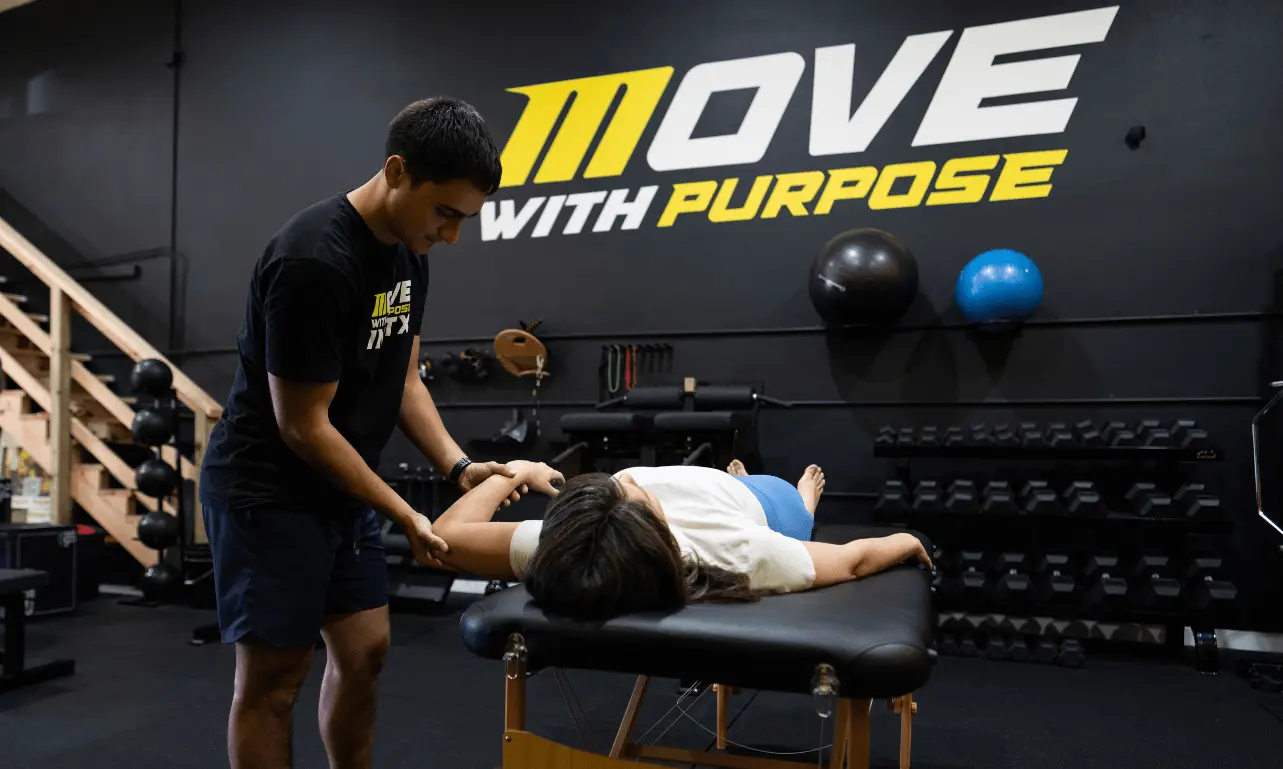
In Austin, “prehab” usually gets talked about in two ways.
One group treats it like a magic list of corrective exercises. The other group ignores it until something hurts.
Neither is a great plan.
Prehab and injury prevention training are not guarantees that you will never get hurt. It is a training strategy that improves your odds by building more usable options in your body before the volume, intensity, or sport demands start cashing checks your joints cannot afford.
At Motive Training in South Austin, we treat prehab as part of training, not something you tack on at the end. The goal is simple: build joints that can express strength in more positions, under more conditions, with less “borrowed” motion from places that tend to flare up.
What prehab and injury prevention training actually is
Good prehab is not random mobility drills.
It is a progression that starts with three questions:
- Do you have the range needed for your life and training goals?
- Can you control that range under tension?
- Can you express it in terms of the loads and speeds you care about?
If any part of that chain is missing, the body still finds a way to get the job done. That is where compensation patterns show up. The pattern is not the villain; it is the bill collector.
Prehab improves the underlying capacity so your movement options are not fragile.
Why most “injury prevention” plans fail
Most plans fail for one of three reasons.
First, they chase symptoms instead of capacities. If your knee gets cranky when you run, you can do knee things forever and never address the hip, ankle, or trunk limitations that force the knee to solve a problem it did not create.
Second, they train motion without ownership. People “open up” a position for a few weeks, then lose it as soon as they go back to normal training. Range that you cannot control is temporary. Range you can contract in tends to stick.
Third, they do not progress. A plan that never changes becomes a warm-up routine rather than a training stimulus. Prehab needs to adapt as you adapt.
This is the part most people miss: injury prevention is training. It has inputs. It has overload. It has recovery. It has progressions.
The framework we use at Motive Training
If you want the short version, we assess, we build workspace, then we load it.
If you want the real version, here is how that looks.
Step 1: Start with an assessment that shows your risk profile
If you do not measure anything, you are guessing.
We use assessment to find two things:
Where passive range of motion is limited.
Where active control does not match passive capacity.
Those gaps matter. A joint can have “available” range and still be a liability because the nervous system does not trust it under tension.
If you want to see how we think about this process locally, start here: Functional Range Assessment in Austin.
Step 2: Build workspace in the joints that are limiting you
This is where most people jump to “mobility exercises” and hope for the best.
We are more specific.
We use controlled articular rotations (CARs) as daily inputs to explore and maintain joint motion. Then we use targeted end-range training to build strength at the edges of the range you are missing.
That can include techniques like progressive isometrics and controlled expansion work that teaches the joint and surrounding tissues to tolerate tension where they currently feel weak or blocked.
This is also where Functional Range Conditioning becomes a cheat code, because it gives a structured method to build joint capacity without guessing. If you want to understand that system, this is the place to start: Functional Range Conditioning.
Step 3: Integrate that new capacity into real training
Prehab that never touches real training is incomplete.
Once you own more range, we have to teach you to use it in patterns you care about:
- Squatting.
- Hinging.
- Pressing.
- Carrying.
- Rotating.
- Running.
- Jumping.
The goal is not perfect form. The goal is options. More hip rotation options so your knee stops being the only place that can create movement. More shoulder options so your neck and low back stop stealing motion during pressing and pulling.
At this stage, “injury prevention” stops feeling like a separate category. It becomes better training.
Where KINSTRETCH fits in
A lot of people in Austin want a consistent way to train mobility without turning it into a second job.
That is what KINSTRETCH is for.
KINSTRETCH is a coached mobility class built around joint-specific control, usable ranges, and strength at end range. It is not a flexibility class. It is not random stretching. It is training.
It also fits prehab perfectly because it helps you build the missing capacity that makes your lifting, running, or sport more resilient.
If you want the deeper breakdown, read this: The Best KINSTRETCH Class For Ultimate Mobility Training.
If you want to see current class options and how membership works, start here: KINSTRETCH.
A simple weekly prehab template that works for busy people
Prehab does not need to be complicated. It needs to be consistent and targeted.
Here is a framework that works for most people training 3–5 days per week.
The daily baseline 5–8 minutes
Do this most days, even on off days.
- CARs for the joints you are trying to improve that month.
- One focused end-range drill for your biggest limiter.
That is it.
This keeps the nervous system familiar with the positions you are trying to own, and it gives you frequent low-cost exposures without turning your schedule into a mess.
Two focused prehab sessions per week 20–30 minutes
Pick 2 days per week and treat them like training sessions, not “extra credit.”
Session A: Lower body bias.
- Hip end-range work for your biggest limitation.
- Ankle and foot capacity work if your gait, squat, or running is limited.
- A controlled pattern integration drill (split squat variation, hinge pattern, step-down control).
- A carry or trunk control drill that matches your needs.
Session B: Upper body bias.
- Shoulder end-range work for your biggest limitation.
- Scapular control work tied to pressing and pulling.
- A controlled pattern integration drill (landmine press, row, supported overhead variation).
- A trunk drill that supports ribcage and shoulder mechanics.
Your main training stays the main training
Prehab supports the work you actually care about.
If you lift, keep lifting. If you run, keep running. If you play a sport, keep playing.
The difference is that now you are building the capacities that reduce the cost of those activities.
When people feel better, it usually is not because they found the perfect exercise. It is because they stopped forcing the same pattern through the same limited ranges.
Who prehab and injury prevention training is for in Austin
This is for you if any of the following sounds familiar.
You keep cycling through the same “tight” areas.
You have pain that disappears when training stops, then returns when training ramps up.
You have been told you are “weak” or “imbalanced,” but the fixes never stick.
You want to train hard, but you want to train longer.
You are coming back from a setback and want a better plan this time.
We do this with beginners, athletes, busy professionals, parents, and people who have tried physical therapy and still feel stuck. The common denominator is not the sport. It is the need for more options.
FAQ
Can prehab prevent injuries completely?
No. Bodies are not warranties.
What prehab can do is improve your tolerance, reduce repeat flare ups, and give you better movement strategies when things get spicy. It shifts you away from fragile positions and toward owned positions.
How long does it take to see results?
Most people feel changes quickly once the right joint limitations are targeted, often in a few weeks.
Lasting change comes from building strength and control in the new range, then integrating it into real training. That takes longer, but it also tends to stick.
Do I need to stop lifting or running to do this?
Not in most cases.
The better approach is to adjust volume and intensity while you build missing capacities, then ramp back up with more options available. That is part of coaching.
What is the first step if I want this done right?
Get assessed, then follow a plan that matches what the assessment shows.
If you want an Austin-based starting point with one-on-one coaching, start here: Injury Rehab Personal Trainer Austin.
How to get started?
If you want prehab and injury prevention training in Austin, the move is not to hunt for the perfect routine.
The move is to figure out what your body is missing, build that capacity, and then train like you mean it.
If you are looking for a coach-led plan in South Austin, start here: South Austin Personal Trainer.
Written by

Brian Murray, FRA, FRSC
Founder of Motive Training
Motive Training is a coaching studio in South Austin built around assessment, joint health, and strength you can use. Train with us in the studio, come to a KINSTRETCH class, or work through the progressions in KINSTRETCH Online.