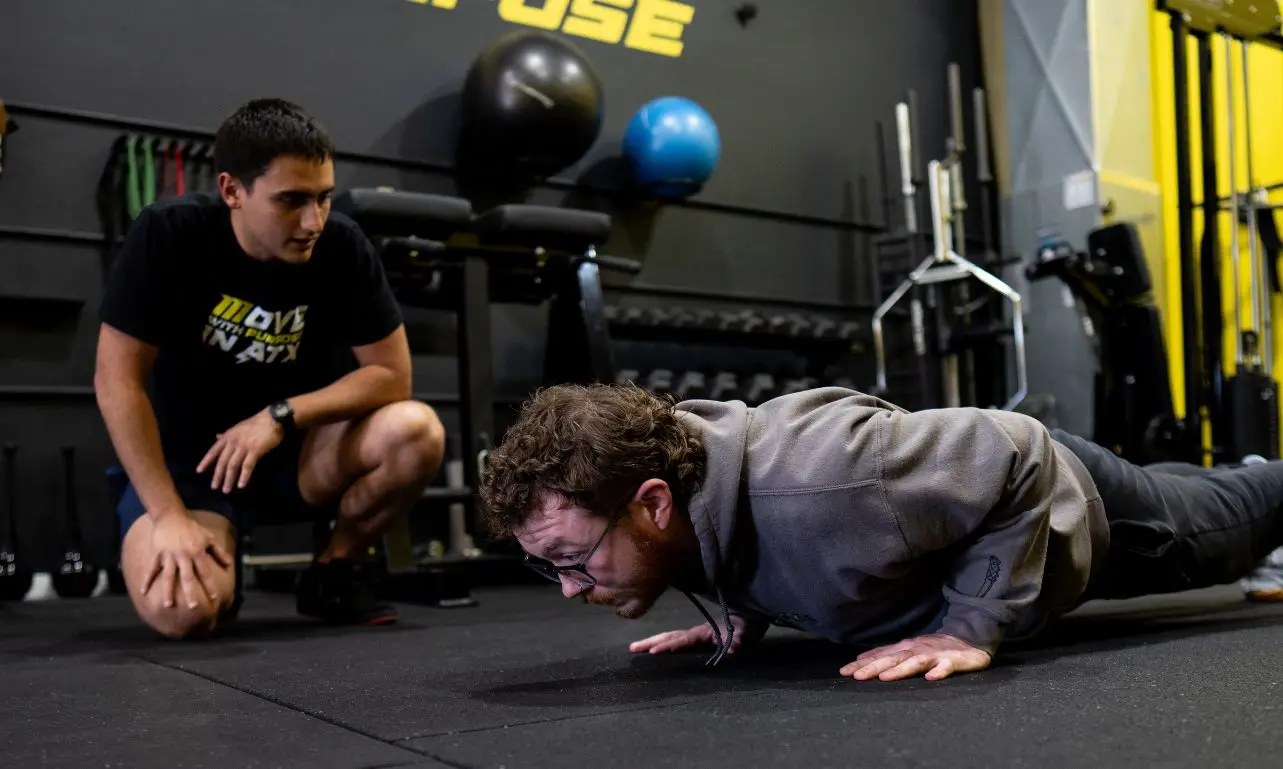
I have hired trainers, been hired as one, and sat on the other side of the table interviewing people who wanted to coach at my studio. The gap between what the standard hiring advice tells you to look for and what predicts a good coach is wide enough to drive a truck through.
The standard advice says check certifications, read testimonials, make sure the personality is a fit. None of that is wrong. All of it passes almost everyone, which makes it close to useless as a filter. A trainer with a current certification, a wall of five-star reviews, and a warm handshake can still put you through the same twelve exercises they put everyone through, never measure anything, and have no idea what to do when your shoulder starts complaining in week six.
So here is the version I would give a friend.
What a certification is, and what it is not
Certification bodies do real work. The ACSM, NSCA, and ACE exams cover exercise physiology, program design, screening, and basic anatomy at a level that keeps someone from doing something stupid. A trainer without any credential has no demonstrated baseline at all, and I would not send anyone to one. The credential is a floor.
Now the limitation. Personal training is not a licensed profession anywhere in the United States except Louisiana, which regulates clinical exercise physiologists, and the District of Columbia, which has been working on it. Nobody can revoke a personal trainer’s ability to practice, because there is nothing to revoke. The certification is a private credential from a private organization, and the exam tests recall.
The practical consequence is that the credential tells you someone passed a test on paper. It tells you nothing about coaching. Coaching is watching a person move, deciding what matters, choosing a cue that lands with that specific human, and adjusting in real time when the cue does not work. There is no exam for that. There is only time on the floor with people who are not textbook cases.
Specialty credentials carry more information than the general ones, because they usually require in-person assessment. Our staff carries Functional Range Conditioning credentials, and the reason I value them is that the certification process requires you to demonstrate assessment on a live person, not bubble in answers. That is the distinction worth applying broadly. Ask what the credential required someone to do, not what letters it produced. I have written elsewhere about how the FRC framework changed the way I coach, and the short version is that it gave me a way to measure rather than guess.
Years of experience work the same way. Ten years of running the same session ten thousand times is one year of experience repeated. What you want to know is what someone’s coaching looked like five years ago compared to now, and a good trainer will tell you without prompting, usually with some embarrassment about the earlier version.
The question that sorts trainers faster than any other
Ask what happens in the first session.
If the answer is a workout, keep looking. A first session that starts with exercise means the program was decided before anyone saw you move, which means it is the program everyone gets with the weights adjusted.
If the answer involves measurement, you are in better territory. Something has to get assessed before anything gets prescribed. What that assessment looks like varies by system and that variation is fine. What matters is that numbers exist at the end of it, they get written down, and they get checked again later.
The follow-up question is better still. Ask what gets measured and why those things. A trainer who has thought about this will have an answer with reasoning attached, something about the relationship between what they measure and what you told them you want. A trainer who has not will say something vague about movement screens or flexibility. That difference takes about eight seconds to detect and it is the most informative eight seconds of the whole conversation.
Passive range and active range are worth asking about specifically. Passive range is how far a joint can be moved by an outside force. Active range is how far you can move it under your own control. The gap between those two numbers is territory your nervous system does not own, and it is where a lot of problems live. Most gym assessments measure the first and never look at the second. If you want to see what a real one looks like before committing to anything, that is what an assessment session is for.
Watch what happens when something does not go as planned
The most useful thing you can observe in a trial session is a small failure. You cannot get into the position. A cue does not make sense. Something pinches.
A trainer who repeats the same cue louder is done thinking. A trainer who moves you on to the next exercise has decided the problem is not worth solving. A trainer who changes the setup, tries a different entry into the same position, and tells you what they are watching for is doing the job.
The verbal version of this is asking why. Why this exercise, why now, why in this order. The answer should connect to something specific about you, and it should be in plain language. A coach who cannot explain their reasoning without hiding behind terminology usually does not have reasoning, they have a template. A coach who can explain it plainly has thought it through enough to translate it, which is a much higher bar than sounding smart.
There is a related tell around pain. If a trainer tells you where your pain is coming from in the first hour, they are guessing. Nobody knows that from watching you do a bodyweight squat. Restrictions in one area commonly show up as complaints somewhere else, and a good coach will say it that way, as a pattern worth investigating rather than a diagnosis. Certainty at first contact is a red flag disguised as competence.
Where the job ends
A trainer who does not know where their scope ends is more dangerous than one who is merely mediocre.
Personal trainers do not diagnose. They do not treat pathology. They do not manage a condition that belongs to a physician or a physical therapist. What they can do is build capacity, and capacity is a wide territory that includes plenty of people who hurt. Chronic low back complaints that come and go, an old shoulder that gets cranky under load, a knee that has been managed for years: those are trainable situations. Sudden onset with no mechanism, night pain, numbness, loss of function, anything neurological gets referred out, and a good trainer refers without hedging.
The place this matters most is the handoff after rehab. Physical therapy ends when the insurance visits run out or the discharge criteria are met, and those two events have almost nothing to do with being ready for the thing you want to go back to. That gap between clearance and capacity is where a lot of people stall, and it is one of the few places a trainer adds something the clinical system structurally cannot provide. Ask any prospective trainer how they handle a client coming out of PT. The good answer involves talking to the therapist. The bad answer involves confidence.
If you are still working out which kind of professional you need, the distinction between a trainer and a physical therapist is worth understanding before you spend money on either.
Online versus in person, honestly
Online coaching solves scheduling, geography, and cost. Those are real problems and for some people they are the binding constraint. If the alternative to a remote coach is no coach, take the remote coach.
The limitation is worth naming plainly rather than glossed. Correction is the thing that does not transfer well. A coach watching a video you filmed sees one angle, after the fact, of a rep you already finished. They cannot put a hand on your ribcage to show you what you are doing, cannot catch the compensation that appears on rep eight, cannot change the plan mid-set. Video feedback is better than nothing and it is not the same product.
We run an online mobility program and I would describe its value the same way: it works well for people who already understand the material and need structure, and it works less well for someone who has never been taught what the positions are supposed to feel like. Any online offering that pretends otherwise is selling.
Hybrid tends to be the honest answer. Learn in person, maintain remotely, come back in periodically to get re-measured and corrected.
About price
Rates vary enormously, from around thirty dollars an hour at a big-box gym to well north of a hundred for an experienced independent coach. We charge $115. I am not going to pretend that number is small.
What I will say is that comparing hourly rates across those tiers compares things that are not the same product. A thirty-dollar hour usually means a trainer carrying a large client load on a gym’s schedule with fifteen minutes of prep and no reassessment cycle. A higher rate should buy assessment, programming built from that assessment, reassessment on a fixed interval, and someone who remembers what your left hip did in March. If it does not buy those things, the higher rate is buying nothing but nicer flooring. I have gone deeper on what the hourly rate is paying for elsewhere, because the question deserves more than a paragraph.
Two structural notes. Short commitments before long ones, always. Anyone who wants a year up front before you have trained together once is optimizing for their cash flow rather than your outcome. And if a trainer is selling you supplements, understand that you are now a customer in two directions, which changes the advice you get in ways nobody will announce.
What I would do
Book one paid session, not a free consult, with two trainers you are considering. Free consults are sales appointments and everyone performs in them. A paid session is the actual product.
Go in with three questions. What are you going to measure today. What did you see. What are we doing about it and why that.
Then notice how you feel walking out. Not motivated, that is easy to manufacture and it fades by Thursday. Notice if you understand something about your own body that you did not understand ninety minutes earlier. That is the thing you are buying, and it either happened or it did not.
Written by

Brian Murray, FRA, FRSC
Founder of Motive Training
Motive Training is a coaching studio in South Austin built around assessment, joint health, and strength you can use. Train with us in the studio, come to a KINSTRETCH class, or work through the progressions in KINSTRETCH Online.