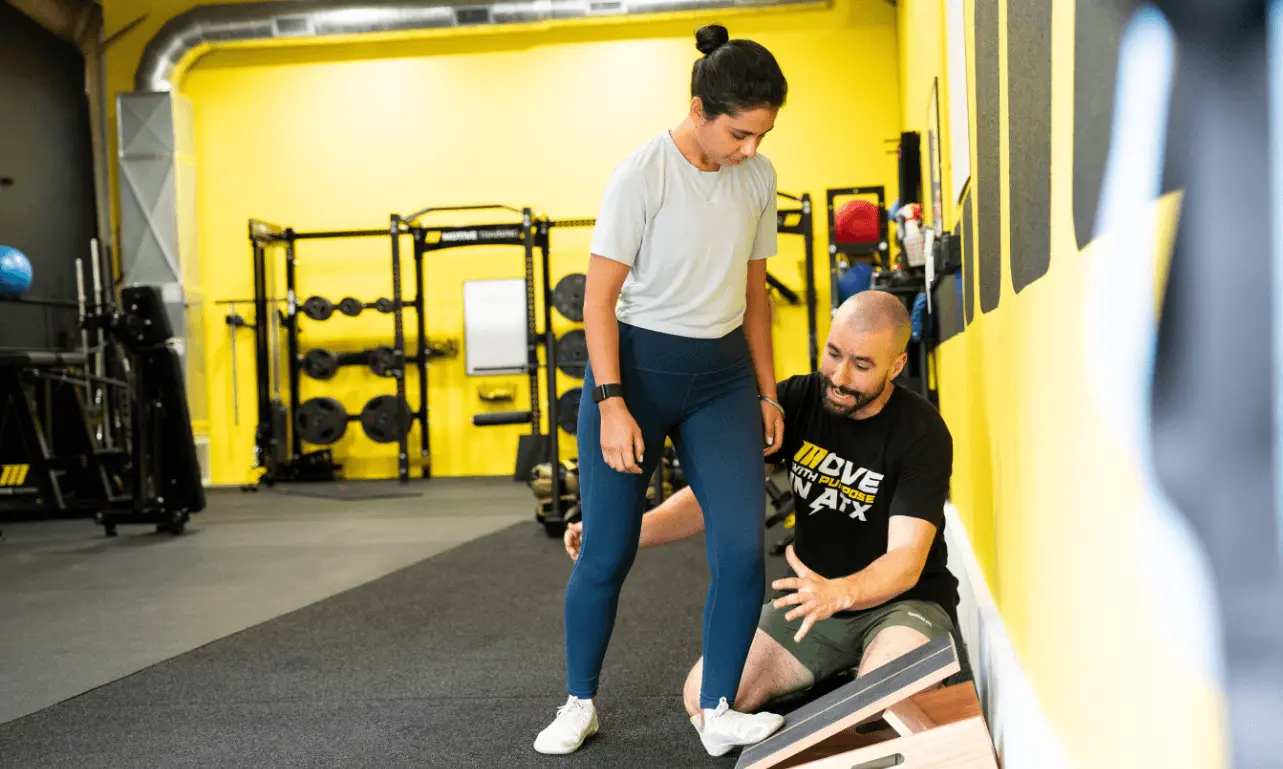
Someone takes a great KINSTRETCH class on Tuesday. Their hip finally opens up in a position that’s been locked for years, the coach gets them there, they feel it, it’s real progress. Then they don’t touch that joint again until the following Tuesday. By the time class rolls back around, a lot of that range has quietly walked itself back. Not all of it, but enough that the session starts to feel like it’s rebuilding ground instead of building on it.
That’s not a failure of the class. It’s a gap in the schedule, and input sessions exist specifically to close it.
What an input session actually is
An input session is a short, joint-specific block of mobility work, five to ten minutes, done to reinforce a position you already know rather than to teach you a new one. No equipment, no gym required: living room, hotel room, the ten minutes between meetings. The intent isn’t to create a training effect in the way a hard workout does. It’s to give a joint that’s been sitting idle a small, consistent signal that the range it worked on in class is still worth keeping.
That distinction matters more than it sounds like it should, because most people’s mental model of progress is built around big efforts: the hard class, the intense session, the one that leaves you sore. Input sessions run on the opposite logic, and the physiology behind why that works is worth actually understanding instead of taking on faith.
Why frequency does something intensity can’t
Cartilage has no direct blood supply of its own. It gets fed through synovial fluid, and that fluid only circulates through the joint capsule when the joint actually moves through its range, including the parts of the range that a normal day never visits. A joint that gets loaded hard once a week but otherwise sits still for the other six days isn’t getting the same nutritional turnover as a joint that gets moved through its full range daily, even briefly. Dr. Andreo Spina calls the alternative articular starvation, and it’s a real mechanism, not a metaphor: infrequent movement through a joint’s available range is a structural problem for that joint, separate from whatever strength or mobility work happens elsewhere in a session.
There’s a second mechanism working alongside that one, and it has to do with the nervous system rather than the tissue itself. Range of motion that isn’t visited regularly gets treated by the brain as range that isn’t trustworthy, which is part of why a hip that felt open on Tuesday can feel meaningfully tighter by the following Monday, even though nothing about the joint’s actual structure changed in a week. Motor control isn’t a one-time deposit. It’s closer to a skill that needs repeated, low-stakes practice to stay reliable, the same way a language you don’t speak for months gets rusty even though you technically still know it.
Both of those mechanisms respond to frequency far more than they respond to intensity. A joint doesn’t need to be pushed hard every day. It needs to be visited every day, and that’s the entire premise behind an input session.
How this differs from a full KINSTRETCH class
A full KINSTRETCH class is built to teach. It slows down, breaks a position apart piece by piece, explains the setup and the cueing and the reasoning behind a drill before ever asking you to load it. That depth is exactly what a class is for, and it’s not something an input session tries to replace.
An input session skips almost all of that on purpose. Instead of rebuilding a position from scratch, it assumes you already recognize the shape and understand the intent, and it moves straight into executing it with control. That trade-off opens up more time for repetition: more reps of Controlled Articular Rotations at a joint that needs daily maintenance, more time under tension in an end-range isometric, more actual training instead of instruction. Less explaining, more doing.
That also means input sessions assume a baseline. If you’ve been through Level 1 or Level 2 KINSTRETCH classes, you already have what an input session requires: you recognize the positions, you know what quality effort in them feels like, and the session can stay efficient without losing effectiveness. Someone brand new to this kind of training is better served starting in a full class first, where the setup and cueing actually get taught. Input sessions are built to reinforce a foundation, not create one from nothing.
What one actually looks like
A shoulder-focused input session might run two slow, fully controlled reps of shoulder CARs, followed by two minutes of internal rotation PAILs and RAILs built up to a maximum voluntary contraction at end range, then three five-second passive range holds in the sleeper position to reinforce the internal rotation ceiling. A hip-focused session might use a minute of 90/90 isometric movement path work to establish control, two minutes of external rotation PAILs and RAILs, and three five-second passive holds in a side-lying 90/90 position.
For desk workers and pickleball players specifically, a wrist and elbow input session tends to earn its place fast, since that’s territory almost nobody trains directly until something already hurts. Three reps of wrist and elbow CARs in each direction, two minutes of wrist extension PAILs and RAILs, and a minute of elbow axial rotations worked to near failure on both sides covers ground that a typical strength program never touches, even though wrist and elbow restriction shows up constantly in anyone who types or grips a paddle for a living.
None of that requires a gym, a coach standing over you, or more than a few minutes. You can run one of these once, twice, even three times in a single day without cutting into recovery, because the load involved is deliberately, intentionally low.
Progress in doses, not leaps
Most people picture progress as a series of jumps: heavier weight, more reps, a harder class. Joint capacity doesn’t respond the same way strength does, at least not entirely. A joint that gets a small, consistent dose of movement every day tends to hold its range better over time than a joint that gets one intense session a week and nothing else, because the mechanisms behind that range, synovial fluid circulation and nervous system trust, both respond more to how often a joint moves than to how hard it gets pushed on any single day.
That’s not an argument against training hard. It’s an argument that hard training and daily maintenance are solving two different problems, and skipping the second one because the first one feels more productive is how people end up rebuilding the same range every few weeks instead of actually keeping it.
Where this fits
If you train with us in person, your coach builds your input sessions directly from your Functional Range Assessment, targeting whatever joints actually need daily attention rather than a generic set of drills. If you train through KINSTRETCH Online, input sessions live inside the platform as their own category, organized by joint, so you can pick exactly what needs the work on a given day without guessing.
Start with one honest question: what feels stiff, stuck, or genuinely out of your control right now. Pick the input session that targets that joint specifically, run it daily for a couple of weeks, and pay attention to what actually changes. Most people notice the shift faster than they expect, and it’s rarely because any single session was intense. It’s because the joint finally started getting visited often enough to remember what it’s supposed to be able to do.
Written by

Brian Murray, FRA, FRSC
Founder of Motive Training
We’ll teach you how to move with purpose so you can lead a healthy, strong, and pain-free life. Our headquarters are in Austin, TX, but you can work with us online by signing up for KINSTRETCH Online or digging deep into one of our Motive Mobility Blueprints.