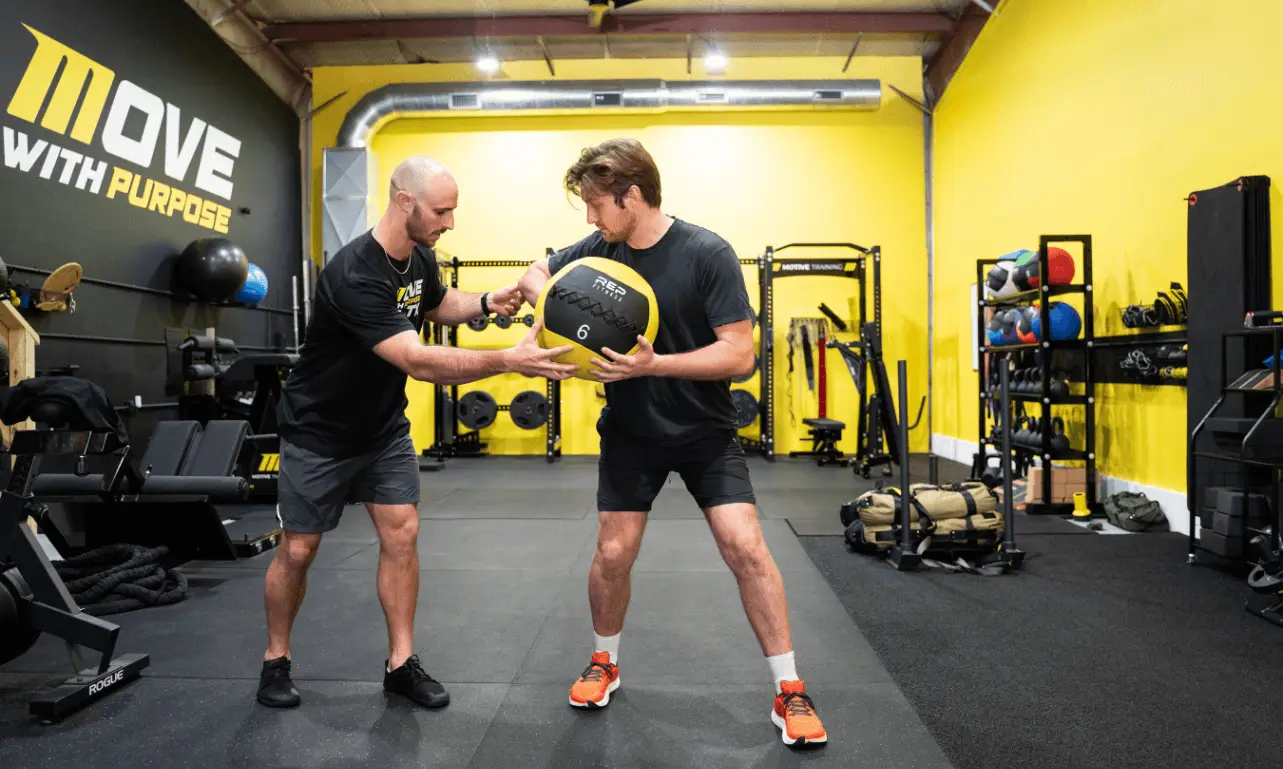
Most people think of the core as something you brace.
They’re taught to lock it down, hold tension, and resist movement. That approach makes sense in certain contexts, but it leaves out a major piece of how the body is designed to produce and transfer force.
Real-world movement isn’t just about resisting motion. It’s about controlling it.
That’s where coiling core training changes the conversation.
The Core Was Never Meant to Be Static
If you look at how people actually move—run, throw, cut, swing, or even walk—the spine and ribcage are constantly rotating, side-bending, and transitioning between positions.
The core’s job isn’t to eliminate that motion. It’s to manage it.
Traditional training often emphasizes linear stability: resisting extension, flexion, or rotation. That has value, but when it becomes the only strategy, it creates a gap between gym strength and real movement.
Coiling core training focuses on how the spine and ribcage store, transfer, and release force through rotation. Instead of treating rotation as something to avoid, it treats it as something to organize.
What “Coiling” Actually Means
Coiling refers to the body’s ability to wind and unwind through the spine, ribcage, and hips in a coordinated way.
This isn’t loose movement. It’s controlled, intentional rotation that allows force to travel efficiently from the ground, through the body, and out into an action.
You see this in:
- Sprinting and gait.
- Throwing and striking.
- Cutting and decelerating.
- Rotational lifts and athletic transitions.
Coiling core training, as taught in systems like WeckMethod, emphasizes how rotational loading and unloading improve force transfer without excessive stiffness.
Why Linear Strength Alone Doesn’t Carry Over
Many people are strong in straight lines but feel awkward, slow, or unstable when rotation is introduced.
They can squat, deadlift, and press impressive loads, yet struggle with:
- Rotational power.
- Change of direction.
- Asymmetrical loading.
- Movement that isn’t perfectly braced.
This happens because linear strength doesn’t automatically teach the body how to manage rotation. If rotational capacity isn’t trained, the body either avoids it or compensates somewhere else.
That compensation often shows up in the low back, hips, or shoulders.
The Role of the Spine and Ribcage
One of the biggest shifts coiling core training introduces is how we think about the spine.
Instead of treating the spine as something to lock down, it’s trained as a structure that needs controlled access to flexion, extension, rotation, and side-bending.
The ribcage plays a major role here. Its position influences spinal mechanics, breathing, and how force moves between the upper and lower body.
When the ribcage and spine can rotate under control, movement becomes smoother and less effortful. When they can’t, everything downstream has to work harder.
This perspective aligns well with how we think about joint-specific capacity and control through Functional Range Conditioning. Rotation isn’t something to eliminate—it’s something to strengthen.
Coiling Is Not the Same as Being Loose
A common misconception is that rotational training makes people sloppy or unstable.
In reality, coiling core training demands more control, not less.
The goal isn’t excessive motion. It’s usable motion.
By training how the body transitions between positions, coiling improves awareness, timing, and coordination. This is especially valuable for athletes and experienced trainees who already have strength but feel disconnected or inefficient when moving dynamically.
How This Fits With Mobility and Joint Health
Coiling core training doesn’t replace mobility work. It builds on it.
Joint-specific mobility creates options. Coiling teaches the body how to use those options together.
Without adequate mobility, rotational training gets limited quickly. Without rotational integration, mobility often stays isolated and fails to transfer into real movement.
This is why we view coiling as a bridge between mobility training and performance. It helps connect isolated capacity to whole-body expression, particularly through the spine and trunk.
If you want a deeper look at how we approach joint capacity and control before layering in integration, our KINSTRETCH work provides that foundation.
Why Coiling Matters for Non-Athletes Too
This isn’t just for high-level athletes.
Daily life involves rotation constantly—walking, reaching, carrying, turning, reacting. When rotational capacity is limited, people often compensate by stiffening or overusing certain joints.
Over time, that shows up as chronic stiffness, recurring discomfort, or the feeling that movement takes more effort than it should.
Training the body to coil and uncoil under control helps distribute load more evenly and makes movement feel more natural instead of forced.
How We Use Coiling at Motive Training
At Motive Training, coiling core principles show up as part of a larger system—not as a standalone solution.
We integrate coiling:
- After joint-specific capacity has been established.
- In ways that match a person’s training age and goals.
- As a progression toward more dynamic, integrated movement.
This fits naturally into how we coach movement and performance in our mobility coaching in Austin, especially for people who feel strong but disconnected, or mobile but unable to express that mobility under load.
What Changes When Coiling Is Trained Well
When coiling core training is introduced appropriately, people often notice:
- Smoother transitions between movements.
- Better coordination between upper and lower body.
- Less need to brace aggressively.
- Improved rotational power and control.
- Reduced strain in areas that used to “take over.”
Movement starts to feel organized instead of forced.
Why This Actually Matters for Training
Most training problems don’t come from a lack of effort or discipline. They come from gaps in how force is transferred through the body.
Coiling core training highlights one of those gaps.
When the spine and ribcage are trained only to resist movement, the body loses access to rotation it needs for real-world tasks. Strength becomes isolated. Mobility stays disconnected. Movement starts to feel forced instead of fluid.
Training the ability to coil and uncoil under control restores that missing link. It allows force to move through the body more efficiently, reduces the need for excessive bracing, and makes both strength and mobility more usable.
This doesn’t replace joint-specific work or linear strength training. It complements them. When rotation is respected and trained appropriately, movement becomes more adaptable, resilient, and expressive—qualities that matter far beyond the gym.
That’s what coiling core training changes about how you move.
Written by

Brian Murray, FRA, FRSC
Founder of Motive Training
Motive Training is a coaching studio in South Austin built around assessment, joint health, and strength you can use. Train with us in the studio, come to a KINSTRETCH class, or work through the progressions in KINSTRETCH Online.