Stretching works. It also does not work, depending on what you are asking it to do and what kind of stretching you are talking about. That second half is the part the conversation has glossed over for decades, and the research has finally caught up enough to be specific about it.
In 2025, a panel of twenty international research experts published a Delphi consensus statement in the Journal of Sport and Health Science (1). Twenty researchers from twelve countries worked from existing systematic reviews and settled on what stretching reliably does, what it does not do, and at what dose. The answer is more useful than the usual fitness-blog hedge, and it is also worth reading carefully, because what the literature is testing and what most thoughtful coaches mean by mobility training are not the same thing.
What the consensus actually evaluated
The studies being reviewed almost all examined a specific intervention: passive static stretching. Hold a position that lengthens a muscle, sit there for some number of seconds, repeat for some number of weeks. That is what the evidence base is built on. Whenever you see a headline about what stretching does or does not do, you are reading about that intervention.
The consensus found that passive stretching reliably improves range of motion, both acutely and over time. It reliably reduces muscle stiffness, though the dose required is higher than most people think. The panel pointed at roughly four minutes of static stretching per muscle, five days a week, sustained over time before stiffness changes show up consistently, and something closer to seven to fifteen minutes for the early evidence on vascular benefits, which the panel was honest still needs more work before anyone should lean on it heavily.
On the other side, the panel found consensus that passive stretching, as a standalone intervention, does not serve as a general injury prevention strategy and does not acutely speed up post-exercise recovery. They also concluded that, on its own, passive stretching does not contribute substantively to muscle growth or improve posture. The last two findings are correct for what was actually tested. They are also the ones most likely to get misread, because most people hear “stretching does not build muscle” and assume that settles the broader question of if lengthened positions matter for tissue adaptation at all. It does not settle that. It settles a much narrower question about one specific protocol.
Why range of motion gains are rarely what they look like
Here is the part that rarely makes it into the summary. Even where the consensus credits stretching with something real, like increased range of motion, the mechanism behind that improvement is not usually what people assume.
A muscle that gets more flexible after a few weeks of stretching is not, in most cases, a muscle that has physically lengthened. Weppler and Magnusson’s 2010 review in Physical Therapy (2) laid this out clearly. Across the studies they examined, increases in range of motion after short-term stretching programs were largely explained by a change in stretch tolerance, meaning the nervous system had become more willing to let the joint sit in a position it previously treated as uncomfortable, rather than by any lasting mechanical change in the muscle-tendon unit itself. The tissue did not get longer. Your tolerance for the sensation of being at that length changed.
This matters because it explains a pattern most people have lived through without having language for it. You stretch consistently for a few weeks, your toe-touch improves, you feel proud of the progress, and then you take two weeks off and the range quietly disappears. If the change had been structural, tissue does not unwind that fast. If the change was mostly a shift in what your nervous system was willing to tolerate, losing that adaptation the moment you stop reinforcing it makes complete sense. You did not lose length. You lost familiarity.
This is not an argument that stretching does nothing. Increased stretch tolerance is a real and sometimes useful outcome, particularly for someone dealing with a genuinely restrictive, protective guarding pattern around a joint. But it is a different outcome than the one most people think they are training for, and it is a different outcome than what training end-range strength produces, which is where the next distinction actually starts to matter.
Where the literature ends and where training begins
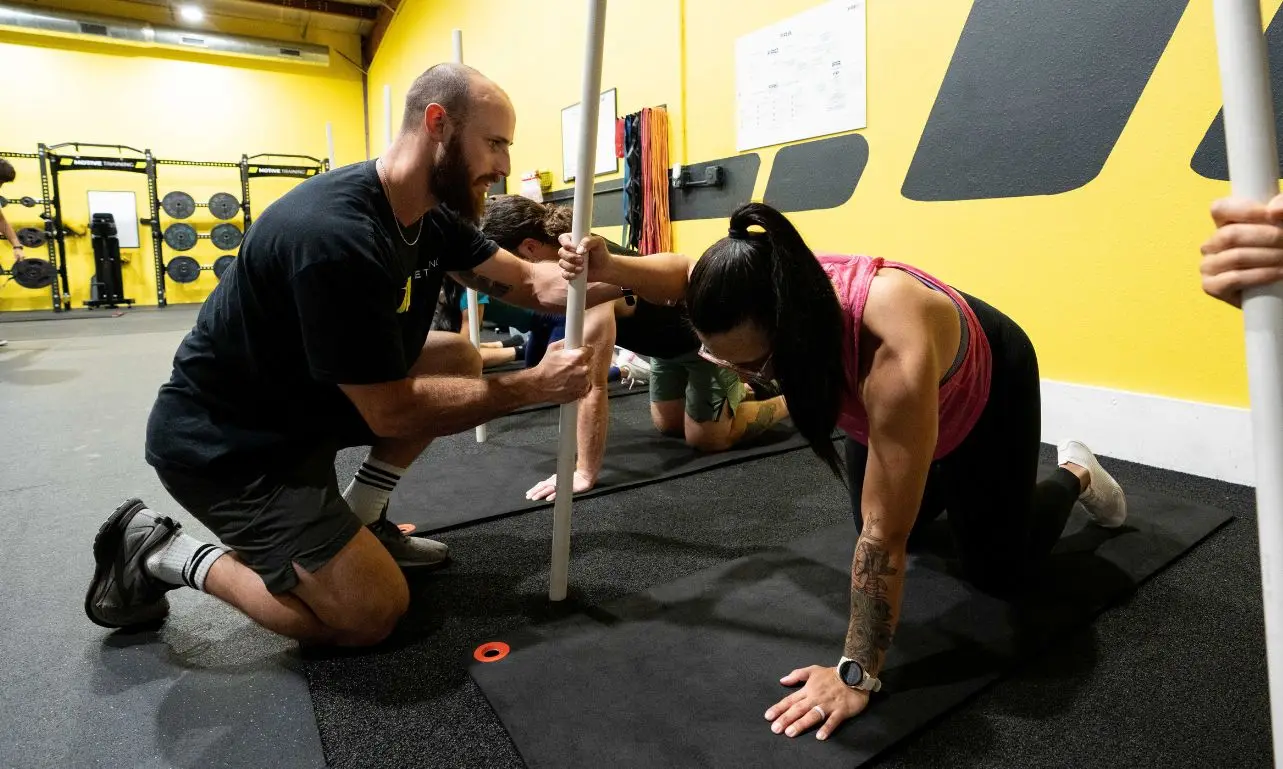
What we do at Motive Training, and what most coaches doing real mobility work do, is not the intervention being tested in those studies.
When we train end-range positions with PAILs and RAILs, we are not asking someone to passively hold a stretch and wait for their nervous system to relax into it. We are loading the tissue isometrically inside a lengthened position, building strength inside that position, and asking the nervous system to develop actual control where there was previously only borrowed range. That is a fundamentally different stimulus than a passive hold, and it produces a fundamentally different kind of adaptation. A 2021 systematic review by Afonso and colleagues (3), pooling eleven randomized controlled trials and 452 participants, found that strength training through a full range of motion produced flexibility gains statistically indistinguishable from stretching, while also building strength that passive stretching cannot. Training muscle in lengthened positions under load is a known driver of hypertrophy. Calling that “stretching” and then saying stretching does not build muscle is the conversation getting confused with itself.
The same problem shows up in the posture claim. Generic stretching programs aimed at no particular tissue and no particular postural limitation will not change anyone’s posture. The consensus is right about that. But targeted work on the specific structures limiting upright organization, the thoracic spine that cannot extend, the hip flexors that have shortened from years of sitting, the scapula that cannot retract, can absolutely change the postural picture. That work uses some of the same starting positions the literature calls stretching, applied with intent, specificity, and a loading component that the studied protocols do not have.
The performance caveat is worth naming directly. The consensus and an earlier 2013 meta-analysis by Simic and colleagues (4) both flag prolonged static stretching of more than sixty seconds per muscle, performed immediately before maximal strength or power output, as something that can temporarily reduce force production. This finding is real, and it holds up across a large body of research. It is also not what anyone training mobility seriously is doing as a warm-up. Nobody is sitting in a passive sixty-second hamstring stretch directly before a heavy squat session. The finding is a reason not to do that specific thing immediately pre-lift, not a general indictment of end-range work as part of a training week.
Where the literature gets it right, and we should not retreat from it
Two of the consensus findings hold up even when you account for everything above.
Stretching, of any kind, is not the lever that prevents injury. The research on this has been pointing the same direction for over twenty years. Thacker and colleagues’ 2004 systematic review in Medicine and Science in Sports and Exercise (5) found insufficient evidence to support routine stretching as an injury prevention strategy for competitive or recreational athletes, and the 2025 consensus confirms that finding still holds. What does prevent injury: appropriate load management, strength built through full ranges of motion, tissue capacity developed over time, and end-range control that closes the gap between what a joint can passively access and what the nervous system will actually let you use. Mobility training can support all of that. The claim that stretching itself, in isolation, protects you from injury is one the evidence does not back, no matter how the stretching is dressed up.
The recovery claim is similar. Stretching the night after a hard session can feel good and can offer real mobility benefits. It does not measurably speed up tissue repair or reduce next-day soreness in any acute, meaningful way. Treating the post-workout stretch as a recovery tool is a category mistake, even though it is one of the most common assumptions in general population fitness.
What this means for how to think about stretching
The shorthand most coaches and clients reach for, “is stretching good or bad,” is the wrong question. The useful questions are narrower, and each one has a different answer.
Are you trying to expand passive range of motion in a specific joint. Stretching can do that, at a dose most people are not actually giving it, and the mechanism is likely more about nervous system tolerance than tissue length, which changes how durable you should expect the result to be without reinforcement.
Are you trying to reduce a stiff, restricted feeling in a tissue you sit on for nine hours a day. Stretching can help, and so can simply moving the joint regularly through its available range, which is a large part of what daily joint maintenance work is built around.
Are you trying to build strength and control inside that new range so the body can actually use it under load. You are no longer doing passive stretching. You are doing mobility training, which uses lengthened positions as one input inside a larger system that includes isometric loading, controlled articular rotations, and integration with strength work. That is the layer the consensus is not really evaluating, and it is the layer where the lasting change happens.
The single most useful idea to carry around is this: range you cannot control is range you do not own. The nervous system protects ranges where strength and motor control are absent, which is exactly the mechanism Weppler and Magnusson’s stretch tolerance findings point toward from the opposite direction. Stretching can raise the ceiling of what feels tolerable. It does not, by itself, give your brain a durable reason to let you use that range when load shows up. The work of closing that gap is what Functional Range Conditioning was built to do, and a direct side by side of the mechanisms is laid out in FRC versus static stretching. This is what separates mobility training as a discipline from stretching as a habit.
How we apply this at Motive Training
We do not throw stretching out. We use it where it earns its place, and we are honest with clients about what it is actually doing and what it is not.
We pair lengthened positions with end-range isometric loading, so the body builds strength inside the new range instead of just visiting it and hoping the visit sticks. We measure joint motion and control through the Functional Range Assessment so we are training what is actually limiting someone, not what feels tight on a given day, which matters more once you understand how much of a stretch’s apparent effect can be nervous system tolerance rather than a true change in the tissue. We integrate the work into KINSTRETCH classes in Austin and through KINSTRETCH Online so the system runs consistently, with intent, instead of as a collection of stretches people remember to do sometimes and forget the rest of the time.
Stretching is a real tool. It does specific, verifiable things, and the 2025 consensus is the clearest picture we have had of exactly what those things are. It is also one tool, and the cultural conversation has been treating it like an entire toolbox for a long time. Being precise about what it does, why it does it, and where you need something else is not a small correction. It is the difference between chasing a feeling and building a body that holds up.
References
- Practical recommendations on stretching exercise: A Delphi consensus statement of international research experts
- Increasing Muscle Extensibility: A Matter of Increasing Length or Modifying Sensation?
- Strength Training versus Stretching for Improving Range of Motion: A Systematic Review and Meta-Analysis
- Does pre-exercise static stretching inhibit maximal muscular performance? A meta-analytical review
- The impact of stretching on sports injury risk: a systematic review of the literature
Written by

Brian Murray, FRA, FRSC
Founder of Motive Training
Motive Training is a coaching studio in South Austin built around assessment, joint health, and strength you can use. Train with us in the studio, come to a KINSTRETCH class, or work through the progressions in KINSTRETCH Online.