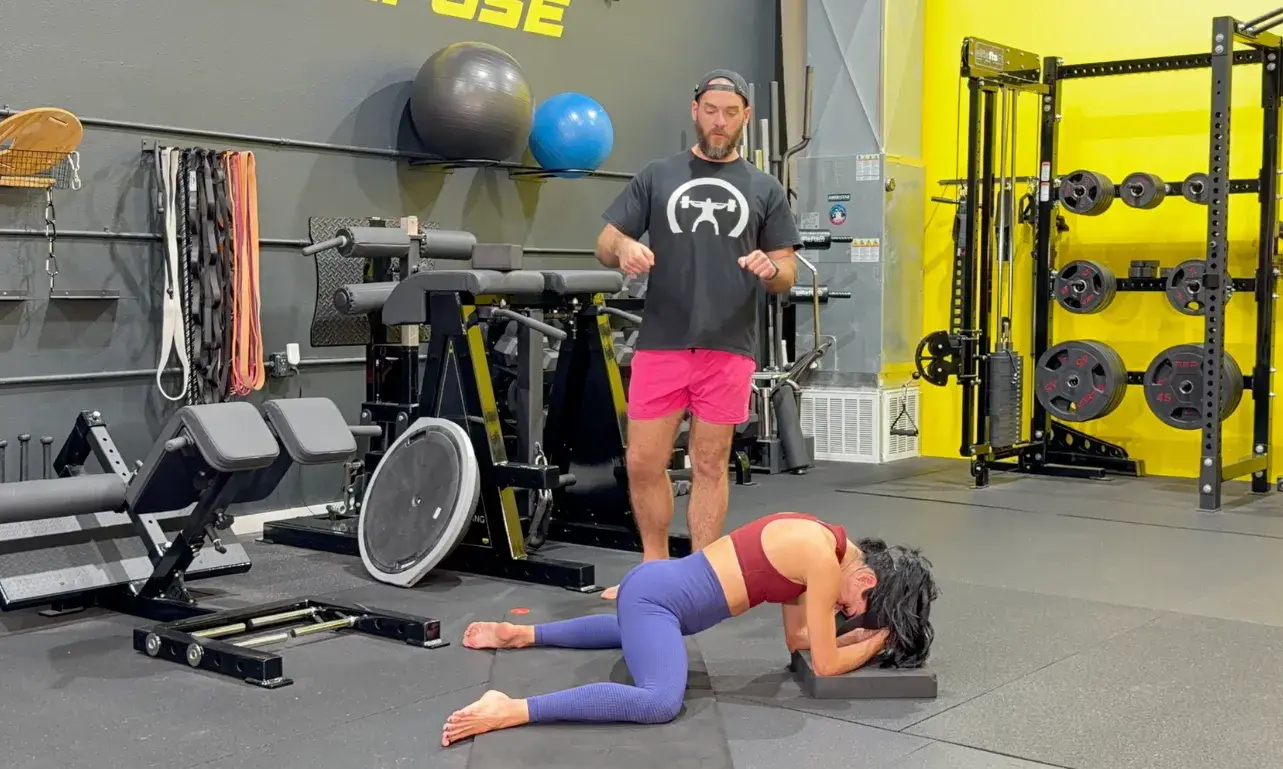
Why frog position is uncomfortable—and why that’s worth understanding
Frog position shows up in yoga classes, physical therapy offices, and mobility work across a lot of different training systems. Most people who have spent time in it describe the experience the same way: deeply uncomfortable, hard to know if they’re doing it right, and vaguely rewarding once it’s over. That’s a fair description of the sensation. It’s not a complete picture of what’s happening.
The discomfort in frog is real, and it’s real for a reason. The position loads the inner thigh and hip in ranges that most people rarely visit outside of it. But the discomfort alone doesn’t tell you where you’re actually restricted, what the position is exposing about your hip, or how to measure progress. Those things require a clearer understanding of what frog position is actually doing—and what the difference is between holding it passively and working it with intention.
This article covers what frog position targets, what it tends to reveal about the hip, and how to get more out of it than simply waiting for time to pass.
What frog position is and how it’s typically used
Frog position places the hips in deep abduction with the knees and ankles bent to approximately 90 degrees. The inner thigh, hip capsule, and adductor group are loaded simultaneously, making it one of the more comprehensive hip mobility positions available. It appears across yoga, physical therapy, and active mobility training—though the intent and execution vary significantly between those contexts.
In yoga, frog is most commonly used as a passive hip opener—a shape you settle into and hold for time, often with long exhales cued as a way to soften into the position. That’s a legitimate approach. Prolonged exposure to end-range positions does influence how the nervous system tolerates that range over time, and many people find real relief in it. The limitation is that holding frog passively doesn’t tell you much about what’s restricted or why, and it doesn’t build any capacity to control the range once you leave the position.
The setup also matters more than it might seem. The version of frog used in active mobility work is not the traditional yoga variation where the feet come toward each other and the toes point back. Instead, the feet go wide with the shins perpendicular to the thighs—two clean 90-degree angles at both the knee and the hip. That distinction changes what gets loaded. The 90-degree version keeps the joint in a mechanically loaded position rather than a loosely collapsed one. If you rotated the whole thing upright, it would look like the bottom of a wide-stance squat. Reframing it that way is useful, because it makes clear that you’re not lying on the floor resting—you’re loading a range your hip doesn’t normally access.
What frog position actually targets
The primary target in frog position is the adductor group—the muscles of the inner thigh that run from the pubic bone to the femur and tibia. What makes the adductors unusual is that they function as both hip flexors and extensors depending on joint position, which means the angle of your pelvis changes which part of the group is under load. This is why frog can feel different depending on how you set it up.
Most people think of the inner thigh as one muscle that does one job: pull the legs together. The adductor group is more complicated than that. It spans a significant length from the pelvis to the lower leg, and the way it functions shifts based on the position of the hip—flexion or extension changes the job it’s doing. The same muscles that assist hip extension from behind the body can assist flexion from in front of it. This is why the tilt of your pelvis in frog matters, and why you’ll feel the position in different places depending on how you’re set up.
The sensation tends to register deep in the groin—high up near the pelvic floor, not in the mid-thigh where people typically expect to feel an adductor stretch. That’s normal. That’s where the work actually needs to happen, because that’s where the hip capsule is being challenged. If you’re primarily feeling frog in your inner knee or mid-thigh, the position may need adjustment.
It’s also worth noting what frog should not feel like. The outside of the hip—the glutes and external rotators—should be quiet in frog, at least initially. If you’re feeling significant tension there from the start, the hip is likely compensating for a lack of available range in the inner thigh. That’s useful information, but it’s not the target.
The pelvic tilt test: what it tells you
One of the more useful things you can do once you’re settled into frog is perform a simple pelvic tilt—try to round the lower back, then try to extend it. Cat-cow, essentially, but with the hip in deep abduction. Most people skip this entirely, which is a missed opportunity, because the result tells you immediately where your hip is actually restricted.
Performing a pelvic tilt in frog position quickly identifies where the hip mobility restriction lives. An inability to flex the lumbar spine—to tuck the tailbone—typically indicates that the adductors are limiting movement in that direction. Restriction going the other way points to a different part of the adductor group in a different position. Either way, the test tells you where to direct your effort.
If you can’t tuck your tailbone—if the lower back simply won’t round when you try—that’s the nervous system flagging something. The inner thigh isn’t available in that direction. It’s not necessarily that the muscle is too short. It’s that you don’t have active access to the range, and the pelvis is being held in place as a result.
Extension restriction tends to be more common, particularly in people who haven’t specifically worked hip abduction ranges. The inability to find posterior pelvic tilt in an abducted hip is a pattern that shows up consistently. Flexion restriction is less common but does appear, often in people who have developed stiffness through the posterior chain. Neither is unusual. What matters is that the test tells you which direction is actually limiting you—and that’s the direction worth spending time in.
There’s also a depth variable worth understanding. As you sit back farther in frog—increasing hip flexion—the pelvis progressively loses its ability to move. The joint simply runs out of space. If you’ve sat back far enough that your pelvis locks entirely, you’ve moved past the range where useful work is possible in that session. The productive range is just inside your current limit, not past it.
How to work frog more intentionally
Once you’ve identified where your restriction is through the pelvic tilt test, the next step is to load that direction—not aggressively, but with intention. The approach used in active mobility training involves a very low-effort isometric contraction in the direction of restriction: try to draw the knees toward each other as if gripping the floor, without actually moving. A 1 out of 10 effort level is enough. Hold it for 20 to 30 seconds, then release and retest the pelvic tilt.
The goal of that contraction is not to force range. It’s to tell the nervous system that you have some muscular control at this position—and that signal tends to produce a measurable response. The pelvis that wouldn’t move before will often move more freely after a low-effort hold in the restricting direction. This is the logic behind PAILs and RAILs applied to a floor position: you’re not stretching harder, you’re demonstrating control, and the nervous system responds by backing off its restriction on range.
Working both pelvic positions—flexion and extension—across a session is more productive than picking one and staying there. The adductors function differently in each direction, and spending time in both gives you a more complete picture of what’s actually restricted and what’s starting to open up.
The internal rotation piece most people miss
Hip internal rotation plays a more significant role in frog position than most people realize. The glute medius and minimus, when activated in end-range abduction, function as stabilizers that modulate tension throughout the hip. Loading them in frog—through passive internal rotation holds with the feet lifted—tends to reduce adductor tension and improve pelvic mobility within the same session.
This is where frog work tends to produce a result that surprises people. After the pelvic tilt work and low-effort loading, shifting focus to internal rotation often creates an immediate change in how the hip feels. From the frog position, rocked slightly forward to reduce depth, the feet lift off the ground—that lifting is hip internal rotation. Holding that position while slowly sitting back loads the outer hip stabilizers in a mechanically challenging way.
The glute medius and minimus are doing real work in this position. These muscles function as hip tuners: they modulate the hip’s access to motion, and when they’re loaded at end range, they tend to reduce tension in the surrounding tissue. It’s why you’ll often see an immediate improvement in how high the feet can lift after a few holds. The hip didn’t suddenly become more flexible. The nervous system relaxed its grip on the joint because the stabilizers demonstrated they could handle the position.
After working internal rotation, returning to the pelvic tilt retest typically shows a clear change. The lower back that wouldn’t round at the start of the session usually rounds more freely. The groin that felt locked usually feels quieter. That’s a consistent pattern, and it’s why internal rotation is worth including in frog work even when the stated goal is adductor mobility.
Why frog is harder than it looks
Frog is one of the more demanding things you can do in a mobility session—not because there’s dramatic movement, but because everything is under sustained load in a position the body rarely visits. Even low-effort isometric holds are working muscles across long ranges they don’t normally control. The internal rotation work asks the hip stabilizers to fire in a mechanically disadvantaged position. The pelvic mobility work requires the lumbar spine and adductors to coordinate in a way most people have never specifically trained.
The fact that it looks like lying on the floor is genuinely misleading. Someone working frog with intention is doing real neuromuscular work throughout—they’re just doing it quietly.
After a demanding frog session, it’s worth checking in the following day. The deep groin structures take time to recover from unfamiliar load. If it feels like you worked hard through something your body didn’t recognize, that’s accurate. Build into it progressively. The body adapts to the load like anything else, and tolerance improves faster than most people expect.
What changes when frog is trained consistently
People who work frog consistently—with the pelvic tilt testing, low-effort loading, and internal rotation work—tend to notice changes that transfer well beyond the position itself. Hip CARs become cleaner. Squat depth improves. Lower back tension that seemed unrelated starts to ease. This makes sense structurally: the adductors attach across multiple joints and influence pelvic position throughout nearly everything you do. When they start functioning across a fuller range, the downstream effects show up across a lot of movements.
That transfer is the point. The goal of working frog isn’t to get better at frog—it’s to build hip mobility that’s available in training, in sport, and in daily life. The position is a means to that end, not the end itself.
Frequently asked questions about frog position
What should I feel in frog position? The primary target is the inner thigh—deep in the groin, closer to the hip and pelvic floor than the mid-thigh. A tolerable, dull discomfort in that area is appropriate. Sharp pain, or significant tension on the outside of the hip from the start, is a signal to reduce depth or exit the position.
Why can’t I tuck my tailbone in frog position? Inability to posteriorly tilt the pelvis in frog typically reflects adductor tension limiting movement in that direction, reduced hip capsule mobility, or both. A low-effort isometric hold—trying to draw the knees together without moving—followed by a retest usually produces improvement within the same session.
Is frog position the same in yoga and active mobility training? The visual is similar, but the setup and intent differ. Yoga frog often allows the feet to come toward each other. Active mobility work maintains 90-degree angles at the knee and hip, which changes what gets loaded. More importantly, the passive hold approach gives way to pelvic tilt testing, low-effort loading, and internal rotation work—all of which require active engagement throughout.
Why does frog feel harder than other mobility work? Because it loads multiple structures simultaneously in ranges they rarely visit. Even at low effort, the muscles working in frog are being challenged in positions they don’t normally control. That novelty is part of why the work is effective, and why building into it gradually produces better results than pushing aggressively from the start.
What does internal rotation have to do with frog position? The glute medius and minimus, when activated in end-range abduction, tend to reduce adductor tension and improve pelvic mobility. Training internal rotation within frog—by lifting the feet off the ground and holding that position while sitting back—regularly produces immediate improvement in how the rest of the session feels.
How long does it take to improve frog position? Most people notice meaningful change within a few weeks of consistent, structured work. The adductors adapt relatively quickly to end-range loading when the approach is progressive. Tolerance for the position improves faster than most people expect.
Work through frog in a structured class
The approach described here—testing the pelvic tilt, loading the restriction, working internal rotation, and retesting—is the same framework used in KINSTRETCH classes at Motive. If frog is a position you’ve been struggling with, or if you’ve hit a ceiling in your hip mobility and aren’t sure what to do next, a structured class gives you the sequencing and coaching context to make it productive rather than just uncomfortable.
KINSTRETCH Online brings that same approach to wherever you train. Classes are coached, methodical, and built around Functional Range Conditioning—the same system used in the studio. If your hips have been a limiting factor, this is a direct way to start addressing that with proper structure.
Written by

Brian Murray, FRA, FRSC
Founder of Motive Training
Motive Training is a coaching studio in South Austin built around assessment, joint health, and strength you can use. Train with us in the studio, come to a KINSTRETCH class, or work through the progressions in KINSTRETCH Online.