What CARs actually are
CARs are slow, controlled movements that take a joint through the largest circle it can actively produce under full muscular tension, with the rest of the body held still. The word “controlled” is doing the most important work in that definition. The intent is to actively rotate inside the joint itself, with the muscles producing and governing the entire arc, rather than to draw a circle in space using momentum.
CARs were developed as a core tool of Functional Range Conditioning, the joint health and mobility system created by Dr. Andreo Spina. They function as the daily practice component of FRC, the thing you do between more intensive sessions to maintain what you’re building. The movement looks deceptively simple. It stops looking simple once you understand what it’s actually asking of you.
What separates a CAR from a joint circle
Most people meet CARs and immediately categorize them as joint circles, a light warm-up drill they’ve done some version of since gym class. That framing misses nearly everything that makes CARs effective.
The difference comes down to two things. The first is the quality of tension throughout the movement. In a joint circle, momentum does most of the work; in a CAR, muscular control drives every degree of the arc. The second is the degree of separation between what the joint is doing and what the rest of the body is doing. In a joint circle, the spine, pelvis, and surrounding joints participate freely. In a CAR, they are deliberately quiet, held still while the working joint moves through its full arc in isolation.
That separation is what makes CARs neurologically demanding. The nervous system has to maintain two things at once. Full contractile tension throughout the body to create a stable foundation, and precise, active rotation through the joint being trained. That’s a coordination demand that joint circles simply don’t create. Once you feel the difference between moving a limb through a circle and actively rotating inside a joint against that level of whole-body tension, the exercise changes completely.
The science behind why CARs work
Joints aren’t self-sustaining structures. Cartilage has no direct blood supply. It receives nutrients through synovial fluid, which circulates when the joint moves. A joint that rarely reaches the edges of its range gradually loses access to those positions as the synovial membrane receives less stimulus and the nervous system’s map of that range becomes less detailed.
Dr. Spina describes this as articular starvation, the joint capsule losing health and capacity not through trauma but through disuse at end range. CARs address it directly by taking the joint to its full available limit under active control on a regular basis.
Three things happen when CARs are practiced consistently. The joint capsule is fully loaded and unloaded through each rotation, which distributes synovial fluid to cartilage surfaces that otherwise receive minimal nutrition. The nervous system maintains and refines its representation of joint position across the full range, which keeps the brain’s map of where the joint is and what it can do detailed and current. And restrictions or asymmetries show up early, in the form of catches, compensations, or reduced range on a given day, before they develop into pain. That last function is the daily diagnostic side of the practice. A consistent CAR routine gives you running data about your joints that no periodic assessment can match.
CARs as warm-up, workout, and standalone practice
CARs work in all three roles depending on context, but they’re more accurately understood as a daily joint health practice that sits outside the warm-up and workout categories.
As a warm-up, a brief CARs sequence prepares joints for training by increasing synovial fluid circulation, activating the stabilizing musculature around each joint, and giving the nervous system an accurate read on current range and any restrictions present that day. A ten-minute CARs routine before training is more informative and joint-specific than most conventional warm-ups.
As a standalone daily practice, CARs do something most training doesn’t. The work is preservation and maintenance of the joint space, what brushing does for your teeth scaled up to your joints, rather than producing the kind of fatigue or measurable adaptation a workout is designed around. That’s why CARs should be practiced daily, including on days with no other training.
As part of a structured mobility session, CARs serve as both the assessment and the starting point before progressing to more intensive work like PAILs and RAILs, which load the end-range positions that CARs identify.
Why daily practice is the standard
Yes, daily. The reasoning is grounded in how joints maintain health over time.
Cartilage nutrition, synovial fluid circulation, and neurological mapping of joint position are continuous processes. They depend on regular movement stimulus, not periodic intense stimulus. Daily CARs provide that continuous input in a way weekly or even three-times-weekly practice can’t replicate.
The practical case is equally strong. A full-body CARs routine takes ten to fifteen minutes. It requires no equipment. It can be done on waking, before training, at a desk, or before bed. The cumulative effect of ten minutes of focused joint work every day over months and years compounds in a way that’s difficult to replicate through any other single practice.
The one real nuance is acute injury or inflammation. When a joint is acutely injured or inflamed, CARs in that joint should be performed with reduced range and reduced irradiation, meaning less whole-body tension. Moving gently through available pain-free range is generally still beneficial, but working through sharp or acute pain isn’t the intent.
How to perform CARs, joint by joint
Before the joint moves, the body braces. Generate tension through your entire body. Contract the muscles not involved in the rotation, grip the floor with your feet, tighten your hands, and create as much full-body tension as you can hold. This is irradiation, explained in detail in the next section. Only then begin the rotation.
Move slowly. A single CAR should take twenty to thirty seconds minimum. Slow, intentional movement forces the muscles to produce and govern every degree of the arc rather than letting momentum do the work. At every point in the rotation, seek the absolute limit of your active range. The areas of the arc that feel restricted are exactly where the practice is most valuable, so don’t shortcut them.
Cervical CARs
Stand, sit, or hinge at the hips with the body still and chin level to start. Begin by tucking the chin toward the throat into cervical flexion. From there, slowly tilt the head to one side into lateral flexion, rotating around through extension as the head moves back, continuing to the other side, and returning to the tucked start position. The head traces the largest possible circle in slow motion.
What you’re looking for are catches, clicks, or areas where movement becomes uneven or stiff. These are information, not cause for alarm. Asymmetry between clockwise and counterclockwise rotation is common and worth noting.
The neck is one of the most undertrained joints in most programs. Most people have significant restrictions in cervical rotation and lateral flexion from sustained forward head posture. CARs are one of the few practices that specifically restore active control of the cervical spine.
Shoulder CARs
Stand with the non-working arm at your side or gripping a fixed object lightly for stability. The torso doesn’t rotate. Reach the working arm forward into shoulder flexion. Continue up and overhead, internally rotating as the arm passes overhead so the thumb turns toward the floor behind you. Continue the circle through extension and back around, maintaining full tension throughout. The rotation comes from the shoulder joint only.
The places to watch are loss of elevation overhead, internal rotation restrictions behind the body, and the tendency to compensate with thoracic extension or trunk rotation as the arm reaches the overhead position. The shoulder has the largest range of any joint in the body, which means there’s more territory to explore and more opportunity for restricted zones to develop unnoticed.
Hip CARs
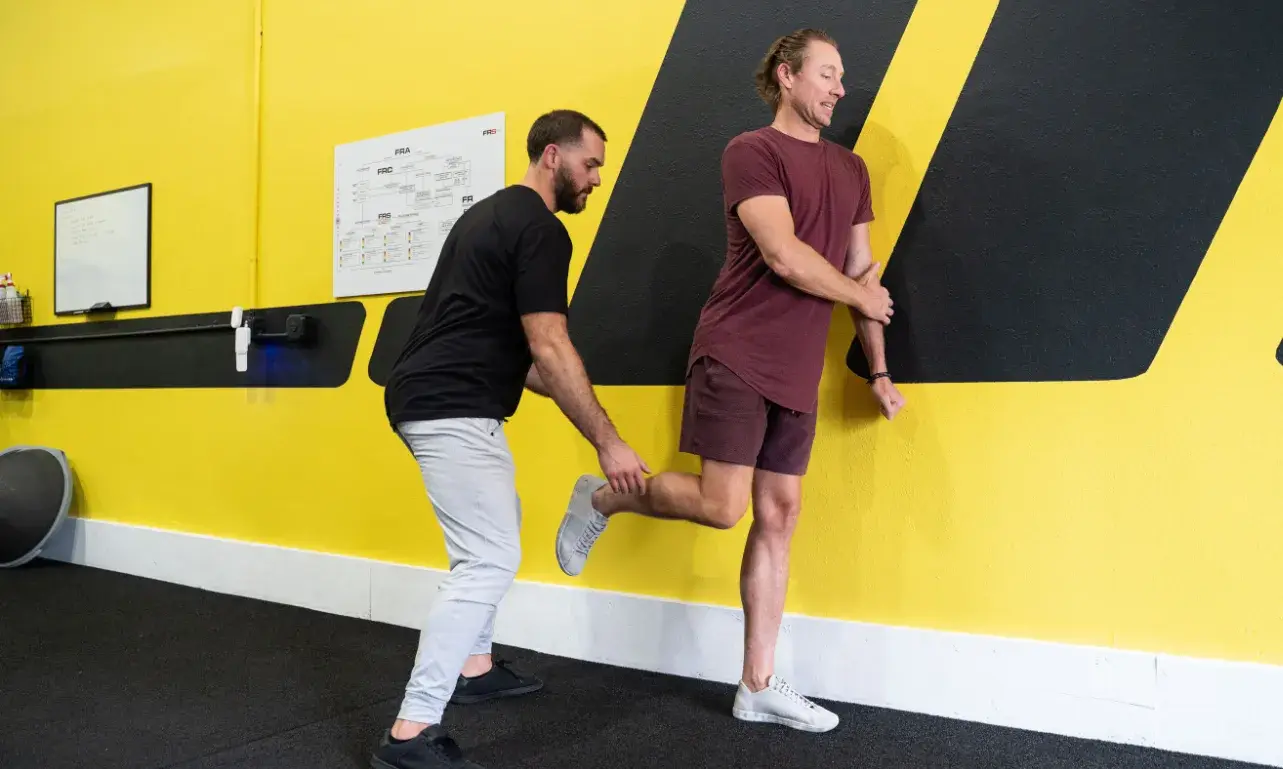
Stand on one leg, or set up on all fours in quadruped for more stability. If standing, brace against a wall with one hand. From the standing position, drive the knee up toward the chest into hip flexion, then move it out to the side into abduction, then behind you and around through extension and adduction, tracing the largest circle possible while the pelvis and spine remain still.
The quadruped version follows the same arc, but the hip-stacked position makes it easier to isolate the hip from the lumbar spine. The low back shouldn’t move. If it does, reduce the range until the motion is coming from the hip alone.
The internal rotation portion of the arc, where the leg crosses behind you, is the most commonly restricted zone in adults, particularly desk workers and cyclists. Any area where the pelvis wants to shift or the low back wants to rotate is an area where the hip is running out of available range and compensating around the limit.
Hip CARs are the highest-yield rotation for most adults. The hip’s connection to the lumbar spine, the pelvis, and the knee means restrictions here create downstream effects throughout the body.
Thoracic spine CARs
Sit, kneel, or stand with arms crossed over the chest. Begin by rounding forward through the thoracic spine in flexion, then shift to rotation to one side, then extend back and open through extension and rotation to the other direction. The goal is segmental movement through the thoracic spine, a true rotation through the spine itself rather than a global lean of the whole torso. Lumbar spine stays neutral.
Most adults have significant restrictions in thoracic extension and rotation from sustained seated posture. The thoracic spine has twelve vertebrae with meaningful rotation available at each segment, so restrictions here affect both the cervical spine above and the lumbar spine below.
Ankle CARs
Sit with the foot hanging free, or stand on one leg. The foot and ankle work as a system rather than just a single joint. As you bring the foot toward inversion, the big toe side and inside ankle actively separate while the pinky side and outer edge work underneath. As you transition to dorsiflexion, maintain rotational intent. At plantar flexion, the pinky side comes up, the inside heel drops, and the rotation continues. The intent is to actively rotate inside the ankle and foot complex at every point in the arc, with the foot treated as a system you’re rotating through, not as a single hinge tracing a circle.
Ankle CARs done with this level of attention produce significantly more joint control than foot circles, and that difference comes from the higher-level thinking: foot as a system, rotational intent at every position throughout the arc.
What irradiation does and why it matters
Irradiation is the technique of generating full-body tension to create a stable foundation for the joint being trained in a CAR. When you contract the muscles not involved in the rotation, gripping the floor, tensing the glutes, bracing the torso, that tension spreads through the body and increases the stability and neurological output available to the working joint.
The mechanism comes from Sherrington’s law of irradiation: muscular tension in one area of the body increases neural drive to surrounding areas. By generating maximum tension in the body while one joint moves, you’re giving the nervous system the most demanding environment possible for that joint to perform in.
In practice, a hip CAR performed while standing under whole-body tension is neurologically more demanding than the same shape performed while relaxed, even though the rotation looks identical from the outside. That difference in neuromuscular demand is what builds real joint control over time.
When learning CARs, irradiation is the hardest part to get right. Most people produce the shape of the movement quickly. The harder part is maintaining whole-body tension while slowly rotating a single joint, without letting the surrounding structure contribute to the rotation. That part takes practice.
Reading pain and discomfort during CARs
CARs frequently reveal restrictions, catches, and areas of discomfort that weren’t obvious before. What those signals mean depends on their character.
A feeling of restriction, stiffness, or reduced range is normal information. The joint is running into the edge of its available range, which is where the practice is most valuable. Continue moving to that limit, not through it. A sensation of pulling, tightness, or mild muscular effort at end range is also normal and expected. The muscles are working at their limit. That’s what productive CARs feel like.
A catch or audible click usually isn’t concerning if it isn’t painful. Joints make noise for various reasons, including gas bubbles in synovial fluid or tendons moving over bony prominences, and occasional clicking without pain is generally not a problem.
Sharp pain, joint pain, or pain that reproduces a familiar symptom is a signal to reduce range and stay in the pain-free zone. CARs should always be performed within the range where you have active, pain-free control. If pain is present throughout the range and doesn’t resolve with reduced intensity, it’s worth getting assessed. The Functional Range Assessment is the diagnostic tool we use to map exactly where restrictions and pain points sit for an individual joint, and it gives a practitioner a clear basis for adjusting how you approach CARs in those areas.
CARs vs dynamic stretching
Dynamic stretching, leg swings, arm circles, hip swings, looks similar to CARs from the outside but operates on different principles. The difference matters for how you program each and what you should expect.
Dynamic stretching is momentum-assisted tissue warming. Movement is moderate to fast, the body is relaxed, joints work freely through their chains. Its primary contribution is increasing blood flow and reducing tissue stiffness, which makes it useful as a pre-activity warm-up tool. CARs are slow, the body is under maximum tension, surrounding joints are held still, and the primary contribution is building and maintaining active neurological control of the joint itself. CARs also reveal restrictions clearly, which dynamic stretching doesn’t.
The two can share the warm-up window without conflict. If time is limited, CARs do what dynamic stretching does plus more. If there’s time for both, CARs at slow tempo followed by more dynamic movement as intensity builds is an effective warm-up sequence.
A full-body daily CARs routine
The full sequence covers all major joints and takes ten to fifteen minutes. Two full rotations in each direction per joint is the standard dose. Working from the top of the body down, that’s cervical CARs first, two rotations each direction, standing or seated. Shoulder CARs come next, two rotations each direction per shoulder. Then thoracic spine CARs, two rotations each direction. Then hip CARs, two rotations each direction per hip, ideally from the quadruped position. Then ankle CARs, two rotations each direction per ankle.
A few things to keep in mind across the routine. Generate full-body irradiation before each rotation begins so the tension is in place before motion starts. Aim for twenty to thirty seconds minimum per rotation. Move to your actual end range at every point in the arc, the place where you feel real restriction, rather than the place where the rotation feels comfortable. Don’t use momentum to push through restricted zones; slow down instead. Note any asymmetries or catches and pay extra attention to those areas in subsequent sessions.
Over time the routine becomes more informative rather than more routine. Each day’s session gives you data about your joints. A restriction that wasn’t there last week, a side that has improved, an area that consistently catches at the same point in the arc, all of that is signal worth paying attention to.
How CARs fit into the rest of FRC
CARs are the entry point and the daily maintenance layer of Functional Range Conditioning, but they’re not the complete system. The progression builds logically. CARs establish your current range and maintain joint health through regular full-circle exposure. They reveal where your active range ends and where restrictions live.
PAILs and RAILs load the end-range positions that CARs identify. PAILs use progressive isometric contractions at end range to signal the central nervous system that you have force production capability at the limit, which overrides the protective braking that normally restricts active range. RAILs build the ability to actively move into and through the new range. Together they convert the passive range that CARs are exploring into active, usable mobility.
Hovers and lift-offs build on PAILs and RAILs by training active control at the extreme edges of newly gained range, the territory where the nervous system has the least experience and where control has to be developed deliberately.
The system runs from assess (CARs), to expand (PAILs and RAILs), to reinforce (hovers and loaded end-range training). CARs are where that cycle begins every day. Inside KINSTRETCH classes at Motive, the progression gets coached across every joint in the body with the technical detail that makes these tools actually work. If you’re starting from zero on your own joints and want to know exactly which ones to prioritize, the Motive Movement & Mobility Assessment is the right first move.
Written by

Brian Murray, FRA, FRSC
Founder of Motive Training
We’ll teach you how to move with purpose so you can lead a healthy, strong, and pain-free life. Our headquarters are in Austin, TX, but you can work with us online by signing up for KINSTRETCH Online or digging deep into one of our Motive Mobility Blueprints.