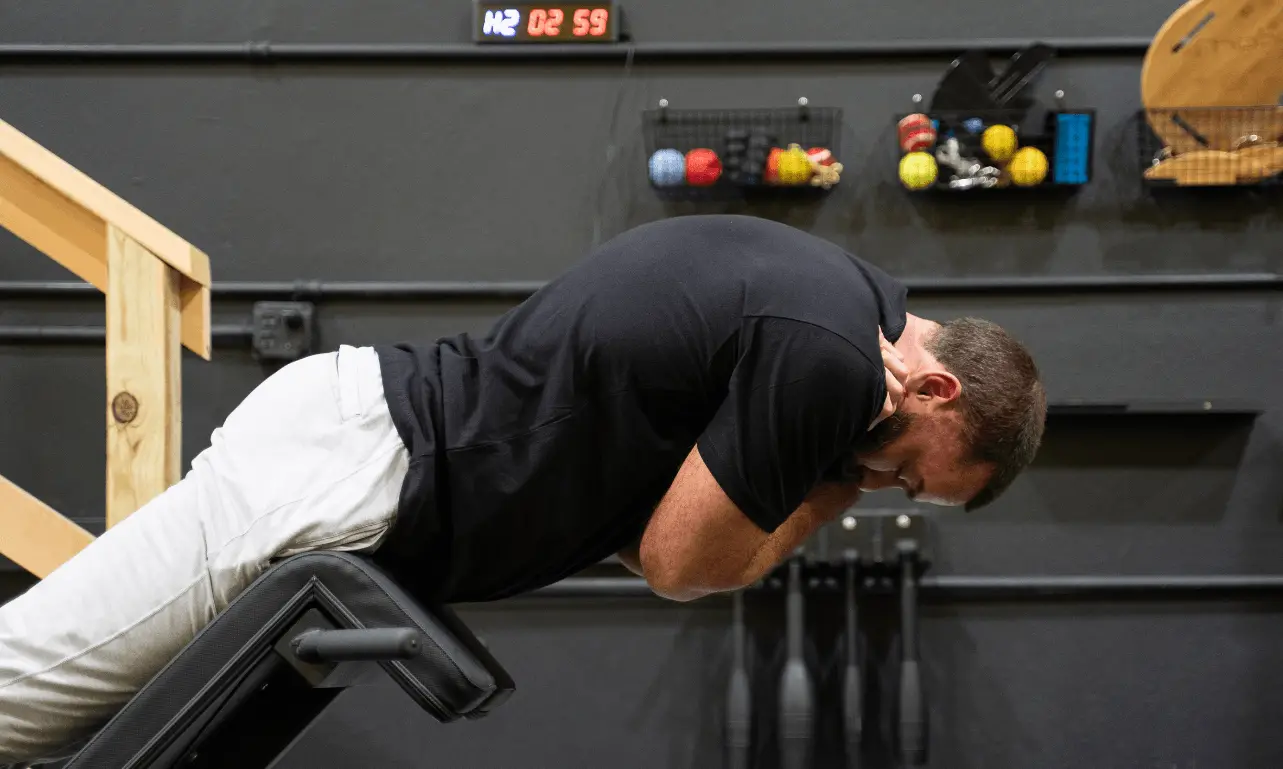
The complaint we hear most often in South Austin arrives with no injury attached to it. It is some version of feeling fine during the week and wrecked on Sunday, and the person telling us this is usually confused about it, because on paper they are one of the more active people they know.
That confusion makes sense once you look at how the week is built. A lot of this city runs a schedule where the body spends forty-plus hours in one narrow set of positions and then gets asked, on a Saturday, to produce force in a range it has not visited since the previous Saturday. Both halves of that schedule look healthy in isolation. Put together, they describe a body with a large gap between what it is conditioned for and what it periodically has to do.
The exposure gap, not the activity level
Sitting for a living does something specific. Hips park near ninety degrees, the thoracic spine settles into flexion, and the shoulders drift forward and internally rotate. The tissue crossing those joints adapts to the position it holds most, which is what adaptation means. Nothing pathological is happening. The body is doing exactly what you would expect it to do given the input it receives, and we go through the joint-level version of this in more detail in what eight hours of sitting does to your body.
Then Saturday arrives with pickleball, or a Greenbelt trail, or a group ride, and the demand profile inverts. Hip extension at speed. Thoracic rotation under load. Overhead reach with force behind it. The tissue that spent the week shortening now has to lengthen quickly while producing tension, which is the specific mechanical situation most soft-tissue injuries happen in.
The workload literature describes this pattern well. Gabbett’s work on training load found that sharp spikes in acute workload relative to what an athlete has been chronically prepared for track with elevated injury risk, and that the athletes with higher chronic loads tolerated those spikes better (1). Worth capping that claim honestly: a 2025 systematic review of the acute-to-chronic workload ratio concluded the association holds while flagging heterogeneity between studies, publication bias, and inconsistent calculation methods, and recommended caution in using the ratio as a measurement tool (2). The underlying idea that unprepared tissue does badly with sudden demand is solid. The precise number people quote for it is shakier than the confidence around it suggests.
For most people here the practical translation is simple. The problem is rarely the Saturday. The problem is the five days that failed to prepare for it.
Why stretching keeps running out
The default response to this is more stretching, and it does something. It just does something narrower than people expect.
Blazevich and colleagues put subjects through three weeks of twice-daily calf stretching and measured what changed. Dorsiflexion range went up nearly twenty percent. Passive joint moment at end range went up twenty-eight percent, meaning the ankle was holding more tension at the new range, and fascicle length did not change (3). The range improved because the subjects tolerated more stretch, and the tissue itself was largely the same tissue.
That is a useful finding rather than a damning one. More available range is worth having. The catch is that available range and usable range are separate measurements, and the gap between them is where a person gets hurt. You can stretch your way into a hip position you cannot produce force in, then walk onto a court and ask that hip for force.
Functional Range Conditioning is a system for closing that gap. Controlled Articular Rotations map and maintain what a joint can produce on its own, with no momentum and nothing else helping, which is a much smaller number than most people expect the first time they try it. Progressive and regressive angular isometric loading then loads the end position deliberately, so the nervous system gets evidence that force is available out there. If you want the mechanics of the daily piece, the CARs guide covers execution in detail.
On the evidence: FRC as a branded system has thinner direct research behind it than its enthusiasts sometimes imply, and the underlying components have decent support. That distinction matters enough that we wrote a page about it, is FRC evidence-based, and I would rather point you there than oversell it here.
Who this suits
The desk-and-weekend combination described above is the clearest fit. So is the person who trains consistently and keeps hitting a positional wall, the squat that will not get deeper, the shoulder that catches at the same point overhead every time. Assessment-driven joint work gives that person something specific to attack instead of another month of general mobility videos.
Athletes with a strong sport bias benefit for a different reason, which is coverage. A sport asks for the same handful of positions thousands of times and quietly stops asking for the rest, and the training week is where the rest gets maintained. Our sport-specific mobility work is built around that logic for golfers, cyclists, runners, and the pickleball population that has grown faster than any other group we see.
Who it suits less well
Someone in acute pain with no diagnosis needs a workup before they need a mobility program. We will assess movement and we cannot tell you what is generating your symptoms, and anyone promising otherwise from a movement screen is overreaching.
Somebody whose main problem is that they do not train at all is also a poor fit for leading with FRC. Joint capacity work is a real intervention and it is not the highest-yield thing available to a person who has not lifted anything heavy in six years. Build a base first, then get precise.
And if the goal is to feel loose for an hour, a stretching appointment delivers that at a lower price with less effort. The trade is that nothing sticks. People who are content with that trade should make it knowingly.
What the first month looks like
We assess before we program, because the passive-to-active gap at each joint is the information that decides everything downstream, and there is no way to guess it accurately from watching someone squat.
From there, a daily CARs practice runs somewhere between eight and fifteen minutes and functions as both maintenance and a self-check. The two or three joints with the widest gaps get loaded end-range work on a training schedule. Then we retest, and if a number has not moved in eight weeks the program was wrong and gets changed. That last step is the one most mobility programming skips, and skipping it is how people end up doing the same drills for two years.
If you want to know what your own numbers look like, a Functional Range Assessment is the measurement, and it is the only part of this that has to happen in person.
References
- Gabbett TJ. The training-injury prevention paradox: should athletes be training smarter and harder? Br J Sports Med. 2016;50(5):273-280.
- Qin W, Li R, Chen L. Acute to chronic workload ratio (ACWR) for predicting sports injury risk: a systematic review and meta-analysis. BMC Sports Sci Med Rehabil. 2025;17:285.
- Blazevich AJ, Cannavan D, Waugh CM, et al. Range of motion, neuromechanical, and architectural adaptations to plantar flexor stretch training in humans. J Appl Physiol. 2014;117(5):452-462.
Written by

Brian Murray, FRA, FRSC
Founder of Motive Training
Motive Training is a coaching studio in South Austin built around assessment, joint health, and strength you can use. Train with us in the studio, come to a KINSTRETCH class, or work through the progressions in KINSTRETCH Online.