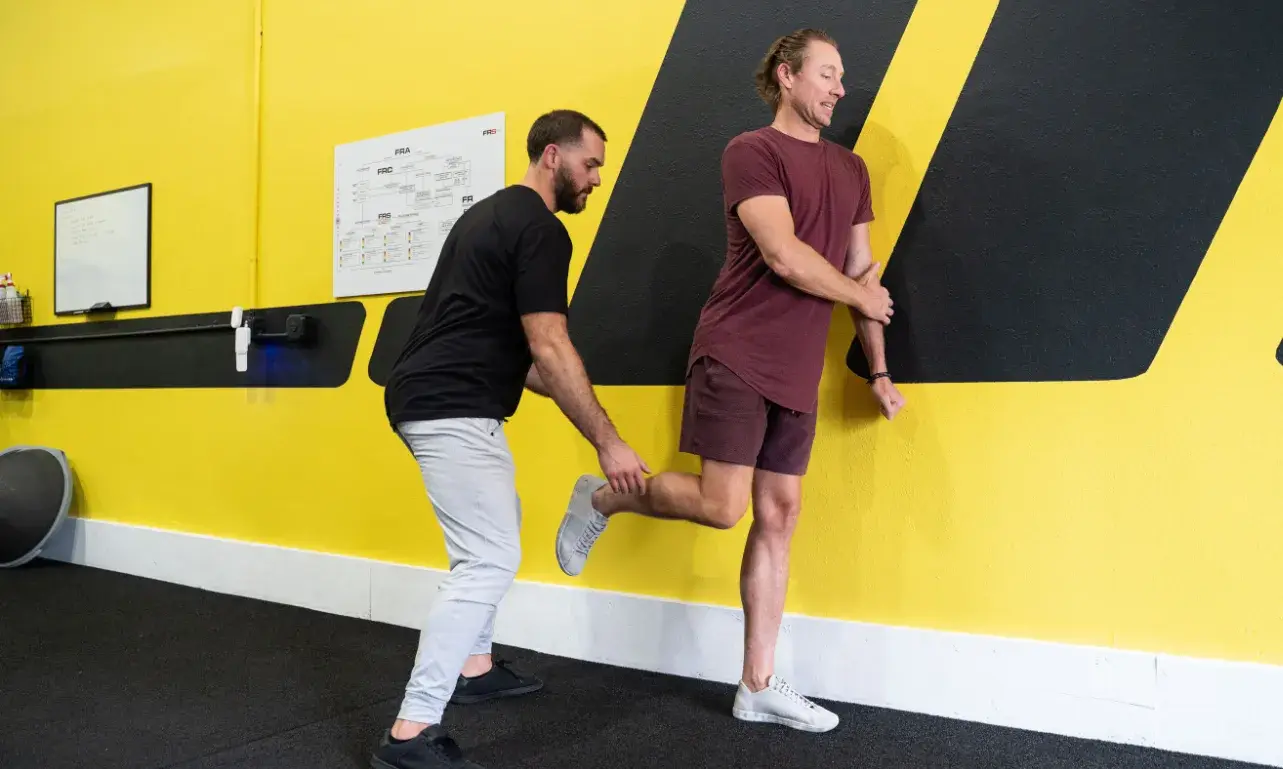
A Controlled Articular Rotation is the largest circle a joint can actively produce, moved slowly, under full muscular tension, with everything around it held still.
That definition is short and every part of it is load-bearing. Actively, so the muscles produce the arc rather than momentum carrying it. Slowly, so there is nowhere to hide. Everything else still, so the joint cannot borrow motion from its neighbors. CARs come out of Functional Range Conditioning, the joint system developed by Dr. Andreo Spina, and they are the daily practice layer of it.
This article is about why we train them. If you want to learn to perform them properly, joint by joint, with someone watching what you are doing, that is what Motive Mobility is for. Written instructions for CARs are close to useless, and I would rather tell you the truth about that than publish a paragraph of cues you will do wrong on your own.
What a joint loses when nothing asks it to move
Start with the problem, because the exercise only makes sense against it.
Cartilage has no blood supply. It gets its nutrients by diffusion through synovial fluid, and that exchange depends on the joint moving and loading. A 2025 review of cartilage architecture makes the case that prolonged sedentary behavior compromises this exchange, describing diffusion-resistant boundary layers forming at the cartilage-fluid interface during immobilization, restricting nutrient influx and slowing waste clearance (1). The paper is a narrative overview rather than a trial, and it argues for periodic joint mobilization as a countermeasure, which is a reasonable thing to argue and not the same as proving it.
Alongside that, the joint capsule itself adapts to the positions it lives in. Research on immobilized joints found that the muscular contribution to lost range tends to recover on its own once movement resumes, while the capsular contribution is irreversible or continues to worsen without intervention (2). That work comes from a rehab context with casts and surgical models, so I would not map it cleanly onto someone with a desk job. The part that survives the caveat still matters: capsular stiffness is not going to resolve just because you started moving more.
Then there is the nervous system, which will not let you actively reach a range it does not believe you can control. It brakes you short of the limit, well before any tissue is at risk, and it holds that brake until you give it a reason not to.
Spina calls the whole picture articular starvation. A joint losing capacity through disuse at end range rather than through injury. I find that a useful frame, and I would hold it as a frame rather than a proven pathway, because the mechanism is assembled from several lines of evidence rather than demonstrated in one.
What CARs are for
Three things, and only one of them is what people assume.
Exposure at end range. The joint gets taken to its actual limit, under its own power, on a regular basis. That is the input the problem above calls for, and it is the part that requires nothing but consistency.
A daily read on your own joints. This is the one that gets undersold. A CAR is a measurement you take every morning. Where the circle goes lumpy, where one side is smaller than the other, where a catch appears today that was not there last week, all of that is information you cannot get from any periodic assessment, because a periodic assessment is a snapshot and this is a running record.
Most people find something in the first two weeks that surprises them. Usually an asymmetry they have carried for years without knowing.
Control as well as range. Producing the arc under whole-body tension is a coordination demand that nothing else in a normal program creates. The nervous system has to hold tension everywhere while rotating one thing precisely. That is the difference between a CAR and a joint circle, and it is why the same shape performed relaxed does not do the same job.
Why it changes nothing to do them occasionally
Cartilage nutrition, capsular health, and the nervous system’s map of joint position are all continuous processes. They respond to regular input rather than to periodic intense input.
That is the entire argument for daily practice, and it is also why CARs are unglamorous. Ten minutes, no equipment, no soreness, no measurable session-to-session progress. The comparison to brushing your teeth is worn out and it is accurate. Nobody has a good brushing session.
What compounds is the record. Six months of daily CARs gives you a detailed sense of what your joints do, how they vary, and what changes when your training or your week changes. That is worth more than any single session of anything.
What a CAR is telling you
Restriction and stiffness at the edge of the range is normal information. That is the point of going there. Pulling or muscular effort at end range is expected and is what productive work feels like.
A catch or a click without pain is usually not a concern. Joints make noise for a range of reasons and painless noise is common.
Sharp pain, joint pain, or pain that reproduces a symptom you already recognize means reducing the range and staying inside what you can control without pain. If that pain is present throughout the arc and does not respond to backing off, it is worth getting the joint assessed rather than continuing to probe it. Mapping where restriction and pain sit at a specific joint is what the Motive Movement and Mobility Assessment is for.
There is one real exception to daily practice. An acutely injured or inflamed joint gets reduced range and reduced tension, or gets left alone. Working through acute pain was never the intent.
CARs against dynamic stretching
They look similar from outside and they are doing different jobs.
Dynamic stretching is momentum-assisted and moderately fast, the body is relaxed, and neighboring joints move freely. Its contribution is blood flow and a temporary reduction in tissue stiffness, which is useful before activity.
CARs are slow, the body is under tension, and the surrounding joints are held quiet. The contribution is active control at the joint, plus the diagnostic read.
If there is time for one, CARs cover more ground. If there is time for both, CARs first at slow tempo, then dynamic work as intensity climbs.
Where CARs sit inside FRC
CARs are the entry point and the maintenance layer. They are not the whole system, and treating them as the whole system is the most common mistake people make with FRC.
The progression is straightforward. CARs establish and maintain what you have, and show you where the range ends. PAILs and RAILs load those end ranges, using progressive isometric work to convince the nervous system that force production exists at the limit, which is what releases the brake. Hovers and lift-offs then build control in the newly available territory, where the nervous system has the least experience.
Assess, expand, reinforce. CARs are where that cycle starts every day, and everything downstream depends on the read they give you.
The question of how well those underlying claims hold up against the research is a fair one, and we took it seriously in our look at the evidence behind FRC.
Where to learn them
I meant what I said at the top. CARs are simple to describe and difficult to perform, and the failure modes are invisible from the inside. People substitute momentum for tension, let the spine contribute to a hip rotation, or shortcut the restricted part of the arc without noticing, and then wonder why nothing changes over six months.
Getting coached out of those habits takes somebody watching. Motive Mobility covers every joint with the progressions attached, and our KINSTRETCH classes here in South Austin coach the same material in a room where corrections happen in real time.
Either way, the reason to do it stays the same. Joints hold the range something asks for. If nothing asks, the range goes, and getting it back is much harder than keeping it.
References
- Del Río E. Thick or thin? Implications of cartilage architecture for osteoarthritis risk in sedentary lifestyles. Biomedicines. 2025.
- Kaneguchi A, Ozawa J. Inflammation and fibrosis induced by joint remobilization, and relevance to progression of arthrogenic joint contracture: a narrative review. Physiological Research. 2022.
Written by

Brian Murray, FRA, FRSC
Founder of Motive Training
Motive Training is a coaching studio in South Austin built around assessment, joint health, and strength you can use. Train with us in the studio, come to a KINSTRETCH class, or work through the progressions in KINSTRETCH Online.