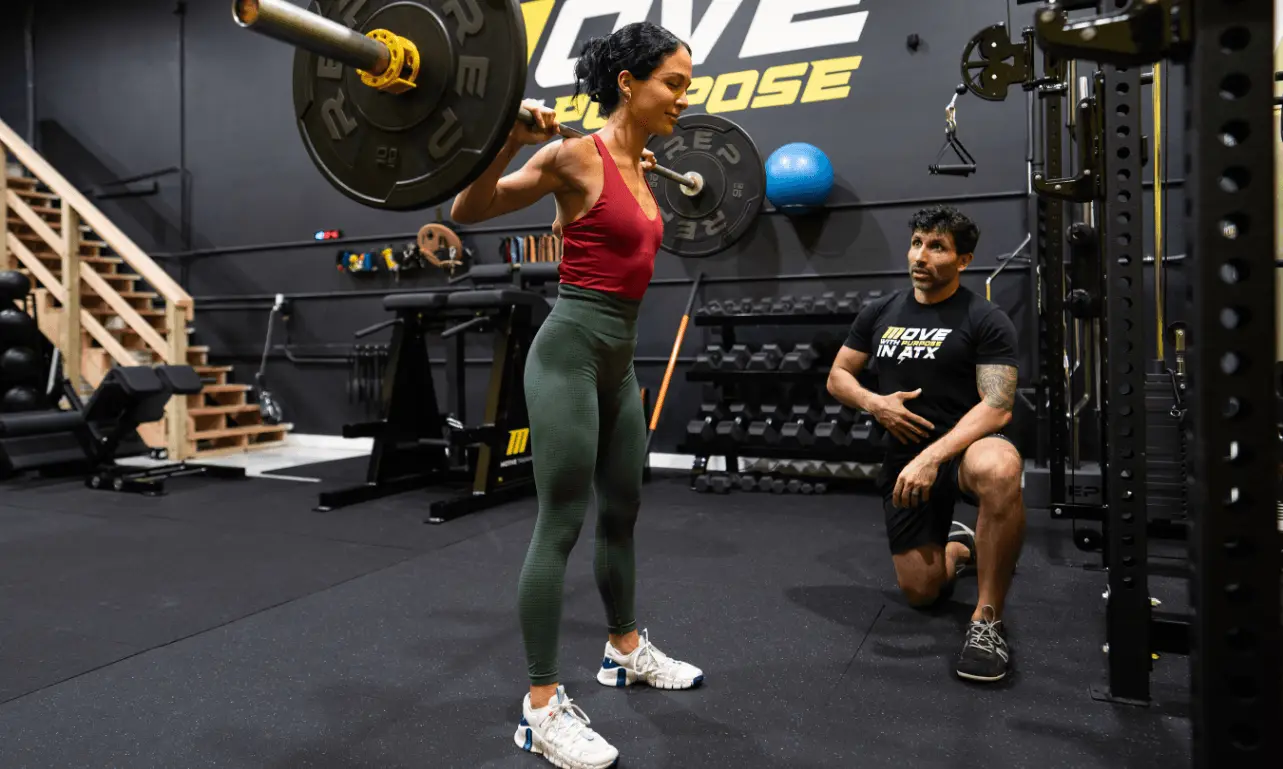
The set felt fine. The lift looked fine on video. Then three hours later your low back is tight and you cannot work out what you did.
That gap between how the reps felt and how you feel afterward is the part worth explaining, because it is not random and it is not a sign you squatted badly. Something moved during those reps that you could not feel moving.
Why the low back specifically
Every squat needs a certain total amount of motion to happen. Ankle, knee, hip, pelvis, and spine each contribute a share, and the sum has to add up or you do not reach depth.
When one joint cannot produce its share, the motion does not disappear. It gets taken from somewhere else, and the somewhere else is decided by whichever joint can give it up most easily. The lumbar spine is very often that joint, because it flexes readily and because nothing about flexing feels like a warning at the time.
This has been measured directly. A 2025 motion-capture study compared people with limited ankle dorsiflexion against people without, both doing bilateral squats. The restricted group showed greater pelvic motion in the sagittal plane, greater lumbar spine flexion, and greater forward trunk lean, all at significance (1). The ankle did not do its share, so the pelvis and the spine covered it.
That is the whole mechanism, and it explains the delayed timing too. Lumbar flexion under load is not painful in the moment. It is a position your spine can absolutely produce. What it cannot do is produce it eighty times a week for a year without the tissue that resists it getting irritated, which is why the complaint arrives after the session rather than during it.
There is a load consequence as well. Earlier work on trunk angle in the barbell back squat noted that more upright trunk positions place less stress on the low back, and found subjects were squatting with an average dorsiflexion deficit of about eleven degrees compared to their own maximum (2). Small restrictions downstream, meaningful changes in what the trunk has to do.
Squats do not create the restriction, they find it
A squat is a high-demand position under load. Depth, coordination, and stability at once. That combination is what makes it a good exercise and it is also what makes it a good test.
Most people can walk, sit, and train for years without ever meeting the edge of their hip or ankle range. A loaded squat meets it every rep. So the pattern that shows up under a bar is usually a pattern that was already there, just never under enough demand to matter.
That reframe matters for what you do next. Removing the squat removes the demand and removes the symptom, and leaves the restriction exactly where it was, waiting for the next thing that asks for range. Building the restriction and then reintroducing the squat is slower and it is the version that holds.
The four things we check
At Motive we do not open by cueing the squat. Cues change what the lift looks like without changing what the joint can do, and if the range is not there, a cue just moves the borrowing somewhere else. We start by finding the limiting factor.
Four buckets cover almost all of it.
Hip range and hip control. If the hip cannot accept the bottom position, the pelvis rotates underneath to create the last few degrees of depth, and the spine follows it. This shows up as a bottom that feels blocked, a shift you cannot explain, or a descent that is smooth until the final inches and then is not. We compare what the hip can be moved through passively against what you can produce actively, because those are different numbers and the gap between them is usually where the problem is. Then we train the hip as a joint rather than as a squat, which is the Functional Range Conditioning side of the work.
Ankle dorsiflexion. The study above is the clearest version of this. A stiff ankle does not stay an ankle problem, because the tibia has to travel forward for you to stay balanced over the midfoot, and if it will not, the torso comes forward instead or the heel comes up or the arch collapses to find the range. Any of the three changes what the low back is holding.
Range you have but cannot own under load. Some people have the range and still cannot produce force at the bottom of it. The nervous system does not trust a position it cannot control, so it finds stability somewhere it can. This is the most common version of the “fine during, tight later” complaint, and it is the one people misdiagnose as a mobility problem when it is a strength problem at end range. Daily joint work is how we start on it, and controlled articular rotations are the input we lean on because they train control rather than range.
Trunk and ribcage strategy. A brace can be strong and inefficient at the same time. The common version is starting already compressed, flaring the ribs to feel tight, and holding extension through every rep. It works until the set gets hard, and then the low back is the only thing left holding the position. The tell is that the unrack feels like the hardest part, or that you cannot take a breath at the bottom without arching, or that front squats feel obviously better than back squats.
About butt wink
Worth saying plainly, because it comes up every time.
A small amount of posterior pelvic tilt at the very bottom of a deep squat is normal and happens in people with no symptoms at all. It is not a defect and chasing it out of your squat is usually the wrong project.
What matters is how early it arrives and how much of your depth depends on it. Tilt appearing in the last inch of a very deep squat is a different thing from tilt appearing at parallel and supplying four inches of your range. The second one means your hip stopped contributing well before you thought it did.
So the question is never about the pelvis moving at all. It is how much of the squat is being paid for by the spine.
Normal soreness against a problem
Squats are demanding and some fatigue is the point. The distinction we care about is if the same thing keeps happening.
Normal tends to be general soreness through the legs and hips that improves across a couple of days, with low back fatigue that feels worked rather than guarded, and symptoms that warm up and do not escalate week to week.
The pattern worth acting on is a specific spot that gets irritated every squat session, discomfort that is getting sharper or more protective over time, or a squat you keep quietly modifying to survive. If you have changed your stance, your depth, and your shoe in the last two months, that is the signal, and it usually arrives before pain does.
What changes in training
The version of this that works is unglamorous. You reduce the demand enough to train without provoking symptoms, build the thing that is missing directly, and reintroduce the squat through a variation you can control before returning to the one you prefer.
That often means a block where your squat looks different or your depth is deliberately limited. People read that as going backward. It is closer to refusing to keep paying for depth with your spine while you build the ability to pay for it with your hip.
Restrictions somewhere else showing up as a back complaint is common enough that it is worth reading about on its own, and we went into why back pain often is not a back problem separately.
When an assessment is faster than guessing
If this has been going on for more than a few weeks, or it is escalating, or it is dictating how you train, the fastest route is measurement.
A joint-by-joint assessment tells you which joint is short, if that is a range problem or a control problem, and how big the passive-to-active gap is at each one. That last number is what makes the plan specific, because a hip that lacks twenty degrees of flexion and a hip that has the flexion but cannot produce force in it need opposite work. The full breakdown of that process is worth reading if you want to know what an hour of it involves.
If you want structured joint work you can repeat on your own between sessions, KINSTRETCH is built around exactly this problem.
A note on red flags
Numbness, tingling, pain radiating down a leg, loss of strength, any change in bowel or bladder control, or pain that is severe and getting worse quickly are all reasons to see a qualified medical professional rather than a coach. None of what is above applies to those.
Common questions
Why does my back hurt after squats but not during?
Lumbar flexion under load does not hurt while it is happening; it is a position your spine can produce without complaint. The irritation comes from accumulated exposure, which is why it shows up once you have cooled down rather than mid-set.
Should I stop squatting?
Usually not. Changing the demand is different from removing it, and most people do better reducing depth or load, building the limitation, and progressing back than they do avoiding the lift for two months and returning to the same restriction.
Is butt wink causing this?
Sometimes, and only when it is early and large. A small amount of posterior tilt in the last inch of a deep squat is normal. Tilt supplying several inches of your depth is the hip handing work to the spine.
Will heeled shoes fix it?
They will change what the lift looks like immediately, and for a lot of people that is a reasonable short-term choice. They do not build ankle range, so the restriction is still there in every other position that asks for dorsiflexion, including running and stairs.
References
- Zawadka M, et al. Effect of limited ankle dorsiflexion on lower limbs and trunk kinematics during squatting. Journal of Manipulative and Physiological Therapeutics. 2025.
- Fuglsang EI, Telling AS, Sørensen H. Effect of ankle mobility and segment ratios on trunk lean in the barbell back squat. Journal of Strength and Conditioning Research. 2017.
Written by

Brian Murray, FRA, FRSC
Founder of Motive Training
Motive Training is a coaching studio in South Austin built around assessment, joint health, and strength you can use. Train with us in the studio, come to a KINSTRETCH class, or work through the progressions in KINSTRETCH Online.