What Actually Changed Since I Told My Story
A while back I wrote about how I got into this work in the first place. That piece ends somewhere in the past. This one picks up more recently, when the business itself needed the same kind of correction I’d apply to a client’s training program. Nothing about it looked broken from the outside. Two locations, a full training schedule, steady growth. But I’d stopped moving toward anything in particular; I was just maintaining what already existed.
That’s a specific kind of stuck that’s easy to miss when you’re the one running it, because busy looks like progress from the inside. It took stepping back from the day to day to see that the calendar was full and the direction wasn’t.
Opening Motive Training ATX Meant Choosing Depth Over Reach
When I moved to Austin, the plan wasn’t to build a bigger version of what already existed. It was to build one studio that actually reflected how I wanted to coach, without the compromises that come from running two locations a thousand miles apart.
Motive Training ATX started small in South Austin, and it stayed that way on purpose. No flashy build-out, no attempt to look like a big-box gym with better branding. Just the coaching model I actually believe in: assessment first, joint health treated as foundational rather than an afterthought, and programming built around what someone’s body can actually do right now, not what a template assumes they can do.
Selling Grand Rapids Wasn’t a Retreat
Motive started in Grand Rapids, and I’m not going to pretend that doesn’t matter to me. But running two studios across the country meant neither one got my full attention, and coaching quality is the first thing that erodes when attention gets split. I felt it in the sessions. I felt it in how much I was reacting instead of building.
Selling the Grand Rapids location wasn’t about giving up on it. It was about admitting that trying to be excellent in two places at once was actually keeping me from being excellent in either. Once that studio was off my plate, Austin stopped being one of two priorities and became the only one.
Doubling Down on Assessment Based Coaching
The industry runs on programs that look impressive and don’t ask a single question about the person doing them. That’s never been the model here, and it matters more now than it did when we were spread across two cities.
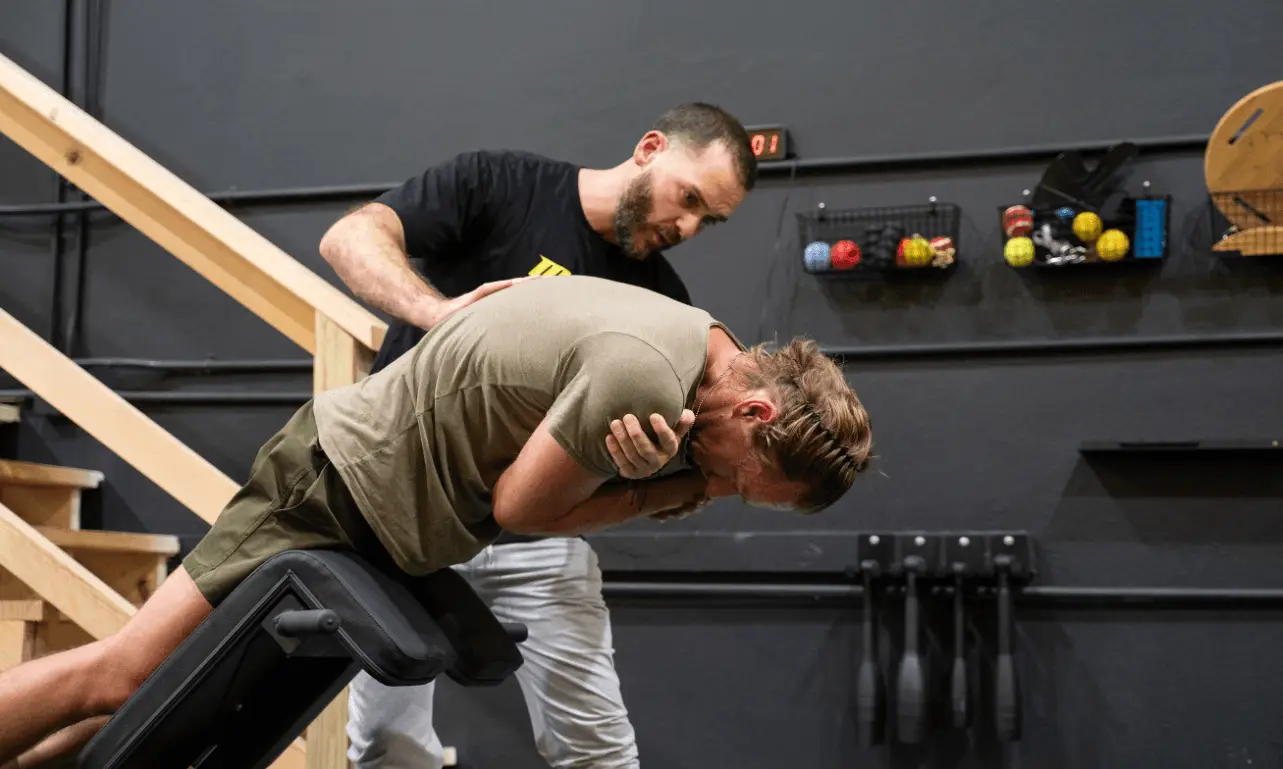
Every client goes through a real assessment before we write a single session. If a shoulder doesn’t rotate the way it should, we find out why before we load anything overhead. If someone’s hips are the limiting factor in their squat, we work the hip first instead of cueing around it forever. This isn’t a marketing point; it’s just how Functional Range Conditioning (FRC) works when you actually apply the assessment piece instead of skipping straight to programming.
Running KINSTRETCH for Real, In Person and Online
The biggest shift in how we train people has been how seriously we’ve built out KINSTRETCH. We run live classes every week; small groups, hands-on coaching, built around how joints actually move rather than a fixed sequence of poses. As far as I’ve found, we’re the only studio in Austin running ongoing KINSTRETCH classes like this. There’s at least one other gym offering a short KINSTRETCH series, which is a different thing than a class that’s actually running week to week, building on itself.
We also built out KINSTRETCH Online so people who can’t get to the studio still get the joint-by-joint programming instead of a generic stretching routine repackaged with better marketing. If you’ve taken a real KINSTRETCH class, you already know it doesn’t feel like anything else on a group fitness schedule. If you haven’t, that’s the gap this fills.
Adding WeckMethod and Rotational Training
Over the past year I’ve layered WeckMethod and rotational movement training into the system: rope flow, coiling core work, landmine rotations done with actual intent behind them. I didn’t add this because it photographs well. Spinal engine theory holds that the spine isn’t just a stack of vertebrae holding weight; it’s part of the mechanism that drives efficient gait, and most training completely ignores that in favor of pure sagittal plane work, squat and hinge and press, nothing that asks the trunk to rotate under control.
FRC gave us structure and end range control. WeckMethod adds the piece that’s harder to program directly: timing, rhythm, and the kind of coordinated rotation the body actually uses to walk, throw, and change direction. Together they cover more of what a body needs than either one does alone, and I’ve watched clients access rotational movement in their first session that they hadn’t felt since they were kids, some of them for the first time they can remember.
What Hasn’t Changed
The coaching philosophy is the same one I started with. Assess before you program. Train pain out instead of around it. Treat joint health, mobility, and strength as one system instead of three separate boxes to check.
What’s different is that we’re doing all of it with a studio built to actually support it, instead of stretching the same attention across two cities and hoping the model held up anyway.
Written by

Brian Murray, FRA, FRSC
Founder of Motive Training
Motive Training is a coaching studio in South Austin built around assessment, joint health, and strength you can use. Train with us in the studio, come to a KINSTRETCH class, or work through the progressions in KINSTRETCH Online.