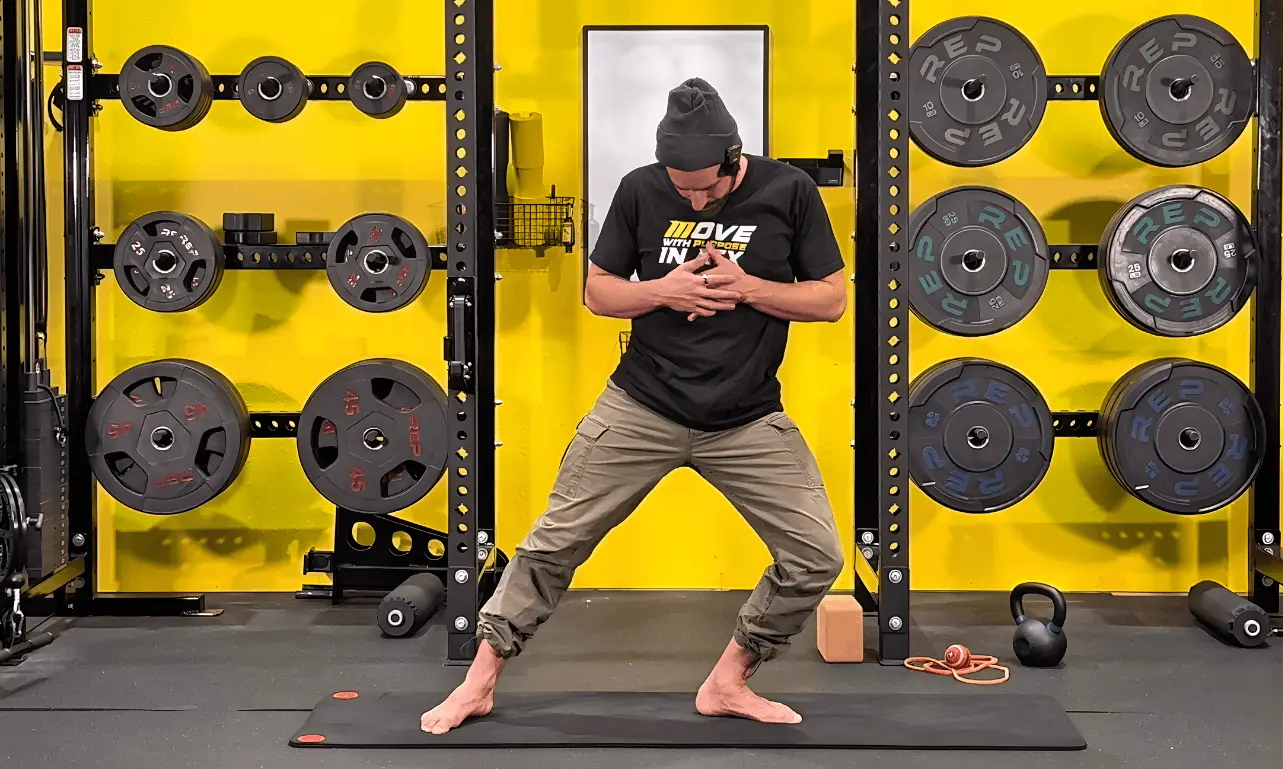
Why We Send New KINSTRETCH Clients to Their Ankles First
A stiff ankle rarely announces itself as an ankle problem. It shows up as a knee that aches on the way down in a squat, a calf that stays tight no matter how much you roll it, a stride that feels shorter than it used to. By the time someone connects the dots, the compensation has usually been running for years, quietly rerouting load to a hip or a lower back that was never built to cover for a joint two segments away.
That routing is the reason we start almost every new KINSTRETCH client at the ankle. Nobody walks into a gym asking for more ankle work the way they ask for more shoulder mobility or hip openers, and it rarely gets a second thought until something above it starts complaining. But it’s the joint doing the most unglamorous work in the chain, absorbing force the instant your foot hits the ground and transferring it back out through the rest of the leg on the way to the next step. When it can’t do that job well, something upstream picks up the slack, and that’s usually where the complaint shows up.
We built a free class on YouTube around exactly this joint. It’s become the first thing we point new members to, before they touch anything else in the system.
Free Class: Ankle Mobility Foundations
What Most Ankle Content Gets Wrong
Search ankle mobility and you’ll get a hundred versions of the same drill: stand on a step, drop the heel, hold for thirty seconds, repeat. Foam roll the calf first if you want to feel extra thorough about it. That approach can make the ankle feel looser walking out of the session. The heel drops a little further. The calf feels a little less like a rubber band pulled tight.
The problem is that nothing about that process asks the nervous system to do anything with the new range. You loosened tissue. You didn’t teach the joint how to use the space you just bought. Passive stretching works on a simple mechanism: hold a position long enough and your tolerance to that stretch improves, so the same range feels less uncomfortable. What doesn’t change is your ability to actively control that range under load, which is the thing that matters when you’re cutting on a pickleball court or catching a barbell in a deep squat. The gap between what you can passively access and what you can actively control is where most non-contact ankle and knee injuries live.
Coach Andres built this class around a different question than the one most ankle content is answering. Not how far can you push the joint, but can you produce tension and rotate through its full workspace on your own, with control, without anyone pushing on you. That question comes straight out of Functional Range Conditioning, where mobility gets trained as a skill the joint has to earn through strength and coordination, one controlled rotation at a time instead of one longer hold.
How the Class Is Sequenced
The session opens with Controlled Articular Rotations through the full ankle, taking the joint through its complete rotational workspace before asking anything harder of it. This step gets skipped constantly in general mobility content, which tends to jump straight to a stretch or a loaded position without ever mapping what the joint can do on its own. You can’t train control in territory you haven’t identified yet.
From there the class narrows into capsule-focused rotations that isolate inversion and eversion specifically. These are the two motions most people have never trained on purpose in their life, and they’re the ones that quietly limit how well an ankle handles uneven ground, a lateral cut, or catching yourself when a step goes sideways. Most training programs live entirely in the sagittal plane, which is fine for forward locomotion and leaves this entire slice of ankle function untouched.
Once that map exists, isometric holds at end range, what KINSTRETCH calls PAILs and RAILs, push the actual boundary of what the joint can access with strength behind it instead of just passive stretch. This is the step that separates the class from a stretching routine. Holding an isometric contraction at the outer edge of a range signals to the nervous system that the range is safe to use, because it proves you can hold that range under your own strength, on command. Liftoffs follow that, asking the ankle to actively hold the new position off the ground instead of resting into a prop or a wall. The class closes with light banded loading, which is where the new range starts to look like something you can use in a squat, a run, or a step off a curb, instead of something you only have on a mat in a quiet room.
Each piece sets up the next one, and none of it is arbitrary. Skip the earlier steps and jump straight to loaded work, and there’s nothing underneath it. That’s the same mistake a lot of general population ankle content makes when it borrows a single exercise out of a larger system and presents it as the whole answer.
Who Should Start Here
Stiff ankles, limited dorsiflexion, a calf that always feels tight no matter how often you stretch it. That pattern is exactly what this class addresses, and it’s a more common starting point than people expect once they test it.
Runners tend to notice the change fastest, because ankle restriction shows up directly in stride length and you can feel the difference within a session or two of doing this work consistently. Lifters notice it in squat depth and in how the bar path organizes itself on the way down, since a restricted ankle often forces the knees or the trunk to compensate to reach depth. People who spend most of the day in shoes with any kind of raised heel, which covers a lot of the working population, tend to be the most restricted of anyone who walks through the door, and often the most surprised by how much changes once the joint starts moving under its own control instead of borrowed range from a shoe.
You don’t need existing flexibility to start this class, and you don’t need much equipment. A yoga block and a light resistance band help with a couple of the positions, but neither is required. The work is in the intent behind each rotation and each hold, not in what gear is sitting next to your mat.
Where This Fits Inside KINSTRETCH Online
This class is one session pulled out of a much larger library inside KINSTRETCH Online, organized around the same logic throughout: joint by joint, with each session building capacity you can layer week over week instead of a random rotation of drills that happen to target the same body part. You could do a different hip video every day for a month and still have no idea if you’re getting better at anything, because nothing about that approach is progressive. The system underneath KINSTRETCH is built so that this week’s session is standing on last week’s.
The ankle is where we start most new members inside that system, partly because it’s foundational to almost everything trained afterward, and partly because the feedback is fast enough to be convincing on its own. Someone can be skeptical about mobility training in the abstract and still notice, within a single session, that their ankle feels different moving through a range it didn’t have access to an hour earlier. Once that happens once, the rest of the system stops being an abstract promise and starts being something worth showing up for consistently.
Pay attention to how the joint feels the day after this class, not only during it. The during is real, but the after is usually where the actual signal is.
Written by

Brian Murray, FRA, FRSC
Founder of Motive Training
Motive Training is a coaching studio in South Austin built around assessment, joint health, and strength you can use. Most clients start with the Movement & Mobility Assessment. From there, train with us in the studio, come to a stretching class, or work through the progressions in KINSTRETCH Online.