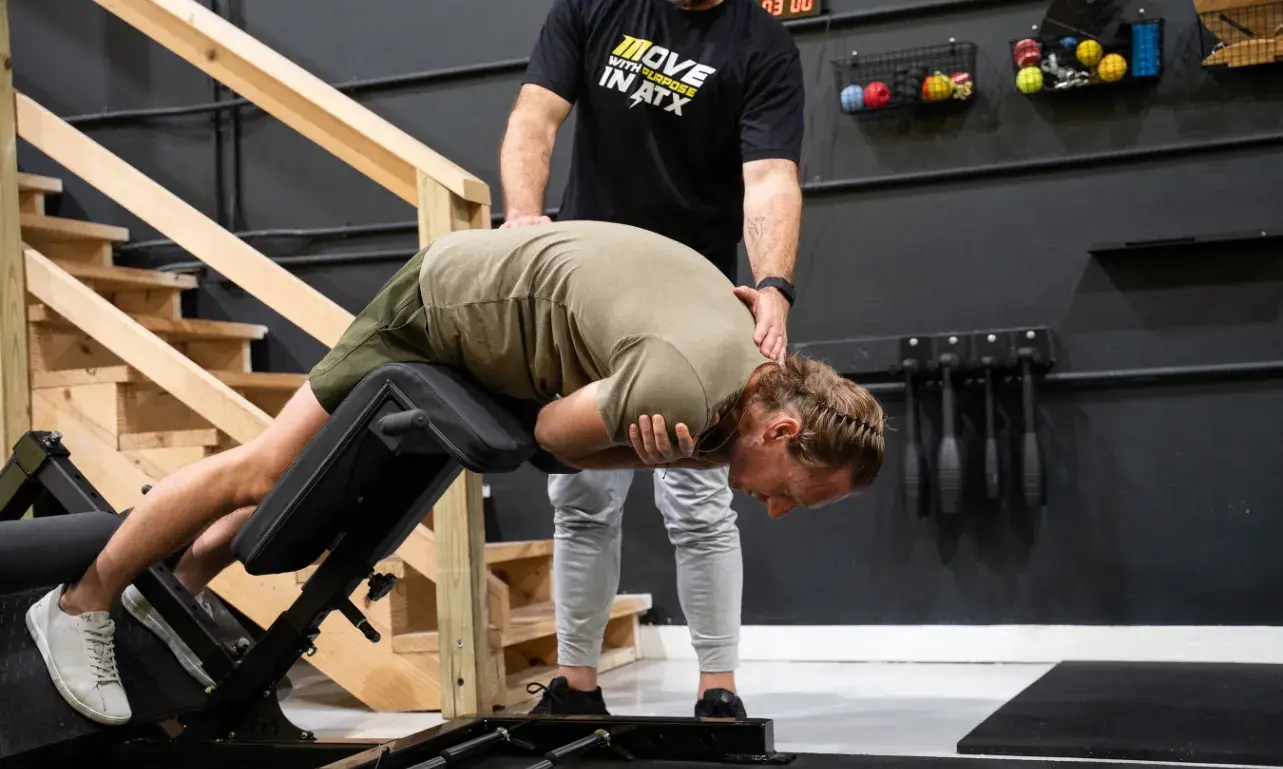
TL;DR: Prolonged sitting doesn’t just cause stiffness. It drives adaptive shortening in the hip flexors, loads the lumbar spine unevenly, rounds the thoracic spine into sustained flexion, and compresses the cervical spine under forces it was never designed to handle for hours at a stretch. The body adapts to what it does most. For most adults in desk-heavy jobs, that means adapting to a posture that creates compounding problems in training and daily life.
What Does Sitting All Day Actually Do to Your Body?
Eight or more hours of daily sitting drives predictable structural adaptations: hip flexors shorten, glutes become inhibited, the thoracic spine stiffens into kyphosis, and the cervical spine bears excessive compressive load from forward head position. These aren’t temporary discomforts. They’re the body adapting to its most frequent position.
Most people who sit for a living know something feels off. The hips feel tight by mid-afternoon. The neck aches by the time the laptop closes. The lower back that was fine at thirty is now a recurring problem at forty-two. What’s less clear is the mechanism behind all of it—what’s actually changing in the tissue, in the joints, and in how the nervous system controls movement.
Understanding that clearly matters, because the standard advice—get up and stretch every hour, do some hip flexor stretches before bed—addresses the symptom without touching the underlying adaptation. If you want to actually change the pattern, you need to understand what the pattern is.
What Happens to Your Hips When You Sit for Hours
The hip flexors are among the most affected tissues in a desk-bound body, and the mechanism is straightforward. The iliopsoas, the primary hip flexor, runs from the lumbar vertebrae and ilium down to the femur. In a seated position, it sits in its shortened state for hours. Tissue that spends most of its time short adapts to be short. This is not pathology—it’s normal biological adaptation. The problem is where that adaptation leads.
Shortened hip flexors create anterior pelvic tilt. The pelvis tips forward, the lumbar spine hyperextends to compensate, and the glutes—which should be the primary hip extensors—become reciprocally inhibited. They don’t turn off entirely, but their ability to generate force at the ranges where you actually need them, in a lunge, a deadlift, climbing stairs, diminishes. The hip flexors are pulling from the front while the glutes progressively lose their authority from behind.
This is one of the main reasons tight hips are so persistent in people who train consistently but sit for most of the day. They may be doing hip mobility work in the gym, but they’re spending eight times as many hours reinforcing the pattern they’re trying to undo. The adaptation wins by volume.
The hip capsule compounds the problem. Joint capsules adapt to the ranges they’re routinely asked to inhabit. A hip that spends most of its time in flexion, with limited excursion into extension and internal rotation, develops capsular tightening in those restricted directions. This is different from muscular tightness and responds differently to training. Static stretching can temporarily change perceived tightness in the muscle, but it does relatively little for capsular restriction. That requires active end-range loading, which is a fundamentally different kind of work.
What Happens to Your Thoracic Spine
The thoracic spine has a natural curve, and a mild kyphosis is normal and appropriate. What prolonged sitting does is push that curve toward the extreme end of its range and hold it there for hours. Over time, the tissues on the posterior side of the thoracic spine adaptively lengthen, the anterior structures shorten, and the vertebral segments lose their ability to move independently through rotation and extension.
Thoracic restriction matters well beyond the mid-back. The thoracic spine and the shoulder girdle are mechanically linked—when the thoracic spine can’t extend or rotate, the scapulae can’t move through their full range, and the shoulder joint is forced to compensate. This is a common driver of shoulder impingement patterns and rotator cuff irritation that people attribute to their training without recognizing the desk posture upstream.
Thoracic stiffness also directly increases demand on the lumbar spine. The lumbar spine has minimal rotational capacity by design. When the thoracic spine stops contributing its share of rotation during everyday movements, the lumbar spine absorbs that demand instead. Multiply that across thousands of repetitions of reaching, turning, and bending and you have a predictable load accumulation at a region that was never built for high-rotation demands. The back pain that shows up isn’t coming from nothing—it’s coming from a mechanical arrangement the desk posture built over months and years.
What Happens to Your Neck and Shoulders
Forward head posture is nearly universal in desk workers, and the physics behind it are worth understanding. The average head weighs ten to twelve pounds in neutral position. For every inch the head moves forward from that neutral, the effective load on the cervical spine roughly doubles due to the leverage effect. At a moderate forward tilt, the cervical spine may be managing forces equivalent to thirty or forty pounds rather than twelve.
The upper trapezius, levator scapulae, and suboccipital muscles work constantly to hold the head in that forward position. They don’t fatigue dramatically—they just stay chronically active, which is why the upper traps in desk workers are often palpably dense and tender. Meanwhile, the deep cervical flexors, the muscles that should be doing the stabilization work at the front of the neck, become progressively inhibited. The neck is essentially being held up by its extensors while its stabilizers go quiet.
This pattern has a well-documented downstream effect: neck pain, headaches, and restricted cervical range of motion that most people manage with ibuprofen or massage rather than addressing the underlying postural load. The massage may provide temporary relief by reducing tone in the overworked muscles. It doesn’t change what those muscles are doing eight hours a day.
The shoulders follow a related pattern. Sustained keyboard and mouse work keeps the shoulders in mild internal rotation and protraction. The pectorals and anterior deltoids shorten adaptively. The rhomboids and lower trapezius, which should be providing posterior stability, lengthen and weaken. The result is a shoulder girdle that’s pulled forward and inward, with limited capacity to achieve the posterior stability needed for overhead movements, pressing, or pulling.
Why Stretching Alone Doesn’t Fix This
Most desk workers who’ve tried to address these issues have reached for stretching first—a hip flexor stretch before a run, a doorway chest stretch in the morning, some neck rolls at the desk. These aren’t useless, but they’re addressing the wrong layer of the problem for lasting change.
The issue with prolonged sitting isn’t purely muscular tightness. It’s a combination of adaptive tissue shortening, capsular restriction, altered motor patterns, and nervous system habituation to a particular positional range. Static stretching can temporarily change perceived tightness by increasing stretch tolerance. It does significantly less to change capsular restriction, restore motor patterns, or teach the nervous system to actually use ranges it’s been avoiding.
Foam rolling has similar limitations. It can reduce tone in overactive tissue and improve local circulation, both of which feel good and have some value as part of a warm-up. But the effect is temporary, lasting minutes rather than hours, and it doesn’t address the control deficits that make the restriction persist. You can roll your hip flexors for ten minutes and still have a hip that lacks active control at end-range extension, which is the range that matters for athletic movement and injury resilience.
What actually changes the pattern is active end-range training: teaching the joint to move through the ranges it’s lost and building the capacity to generate force there. That requires a different approach than most desk workers have been given.
What to Do About It: An Active Mobility Framework
The response to desk-driven restriction has to be proportionate to what’s creating it. Eight hours of daily positional loading requires a training approach that systematically addresses each affected region with active work, not just passive length change.
Controlled articular rotations are the most practical starting point for most people. Hip CARs take the hip joint through its full available range under active muscular control, maintaining tension throughout the movement to signal the nervous system that this range is accessible and safe. Thoracic CARs work the spinal segments through rotation with the same intent. Cervical CARs address the neck’s movement capacity. Done daily, even for ten to fifteen minutes, CARs serve as both an assessment tool—you’ll notice which ranges feel restricted or controlled differently than others—and a maintenance practice that directly counteracts the positional demands of the day.
PAILs and RAILs build on that by developing strength at end range, which is where the desk-adapted body is most deficient. Hip extension PAILs load the hip flexors at their lengthened position and signal the nervous system that force production is required there. This is categorically different from stretching the hip flexor, because it introduces a training stimulus rather than just a length change. Over time, this is what converts a restricted range into a usable one.
The thoracic spine responds well to active rotation work combined with extension loading. Scapular CARs and shoulder CARs address the shoulder girdle restriction that follows from thoracic stiffness. The cervical spine needs controlled active movement through flexion, extension, rotation, and lateral flexion—not aggressive stretching, but deliberate, controlled excursion through full range.
For Austin desk workers specifically, the pattern is compounded by the reality of the work culture here. Long hours at high-output jobs, often without structured movement breaks, mean the positional load accumulates consistently. If this is your situation and you want a structured approach rather than a piecemeal one, KINSTRETCH Online is designed exactly for this: systematic active mobility training you can do on your own schedule, built around the same FRC methodology we use in studio.
How Much Does This Matter for Training?
If you strength train, run, or play a sport, the desk adaptations matter for performance as much as for pain. A hip that can’t extend fully will limit your stride and your ability to produce force through hip extension patterns in the gym. A thoracic spine that can’t rotate will limit your rotational power and your overhead position. A shoulder girdle held in protraction will create instability in pressing and pulling movements that no amount of accessory work fully compensates for.
This is why athletes and active adults who also have desk jobs often plateau in ways that seem unrelated to their training. The restriction isn’t showing up as obvious pain—it’s showing up as a ceiling on performance that proper mobility work would remove. A functional range assessment makes this visible by measuring exactly how much gap exists between passive and active range at each joint, which tells you specifically where the training response is being limited.
The desk job and the training life don’t have to work against each other. But they will by default unless the positional demands of one are specifically addressed in the other.
What This Looks Like Over Time
The adaptations from prolonged sitting don’t happen overnight, and they don’t reverse overnight either. What tends to happen is that the pattern builds gradually and then becomes visible through a series of thresholds: the hip that starts feeling tight in the morning, the shoulder that starts clicking during pressing, the lower back that goes from occasional to reliable.
By the time most people seek help, the pattern has been consolidating for months or years. That doesn’t make it irreversible—the tissue and nervous system remain adaptable throughout adult life—but it does mean the training response needs to be consistent and targeted rather than occasional and general. Ten minutes of deliberate active mobility work daily, focused on the regions most affected by your specific movement diet, produces more change over six months than an hour of random stretching on weekends.
If you’re dealing with the downstream effects of a desk-heavy workload and want to understand specifically what your body has adapted to and what to do about it, that’s exactly what we assess and build programs around. The pattern is common. The response doesn’t have to be generic.
Frequently Asked Questions
How many hours of sitting per day is harmful? Research suggests that sitting for more than six to eight hours daily is associated with increased risk of musculoskeletal complaints, metabolic changes, and movement quality decline. The specific threshold varies by individual, but most adults in full-time desk roles exceed it. The issue isn’t sitting itself but sustained, uninterrupted sitting without adequate active movement to counteract the positional demands.
Can you reverse the effects of sitting all day? Yes, but the approach matters. Passive stretching produces limited lasting change because it doesn’t address the full picture: capsular restriction, motor pattern changes, and nervous system habituation. Active end-range training through methods like CARs and PAILs/RAILs produces more durable change by introducing a training stimulus rather than just a length change. Consistency over weeks and months is what actually shifts the adapted pattern.
What is the best exercise to counteract sitting? There isn’t a single best exercise. The most effective approach addresses each affected region systematically: hip extension and rotation, thoracic rotation and extension, cervical mobility, and scapular movement. Controlled articular rotations cover this efficiently across multiple joints. For most desk workers, ten to fifteen minutes of CARs daily is more effective than longer but less targeted stretching sessions.
Why do my hips feel tight even though I stretch them? Perceived tightness after stretching often returns because stretching primarily changes stretch tolerance rather than the underlying capsular restriction or motor pattern. The hip may have adequate passive length but lack active control at end range, which means the nervous system continues to limit access to that range as a protective measure. Building active strength at end-range hip positions is what changes the nervous system’s assessment of that range as safe to use.
Is neck pain from sitting a serious problem? Neck pain from desk work is extremely common and often undertreated. The cervical spine bears significantly more compressive load in forward head position than in neutral, and the sustained muscular activation required to hold that position creates chronic overload patterns in the upper trapezius and suboccipitals. Left unaddressed, this pattern can contribute to cervicogenic headaches, restricted rotation, and referred pain into the shoulders and arms. Active cervical mobility training and thoracic extension work address the root of the pattern more effectively than symptom management alone.
How is KINSTRETCH different from yoga for desk workers? Both involve deliberate movement and address restricted ranges. The key difference is the emphasis on active muscular control throughout the range rather than passive end-range holds. KINSTRETCH trains the nervous system to own the range by requiring active tension at positions where most people simply relax into a stretch. For desk workers specifically, this distinction matters because the restriction isn’t just about tissue length—it’s about the nervous system’s willingness to use ranges it’s been avoiding. Active training changes that assessment; passive stretching changes it less reliably.
Written by

Brian Murray, FRA, FRSC
Founder of Motive Training
Motive Training is a coaching studio in South Austin built around assessment, joint health, and strength you can use. Train with us in the studio, come to a KINSTRETCH class, or work through the progressions in KINSTRETCH Online.