Most people don’t come to a coach because they want new exercises.
They come because something isn’t working.
Pain keeps showing up.
Progress feels inconsistent.
Movement feels harder than it should.
By the time someone walks through our door, they’ve usually tried plenty of workouts already. They don’t need more ideas—they need clarity.
That’s why we don’t just give people exercises.
Exercises Are Tools, Not Solutions
Exercises aren’t the problem. Most exercises work under the right conditions.
The issue is how often exercises are treated as solutions instead of tools.
When someone says their shoulders hurt, they’re handed shoulder exercises. When their hips feel tight, they’re given hip drills. When progress stalls, variety gets added.
This assumes the missing piece is the right movement.
More often, the missing piece is understanding how the body is organizing movement in the first place.
Without that context, exercises become educated guesses at best—and noise at worst.
Movement Problems Follow Patterns
Bodies don’t fail randomly.
Over time, joints lose usable range. Certain positions stop feeling safe. The body learns to work around those limitations. Load gets shifted instead of absorbed.
Eventually, discomfort shows up—not because something is “broken,” but because the system is running out of options.
If you skip that process and jump straight to exercises, you’re often reinforcing the same patterns that created the issue. That’s why problems disappear briefly and then return.
Why We Start With How You Move, Not What You Do
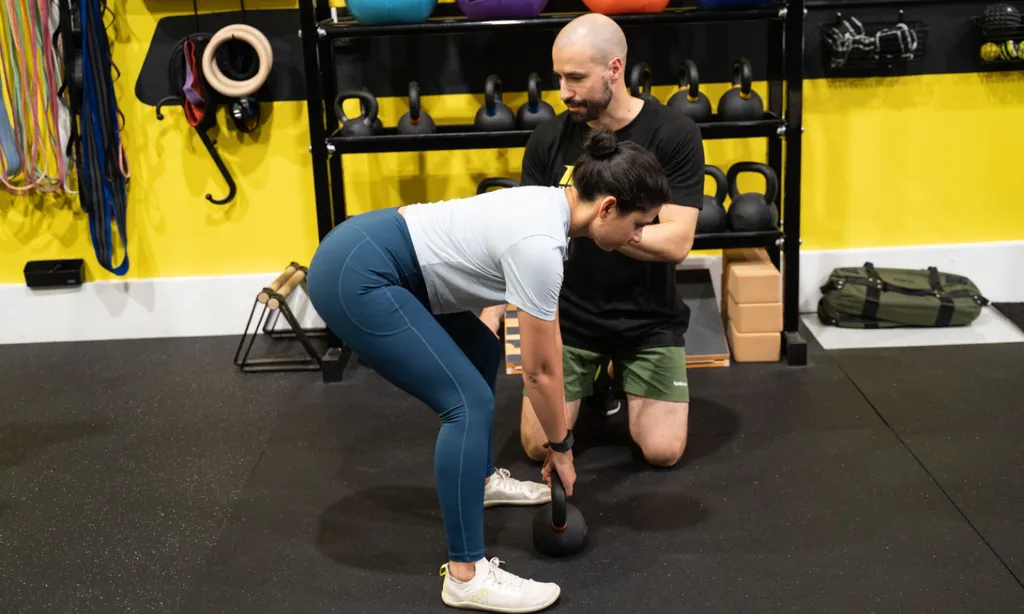
Before deciding what someone should do, we care about how they’re doing it.
That’s why our coaching is grounded in principles from Functional Range Conditioning—a system focused on joint-specific capacity, control, and resilience.
Understanding joint behavior changes everything.
Two people can have the same complaint and need entirely different inputs. One might need more rotational capacity. Another might need better control through range. Giving both the same exercises makes no sense.
Context determines strategy. Exercises come later.
Why Random Programs Feel Busy but Don’t Stick
Most generic programs are designed for averages. Real people aren’t averages.
When a plan isn’t built around your specific limitations, a few things tend to happen. You gravitate toward movements that feel strong. You avoid positions that feel unstable. You get better at what you already do well and stay limited where you don’t.
Over time, that gap widens.
This is why people feel “in shape” but still fragile—or strong but constantly stiff. The program never addressed the limiting factor.
Intent Is What Makes an Exercise Effective
The same exercise can produce very different outcomes depending on intent.
A mobility drill can be about expanding range, reinforcing control, or simply maintaining capacity. A strength exercise can build output, resilience, or positional awareness. Without a clear goal, the exercise becomes vague movement instead of a targeted input.
This is why we don’t separate mobility and strength into different silos.
Our approach integrates intent-driven movement through systems like KINSTRETCH, where positions, effort, and control matter more than chasing sensation or fatigue.
Exercises are chosen for what they’re meant to change—not because they look good or feel productive.
Why Pain Often Improves Without Chasing It
One of the biggest misconceptions in training is that pain must be attacked directly.
In practice, pain often improves when the body becomes more capable.
When joints move through controlled ranges, load spreads more evenly. When positions feel safer, the nervous system doesn’t guard as aggressively. When movement becomes predictable, confidence returns.
This is why mobility-focused systems like KINSTRETCH are so effective for people who’ve already “tried everything” and still feel limited.
Coaching Is Decision-Making, Not Exercise Libraries
Good coaching isn’t about having a long list of exercises. It’s about making good decisions over time.
That includes knowing when to:
- Expand range versus reinforce control.
- Load tissue versus reduce exposure.
- Push adaptation versus build safety.
- Progress versus hold steady.
Those decisions evolve as the body adapts. Exercises change because the person changes—not because boredom sets in.
What This Looks Like in Real Training
Training at Motive isn’t about doing everything. It’s about doing what matters most right now.
Some phases emphasize joint-specific work. Others prioritize strength expression. Some focus on integration and flow. All of them are driven by intent and feedback, not templates.
This philosophy carries through every part of how we coach, including our mobility training in South Austin, where the goal isn’t just to move more—but to move with purpose.
The Bottom Line
Exercises don’t solve problems on their own.
Understanding movement does.
When you know how a body organizes motion, where it lacks options, and what it needs next, exercises become powerful tools instead of random attempts.
That’s why we don’t just give you exercises.
We give you decisions that make sense for your body—right now, not in theory.
Written by

Brian Murray, FRA, FRSC
Founder of Motive Training
We’ll teach you how to move with purpose so you can lead a healthy, strong, and pain-free life. Our headquarters are in Austin, TX, but you can work with us online by signing up for KINSTRETCH Online or digging deep into one of our Motive Mobility Blueprints.