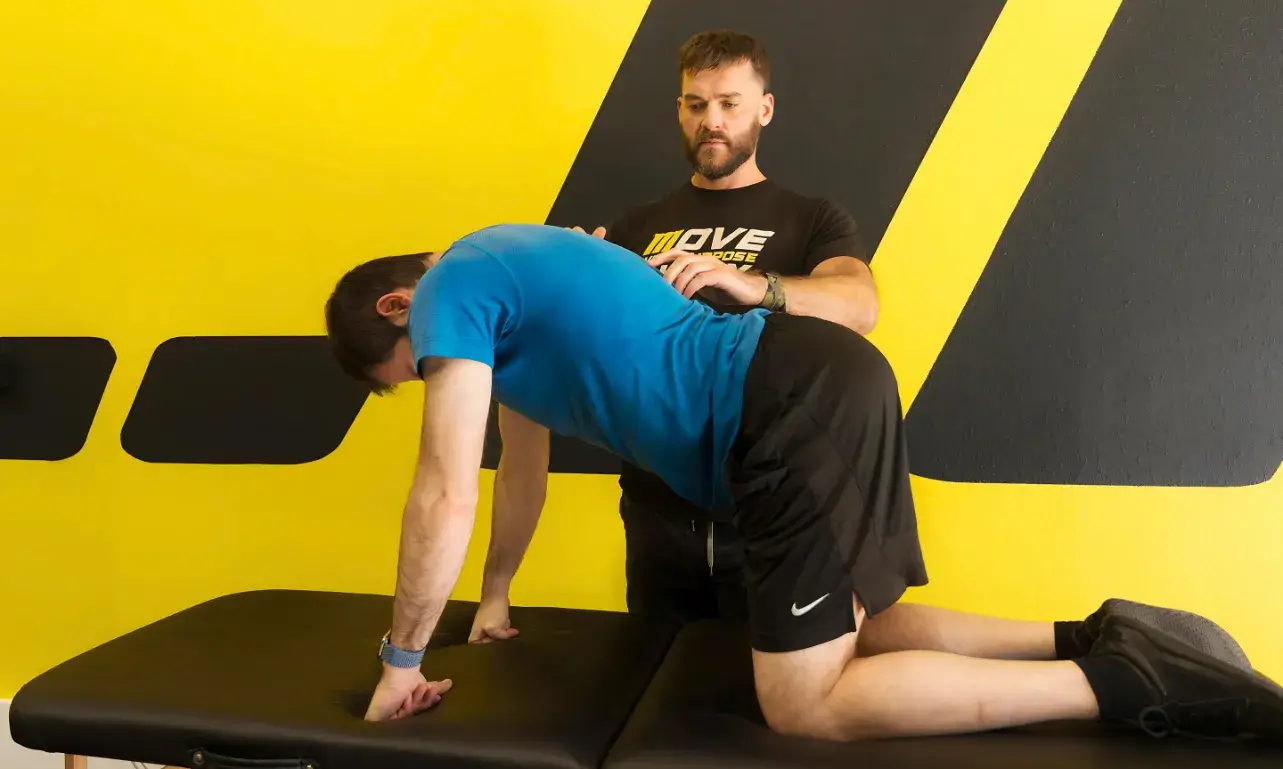
TL;DR: Persistent lower back pain is often the result of the lumbar spine compensating for restricted hips and a stiff thoracic spine. The back isn’t failing. It’s doing too much work on behalf of joints that aren’t pulling their weight. Understanding that distinction changes how you train, what you address first, and why most back pain approaches keep falling short.
Why Does My Back Keep Hurting Even When Nothing Is Structurally Wrong?
Lower back pain frequently develops not because the lumbar spine is damaged, but because it’s compensating for mobility restrictions elsewhere, most commonly in the hips and thoracic spine. When those joints can’t move well, the lumbar spine absorbs forces it was never designed to handle repeatedly. Over time, that chronic overload becomes pain.
This is one of the more common patterns in training. Someone comes in with persistent lower back pain. They’ve had imaging done. Nothing significant showed up. They’ve done the exercises their physical therapist gave them, stretched the hamstrings, rested when it flared. And it keeps coming back.
That cycle usually has a clear reason, and it’s rarely the back itself. The lumbar spine is a load-bearing structure. It’s built for stability and compression, not for generating large amounts of movement. When other parts of the body stop doing their job, the lumbar spine picks up the slack. It does this reliably, repeatedly, and without complaint. Until it starts complaining.
How the Spine Actually Divides Its Labor
To understand why back pain so often originates elsewhere, it helps to understand how the spine is actually organized. The thoracic spine, the middle and upper back, has significant rotational capacity. The hips are ball-and-socket joints capable of moving through large ranges in multiple directions. The lumbar spine, sitting between them, is primarily a stabilizer. Its job is to transmit force, not generate it.
When the thoracic spine loses rotation and the hips lose mobility, the body doesn’t stop moving. It finds another way. The lumbar spine, which has far less rotational capacity than most people realize, starts filling the gap. Every time someone reaches, rotates, or hinges, the motion that should distribute across multiple joints gets concentrated in a smaller, less mobile region. That’s not a structural failure. That’s a compensation pattern, and it’s extremely common in people who sit for long portions of the day.
The lumbar spine has roughly 13 degrees of total rotation across all its segments combined. The thoracic spine can contribute far more when it’s functioning. When thoracic rotation is restricted—which happens predictably in people who spend hours at a desk, seated, with rounded shoulders—the lumbar spine takes on rotation it was never designed to handle at scale. Add restricted hips to that picture and you now have a joint complex at the center of the body that’s doing the work of three regions, with the capacity of one.
Why the Hips Are Usually the Bigger Factor
The hips deserve more attention in the back pain conversation than they typically get. Every hip socket is surrounded by a capsule, and that capsule has to move well in multiple directions: flexion, extension, rotation, abduction. That range is what allows the body to distribute load properly during walking, hinging, squatting, and just about everything else.
When hip mobility is restricted, particularly in internal rotation and extension, the pelvis compensates. It tilts. It shifts. It finds positions that allow the movement to happen anyway, usually by borrowing range from the lumbar spine. A hip that can’t extend fully during a lunge or a step will cause the lower back to extend instead. A hip that can’t rotate well during a squat will dump that rotation demand onto the lumbar spine. This happens below the level of conscious awareness, which is part of why it’s so persistent.
Tight hip flexors compound this significantly. When someone spends most of their waking hours sitting, the hip flexors adaptively shorten. The psoas, which attaches directly to all five lumbar vertebrae, pulls on those vertebrae when it shortens. That creates anterior tension on the lumbar spine even when the person is standing still. It’s not dramatic, but it’s constant, and constant low-level stress on a joint produces predictable results over time.
What Thoracic Restriction Looks Like in Practice
Thoracic mobility loss tends to be gradual and largely invisible until something else starts complaining. The thoracic spine stiffens from sustained flexed postures, and because the stiffness develops slowly, most people don’t notice it until their range is already significantly reduced.
In training, thoracic restriction shows up in specific patterns. The overhead position suffers because the thoracic extension needed to achieve a true vertical arm position isn’t there. Rotation-based movements like a golf swing, a throwing pattern, or getting in and out of a car require the person to generate rotation from somewhere, and if the thoracic spine isn’t contributing, the lumbar spine or the hip has to. People with restricted thoracic spines often present with a rounded posture that looks like a shoulder or neck problem but traces back to how the thoracic vertebrae are moving, or not moving.
The thoracic and lumbar spines are continuous structures, and what happens in one region directly affects the other. A stiff thoracic spine doesn’t just limit upper body movement. It changes the mechanical demands on the lumbar spine below it and the cervical spine above it. Treating lumbar pain while ignoring thoracic mobility is a bit like addressing a kink in a garden hose at one spot while ignoring the restriction that’s creating the pressure upstream.
Why This Pattern Is So Persistent
The reason this compensation pattern is so difficult to resolve with standard approaches is that most interventions address the site of pain rather than the source of load. Stretching the lower back, applying heat, getting massage to the lumbar region: these things can provide temporary relief, and that relief is real. But they’re addressing the structure that’s been overloaded, not the structures that caused the overload in the first place.
Rest helps because it removes the load temporarily. But the pattern of restricted hips and a stiff thoracic spine doesn’t change with rest. When movement resumes, the compensation resumes with it. This is why back pain that responds to rest keeps returning when activity does.
The same principle applies to many rehab approaches that focus exclusively on lumbar stability work. Building lumbar stability has value. A stable lumbar spine is a better platform for movement than an unstable one. But if the hips still can’t move well and the thoracic spine is still restricted, the lumbar spine is still going to compensate. Stability without mobility in the surrounding joints addresses one variable while leaving the primary driver of the problem intact.
What Actually Changes the Pattern
Resolving this kind of back pain requires working on mobility where the restrictions actually are: the hips and the thoracic spine. It also requires building the capacity to use that mobility actively under load.
This is meaningfully different from passive stretching. Stretching the hip flexors temporarily changes tissue length, but if the nervous system doesn’t learn to control the hip through its new range, the range doesn’t transfer into how the body actually moves. The same is true for thoracic work. Foam rolling the thoracic spine or hanging in a doorway creates a temporary change. What creates a lasting change is training the thoracic spine and hips to move actively through ranges they’ve been avoiding.
Controlled articular rotations address this directly. Hip CARs take the hip through its full range of motion under active muscular control, training the nervous system to use range that exists passively but isn’t being accessed functionally. Thoracic CARs do the same for spinal rotation. These aren’t stretches. They’re active movements that teach the joint to operate where it needs to operate, which is what eventually takes the compensatory load off the lumbar spine.
PAILs and RAILs build on that by training isometric strength at end range, the range where the joint is most vulnerable and where compensation typically kicks in. When the hip can generate force at end-range extension and internal rotation, it doesn’t need the lumbar spine to fill the gap. That’s the mechanical change that actually reduces the recurrence pattern.
When to Take Back Pain Seriously
This article is about a specific and very common pattern: compensation-driven lumbar pain in otherwise healthy adults. That pattern is real, it’s addressable, and it’s often misunderstood. But back pain can also have other causes, and some of them require medical evaluation.
Pain that radiates down one or both legs, pain that wakes you from sleep and doesn’t have a clear mechanical explanation, pain accompanied by numbness or weakness, or pain following an acute injury should be evaluated by a qualified clinician before beginning any training program. The framework here, hip and thoracic mobility as drivers of lumbar load, applies to the mechanical, non-radicular back pain that most adults deal with. It is not a substitute for clinical assessment when those other presentations are present.
If you’ve had your back evaluated, been cleared of serious pathology, and are still dealing with recurring pain that doesn’t resolve, the joint-by-joint compensation story is worth exploring carefully. A functional range assessment can identify exactly where the mobility restrictions are and what ranges the nervous system is protecting. That clarity tends to make the training approach considerably more targeted than generic back pain protocols.
What This Means for How You Train
The practical implication of all of this is fairly direct. If you have recurring lower back pain and your current approach focuses primarily on the lower back, it’s worth systematically evaluating what your hips and thoracic spine are doing. Not because the back is irrelevant. It isn’t. But because the back is usually the responder, not the initiator.
Training that addresses hip mobility, thoracic rotation, and the relationship between those two regions tends to produce more durable changes in back pain than training that addresses the lumbar spine in isolation. That doesn’t mean ignoring lumbar stability work. It means sequencing the work intelligently: restore mobility where it’s lacking, build strength in the new ranges, and then load the pattern once the compensation has somewhere better to go.
Most chronic back pain in active adults isn’t a back problem. It’s a movement distribution problem. The back is just where the bill arrives.
If you want to understand specifically where your movement is breaking down, we work with clients on exactly this, identifying the restrictions driving their symptoms and building a training approach that addresses the actual source rather than the site of pain.
Frequently Asked Questions
Can hip mobility affect lower back pain? Yes, directly. The hip and lumbar spine share load during virtually every movement pattern. When hip mobility is restricted, particularly in extension and rotation, the lumbar spine compensates by taking on movement it isn’t well-designed to handle repeatedly. Improving hip mobility is one of the most reliable ways to reduce recurrent lumbar stress.
Why does my back pain keep coming back after physical therapy? Physical therapy often addresses lumbar stability and pain management effectively, but may not fully resolve mobility restrictions in the hips and thoracic spine that are driving the compensatory pattern. When those restrictions remain, the overload pattern resumes when activity does. Transitioning from rehab to mobility-integrated training that addresses the surrounding joints is often what breaks the cycle.
Is it safe to exercise with lower back pain? For most non-radicular, mechanically-driven lower back pain, appropriate exercise is not only safe but beneficial. The key is matching the training to the actual problem: addressing mobility restrictions and building active control rather than loading patterns that reinforce the compensation. If you have radicular symptoms, acute injury, or neurological signs, consult a clinician before training.
What is the joint-by-joint approach to back pain? The joint-by-joint approach recognizes that joints alternate between needing stability and mobility along the kinetic chain. The lumbar spine needs stability; the hips and thoracic spine need mobility. When mobile joints become stiff, stable joints are forced to move more than intended. Restoring mobility where it belongs reduces the compensatory demand on the lumbar spine.
How long does it take to resolve back pain through mobility training? This varies significantly depending on how long the compensation pattern has been in place, how restricted the surrounding joints are, and how consistently training is applied. Most people notice meaningful changes in four to eight weeks of targeted mobility work. Resolving a pattern that has been present for years typically takes longer and benefits from structured, progressive training rather than ad hoc stretching.
What is a functional range assessment and how does it help with back pain? A functional range assessment is a systematic evaluation of each joint’s active and passive range of motion, identifying where restrictions exist and how large the gap is between what the joint can do passively and what it can do under active muscular control. For back pain specifically, it reveals exactly which joints are restricted and quantifies how much the nervous system is limiting access to available range. That information makes the training approach considerably more precise than working from symptoms alone.
Written by

Brian Murray, FRA, FRSC
Founder of Motive Training
Motive Training is a coaching studio in South Austin built around assessment, joint health, and strength you can use. Train with us in the studio, come to a KINSTRETCH class, or work through the progressions in KINSTRETCH Online.