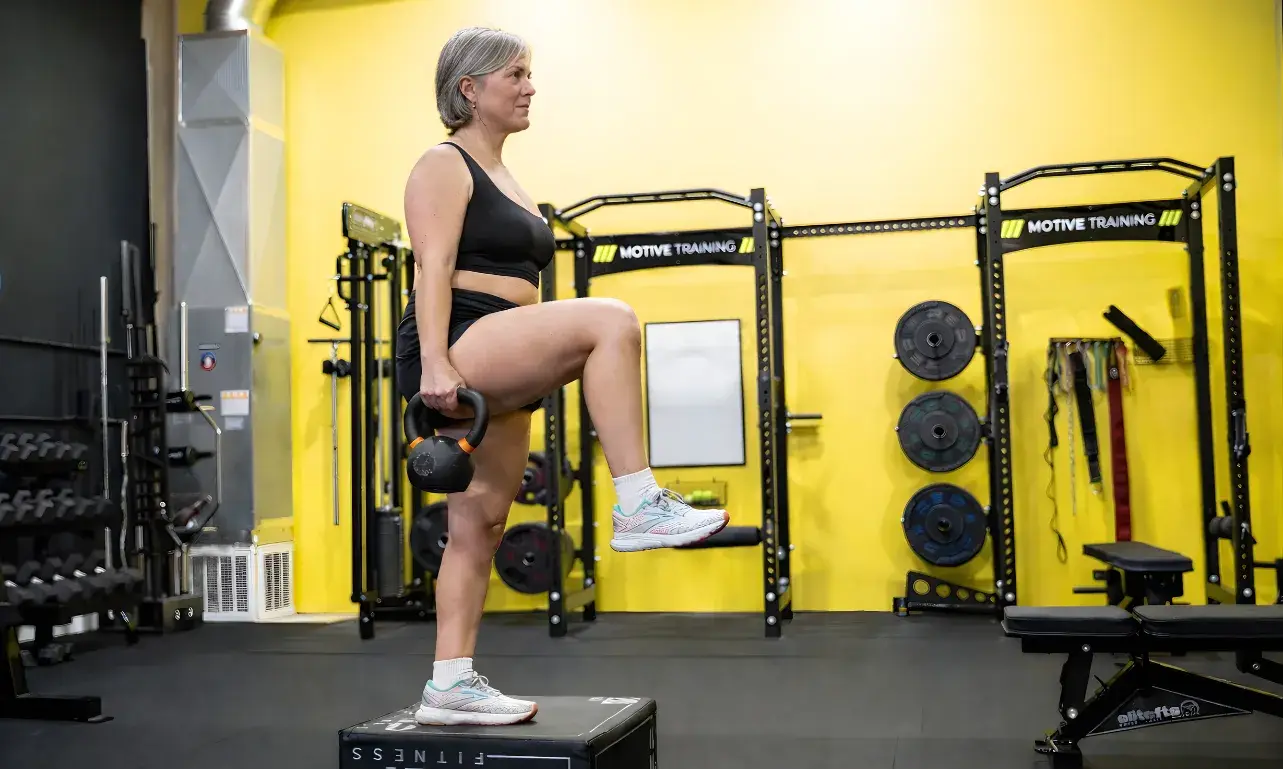
There’s a story a lot of people start telling themselves around sixty. The body is just getting older, the thinking goes, and it’s time to be more careful. The morning stiffness shows up, the hip catches going up the stairs, the shoulder hasn’t felt right in a few years, and getting up off the floor becomes something you have to think twice about.
That story isn’t wrong. The body is changing. But it’s incomplete, because most of what people interpret as inevitable decline is in large part a training problem, and training problems have training solutions.
Why joints get stiffer after sixty
Joint stiffness after sixty has a real physiological cause, but it usually isn’t the cause people assume.
As you age, synovial fluid production decreases, cartilage gradually thins, and connective tissue loses some elasticity. Those changes are real. But the dominant driver of functional stiffness in most people is disuse rather than tissue degradation. Joints that aren’t regularly moved through their full range of motion begin to lose access to that range. The nervous system, which governs all movement, stops allocating capacity to ranges it doesn’t regularly need. Use it or lose it is the practical reality of how neurology handles ranges it never gets asked for.
The stiffness you feel in your hips after a long drive, the shoulder that no longer lifts overhead the way it used to, the ankles that feel locked up in the morning, a significant portion of all of that comes from the central nervous system conserving resources rather than from structural damage. And the nervous system can be retrained.
The distinction matters because the intervention depends on it. If the stiffness were purely structural, cartilage breakdown or bone-on-bone arthritis, the right intervention is medical. If it’s substantially neurological and movement-based, which the evidence supports for most cases, then targeted mobility training is the right intervention. For most people in the early stages of age-related stiffness, the second category applies.
Mobility is still trainable after sixty
It is, and the research is clear on this. The fitness industry has done a poor job communicating it because low-impact chair exercises for seniors get more search traffic than a grounded explanation of how the nervous system actually governs range of motion. But the underlying science isn’t ambiguous. Joints respond to progressive, controlled loading at end range, and that adaptation doesn’t switch off at sixty, sixty-five, or seventy-five.
What does change with age is the timeline. Adaptations take longer. Recovery takes longer. Intensity needs to be managed more carefully. But the underlying mechanism, which is training the nervous system to own and control more range, works the same way it always did.
The practical implication is that starting now, with the right approach, produces real results. Not in six weeks. After about six months of consistent work, the difference in how the body moves and feels is meaningful, and the longer the practice continues, the more it compounds.
The low ceiling of standard senior fitness
Pull up any article on mobility for people over sixty and you’ll find the same content. Seated arm circles, ankle rotations, gentle hip stretches, maybe some cat-cow. Five minutes each morning. The advice isn’t wrong on its face. Movement is good, and something is better than nothing. But the ceiling on that approach is profoundly low. It treats the goal as managing decline rather than building capacity, and it skips the most important aspect of joint health, which is the relationship between range of motion and the strength to control it.
This is the gap Functional Range Conditioning addresses directly. The core distinction matters here. Passive flexibility, the range your body can be moved through when someone or something else controls it, isn’t the same as active mobility, which is the range you can control yourself. Controlled range is what protects you. Uncontrolled range is just range.
If you can be moved into a position by a practitioner but can’t produce force from that position yourself, that range offers no real protection. It can actually create vulnerability. The space between passive and active range, what gets called the injury gap, is exactly where injuries tend to happen. Chair exercises and gentle stretching don’t close that gap. They don’t even try.
The four joints that show up first
Understanding what’s actually going wrong helps you train with intention. Four joint areas come up repeatedly in assessments of adults over sixty, and they’re worth knowing in advance.
The hips tend to go first and go quietly. The hip is a ball-and-socket joint designed for a wide range of motion in every plane: flexion, extension, internal rotation, external rotation. Most people’s hips operate in a small fraction of that range daily, so the nervous system stops maintaining the rest. Hip flexors adaptively shorten, glutes get inhibited, and the lumbar spine compensates for what the hip isn’t doing. A significant portion of chronic lower back pain in this age group traces directly back to restricted hip mobility.
The thoracic spine is the most underaddressed area in standard senior fitness. The middle of the back is built to rotate, but years of sitting and desk posture and disuse stop it from doing what it was built for. When the thoracic spine loses range, the lumbar spine and the cervical spine compensate. Shoulder pain, neck pain, and lower back pain frequently end up being downstream consequences of a thoracic spine that has stopped moving.
Shoulder internal rotation goes earlier than most people realize and is more functionally important than they’d guess. It’s the motion the shoulder needs to reach behind the back, fasten a seatbelt, scratch between the shoulder blades. Losing internal rotation also tends to be connected to neck tension and upper back tightness. If you’ve been wondering why your shoulder feels stuck, this is usually where the answer starts.
Ankle dorsiflexion, the ability to pull the foot toward the shin, changes how the knees and hips get loaded with every step, every squat, every descent of stairs. It also directly affects balance, which makes it one of the higher-leverage mobility targets for fall prevention specifically.
How FRC-based work changes the picture
The core tools come from the same FRC system used with athletes, scaled appropriately. The primary three are CARs, PAILs, and RAILs, and they each do a specific job.
Controlled articular rotations, or CARs, are slow, deliberate movements that take a joint through its complete available range under active muscular tension. They do two things at once. They maintain joint health through synovial fluid circulation, tissue hydration, and capsular mobility, and they function as a daily diagnostic. How a joint moves through its CARs tells you exactly where restrictions exist and what needs attention. For adults over sixty, a daily CARs practice across the major joints serves as both a maintenance habit and an early-warning system for change.
PAILs and RAILs are the tools that actually close the gap between passive and active range. PAILs involve pushing into a stretch with isometric force, which tells the nervous system you have muscular control at that end range. RAILs involve contracting the opposing muscle to actively produce motion into the stretch from the other side. Together they convert passive flexibility into active, controllable mobility. The full programming detail sits on its own page.
These are demanding isometric contractions performed at end range, controlled, low-impact, and fully scalable to capacity. The same protocol that works for a thirty-five-year-old athlete works for a sixty-eight-year-old who hasn’t trained systematically in years, just at different intensities and with different constraints. An FRC-trained coach can dial a PAILs contraction from twenty percent of effort to eighty percent depending on where the person is on a given day.
What a session actually looks like
A structured mobility session for an adult over sixty at Motive typically opens with a joint-by-joint CARs warm-up. Each major joint gets taken through its full available range actively and under control. That part takes ten to fifteen minutes and works as both preparation and real-time assessment.
From there, the session addresses whatever specific restrictions came up in the initial Motive Movement & Mobility Assessment, which is where every new client starts. Someone with restricted hip internal rotation works through PAILs and RAILs in the 90/90 position. Someone with a stiff thoracic spine works through segmented rotation and thoracic CARs. The work is targeted rather than generic, which is what makes thirty to forty-five minutes of focused work actually produce changes.
Sessions are paced appropriately. No rushing through ranges. No forcing. No bouncing through positions. The FRC methodology explicitly accounts for tissue irritability, which means sessions can be calibrated to how someone feels that day rather than pushed through regardless. Over months of consistent work, the pattern is consistent. Ranges that felt locked begin to open. Morning stiffness decreases. Confidence in the body rebuilds because the joints are getting the signal, regularly and progressively, that they need to maintain and expand their capacity.
Stiffness and pain aren’t the same problem
Stiffness, the sense of restriction, reduced range, and resistance to movement, is the primary target of mobility training. It responds well to the approach above.
Pain is a different category and needs different handling. Sharp joint pain, pain that gets worse with movement rather than easing after the first few minutes of activity, or pain accompanied by swelling or instability deserves medical evaluation before starting a structured mobility program. The FRC methodology has real applications in the post-rehab space, and we work with plenty of clients managing chronic conditions, but the right starting point depends on what’s actually driving the symptoms.
If you’re not sure which category your situation falls into, that’s most of what an assessment is for. It clarifies what kind of work is appropriate, where, and at what intensity.
Where to start
Joint stiffness after sixty is real, but most of it is trainable. The dominant driver is neurological rather than purely structural, and the standard approach to senior fitness addresses that inadequately. FRC-based work addresses the actual mechanism, by building strength and control at end range, closing the gap between passive and active range of motion, and giving the nervous system a clear signal that the joints need to keep their capacity rather than let it drift.
This kind of work is fully scalable to different ages, capacity levels, and starting points. It doesn’t require existing flexibility, prior training experience, or a particular level of health. It requires an honest starting point and consistent, progressive work from there. If your joints have been telling you a story about decline, it’s worth asking what the rest of that story might look like before accepting it as the full picture.
If you want to find out where you actually are, that’s what the movement assessment is for. If you’d rather come talk through it first, we’re easy to reach.
Written by

Brian Murray, FRA, FRSC
Founder of Motive Training
Motive Training is a coaching studio in South Austin built around assessment, joint health, and strength you can use. Train with us in the studio, come to a KINSTRETCH class, or work through the progressions in KINSTRETCH Online.