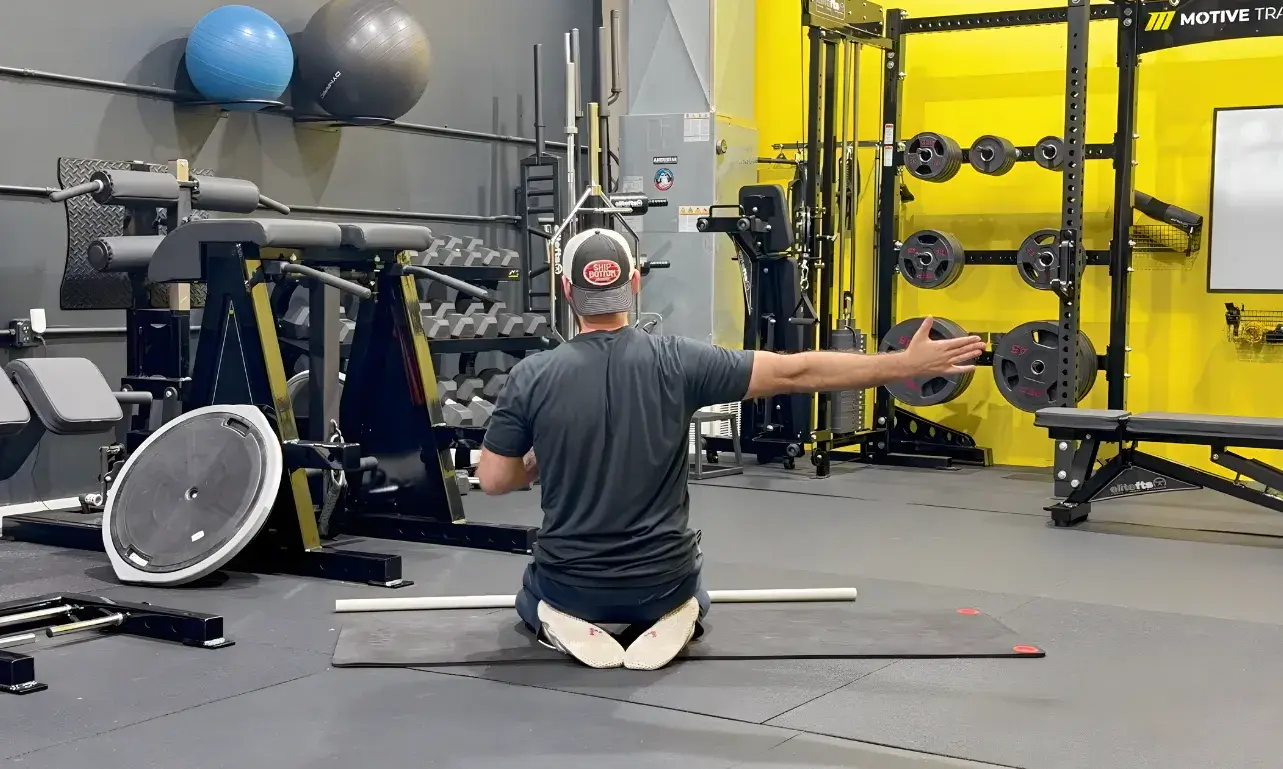
TL;DR: Shoulder tightness, clicking, and limited range are almost never just a flexibility problem. They’re a control problem. The shoulder has more range of motion than any other joint in the body—which means it also needs more active training to stay healthy and accessible.
If your shoulder feels stuck, grinds when you rotate it, or quietly limits what you can do in the gym or in daily life, you’re not alone. Shoulder restrictions are one of the most common complaints we see—and one of the most misunderstood.
Most people’s response is to stretch more. Roll out the posterior shoulder. Do some band pull-aparts. Maybe a doorway stretch. And for a lot of people, those things provide temporary relief without ever actually solving anything.
Here’s why.
The Shoulder Has a Range Problem—But Not the One You Think
The shoulder is the most mobile joint in the body. That’s both its greatest asset and its biggest liability. All of that available range requires active muscular control to be safe and usable. When that control breaks down—whether from desk posture, repetitive training patterns, past injuries, or simply never training those ranges directly—the nervous system starts pulling back access.
Shoulder internal rotation is almost always the first range to go. It’s the motion of turning the upper arm inward toward your body, and it’s essential for everything from reaching behind your back to overhead pressing to the catch position in a clean. When it’s restricted, the body compensates: the shoulder blade overtracks, the elbow flares, the neck tightens. The problem spreads.
And here’s the part that trips most people up—that restriction isn’t your tissue being too short. It’s your nervous system deciding that range isn’t safe to access. Stretching can temporarily change how that feels, but it doesn’t change the underlying equation. Until the shoulder has actual strength and control through those ranges, the nervous system will keep applying the brakes.
Why Self-Led Shoulder Work Usually Stalls
The issue with most shoulder mobility routines isn’t the effort—it’s the lack of progression and specificity.
Passive stretching gives you a temporary window of looseness without building any control. Foam rolling the posterior shoulder changes tissue tone for a few minutes. Generic band exercises hit the shoulder in familiar ranges without ever challenging the end ranges where the real restrictions live.
What’s missing is progressive, intentional training at the ranges the shoulder currently can’t access. That means working into internal rotation with load. Spending time in positions that feel limited and building strength there, not just tolerance. Training the shoulder blade and ball-and-socket independently so they each do their job.
That kind of work isn’t complicated—but it requires structure. It requires knowing which position to be in, how much effort to apply, and how to progress over time. Without that, most people cycle through the same movements indefinitely and wonder why nothing changes.
What Shoulder Mobility Training Actually Looks Like
A well-designed shoulder session starts with controlled articular rotations—not as a formality, but as a genuine assessment of where the joint is today. How it moves through its full range tells you exactly where to focus.
From there, the work gets specific. Internal rotation gets trained directly, not just stretched—using positions that load the rotator cuff through ranges it rarely encounters in typical training. Abduction gets addressed in the frontal plane, opening the anterior capsule in a way that most people have never targeted. And then those ranges get integrated: the shoulder learns to move through the full arc with control, not just tolerance.
The result isn’t just a shoulder that feels looser for a day. It’s a shoulder that has more access to its own range—because the nervous system has been given a reason to allow it.
If Your Shoulder Has Been a Problem, This Is Where to Start
Our KINSTRETCH Online library includes focused shoulder sessions at multiple levels—including intermediate classes that target internal rotation and abduction specifically for people who already have some mobility background but keep hitting the same wall.
You don’t need to be in Austin. You don’t need special equipment. You need a structured approach and a coach who can walk you through it. Try a free shoulder external rotation session or explore KINSTRETCH Online and start training your shoulder the way it was designed to move.
Frequently Asked Questions
Why does my shoulder click and pop during rotation? Clicking and popping during shoulder movement—especially rotation—is usually caused by the ball moving slightly off-center in the socket, often because the muscles controlling the joint aren’t engaging evenly through the range. It’s rarely dangerous on its own, but it’s a signal that the shoulder isn’t moving with full control. Structured rotational training typically reduces it over time as muscular coordination improves.
Is shoulder internal rotation the same as the sleeper stretch? The sleeper stretch is one way to access posterior shoulder capsule tissue, and it has a place. But targeting internal rotation as a trained range—using progressive load and active contraction at end range—is a different thing entirely. One is passive exposure. The other is building the neuromuscular control to actually own that range.
Can I train shoulder mobility if I’ve had a previous injury? Often yes, but the approach needs to match where you are. If you’re post-surgical or dealing with active pain, a Functional Range Assessment is a better starting point than jumping into a class. If you’re cleared and dealing with lingering tightness or restriction, structured mobility training is usually exactly what’s been missing from your recovery.
How is KINSTRETCH Online different from following YouTube mobility videos? The difference is structure and progression. YouTube videos give you movements. KINSTRETCH Online gives you a system—organized by joint, difficulty level, and training goal—so you’re building on previous work rather than doing a random collection of things that feel good. The coaching cues are specific, the progressions are intentional, and the sessions are designed to produce cumulative results, not just temporary relief.
Written by

Brian Murray, FRA, FRSC
Founder of Motive Training
Motive Training is a coaching studio in South Austin built around assessment, joint health, and strength you can use. Train with us in the studio, come to a KINSTRETCH class, or work through the progressions in KINSTRETCH Online.