Someone walks in for an intake having just spent six months working with another trainer. They were disciplined about it. They showed up. They pushed in their sessions. The results never came, or never really started, and they’re trying to figure out what they did wrong.
The honest answer is usually that they didn’t do anything wrong. The program they were running just wasn’t built to produce what they were trying to produce. That’s a structural problem with how most personal training is designed, and it’s worth understanding before you commit to any trainer, including us.
The fitness industry is good at producing effort. It’s considerably less good at producing durable, compounding results in people who have actual training histories, desk jobs, old injuries, and bodies that stopped behaving like a twenty-four-year-old’s a while ago. The reason that gap exists is structural, and once you can see it, you can’t really unsee it.
Most training starts in the wrong place
A version of this plays out every day in commercial gyms. Someone walks in, gets paired with a trainer, and starts doing squats and deadlifts on day one. Nobody checks hip mobility. Nobody evaluates ankle dorsiflexion. Nobody asks about the low back pain that’s been showing up every Tuesday for three years. The program gets built around what the trainer knows how to program, not around what the body in front of them actually needs.
This is the part that doesn’t get said out loud often enough. Most personal training is templated from the trainer’s expertise, not from the client’s specific situation, and it works fine for the percentage of clients whose situation happens to match the template. Everyone else gets a program that’s reasonable on paper and wrong for their actual body. All that work goes into a body that isn’t really adapting to it.
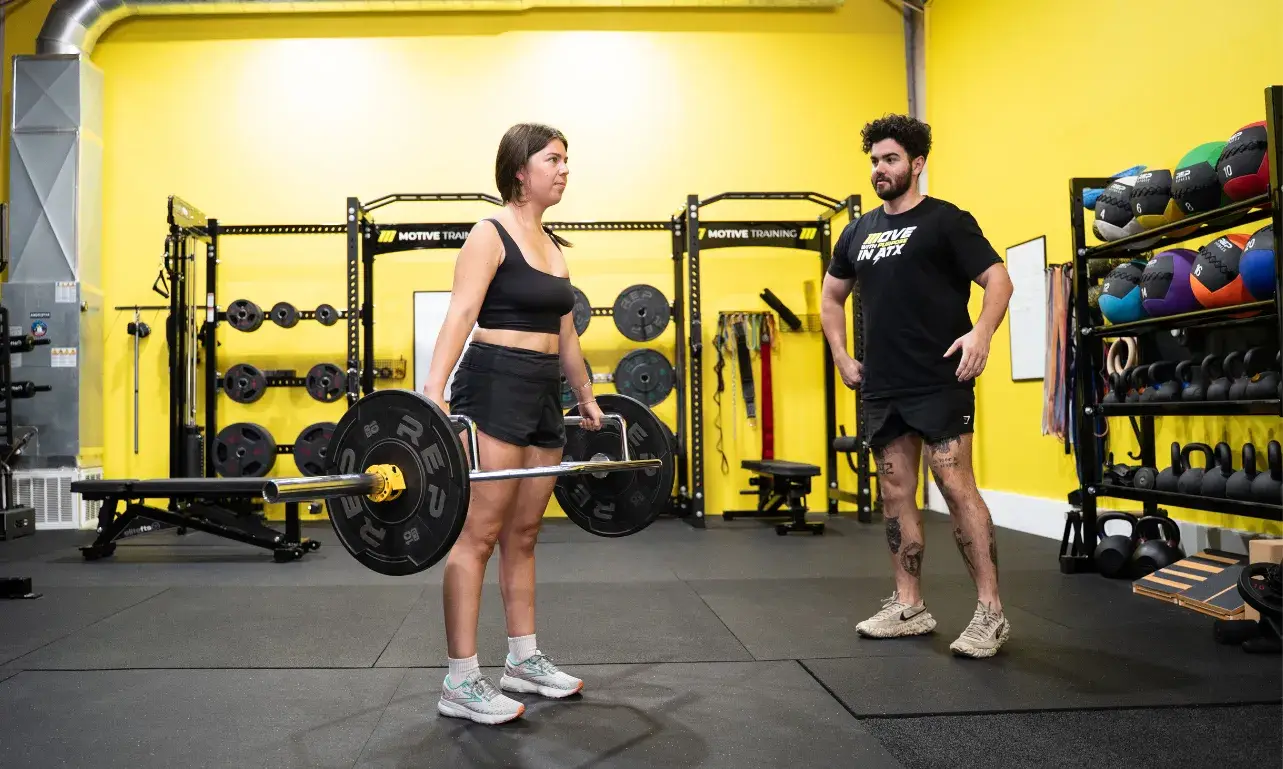
At Motive, every personal training relationship starts with the Motive Movement & Mobility Assessment. It evaluates the quality and control of motion at each joint, not just what range you can reach but what range you actually own under load and fatigue. The assessment surfaces exactly where you have passive range without active control, which is the gap where injuries happen and progress quietly stalls. In Austin, where most of our clients are spending eight to ten hours at a desk before they come in to train, that assessment surfaces the same clusters over and over: reduced hip internal rotation, limited thoracic mobility, restricted shoulder range. Training without addressing those patterns doesn’t fix them. It loads them.
When effort doesn’t produce results
A client who deadlifts with a flexion-intolerant lumbar spine isn’t building a stronger back. They’re rehearsing a compensation pattern under load, and every session that runs through it is adding volume to something that should first be corrected. The shoulder that limits overhead pressing, the hip that limits squat depth, the ankle that drives knee valgus on every step under load, these are the actual training priority. They aren’t inconveniences to route around. They’re what the program should be built to address first.
This is the central problem with most general personal training. Effort substitutes for specificity. The client works hard, the trainer programs consistently, and nothing meaningful changes, because the program isn’t addressing the limitations that are capping progress and quietly accumulating risk. After six months of this, the client either plateaus visibly or starts getting hurt, often both. Neither outcome is the client’s fault. They were doing exactly what they were asked to do.
Functional Range Conditioning gives us a framework for working on these limitations directly within strength training, not as a separate bolted-on mobility block. CARs, PAILs, and RAILs are integrated into the actual sessions, which means the range being developed is also the range being reinforced under tension. Mobility work and strength work become the same work, which is more efficient and produces results that hold.
What strength training should actually produce
Strength isn’t just about how much you can lift. It’s about how much you can control, across how much range, in positions that aren’t always going to look like a textbook diagram. A 200-pound squat through 60 degrees of range with significant forward trunk lean isn’t a strong squat. It’s a compensated one, and the difference matters more as the load goes up.
Personal training at Motive is designed around range-of-motion targets alongside load targets. A client working on hip mobility isn’t taking a break from strength work while they resolve the issue. We program end-range isometrics, eccentric loading, and position-specific strength alongside conventional compound lifts, so the range being developed is also the range being reinforced under tension.
The research backs the integration. A 2024 study in the European Journal of Applied Physiology found that resistance training through full range of motion improved both flexibility and maximal isometric strength, while static stretching alone improved only flexibility. Training through range produces both adaptations at once, which is more efficient and more durable than treating them as separate problems to solve.
Why Austin adults need a different model
Most of the people who find their way to Motive in South Austin have already been through the conventional model. They’ve done the group fitness classes. They’ve hired a trainer at a big box gym. They’ve run a program they found online. The common thread isn’t that those things were bad. It’s that none of them were designed for someone with a real training history, accumulated compensations, and goals that extend past the next twelve weeks.
Austin’s tech workforce is the client population we work with most. These are disciplined, goal-oriented adults who are entirely capable of working hard. What they need is a program that accounts for the ten hours of sitting they did before they walked in, the shoulder that’s been clicking since a mountain bike crash four years ago, and the fact that their real goal is to still be training well at fifty-five, not to look good for one summer. That’s a different design problem than standard personal training is built to solve. It requires individualization at the assessment level, not just at the exercise selection level.
Our programs are built around what the assessment finds, progressed through a framework that treats joint capacity and strength as connected rather than separate, and updated as the client adapts. For people who want a deeper diagnostic on a specific joint or limitation, the Functional Range Assessment goes further than the initial movement assessment and is the right tool when the question is technical. Either way, nothing is templated. The program reflects what the assessment revealed and what the client is working toward, and it changes when those things change.
Where to start
If you’re currently training and experiencing recurring discomfort, a plateau you can’t explain, or a nagging sense that something is off in how you move, the most useful next step is getting a clearer picture of what your joints are actually doing. The assessment is what gives you that picture, and it changes what the training that follows looks like.
If you’re starting from scratch, or coming back after time away, the same logic applies. Understanding your baseline, what you own, what you have on loan, and where the gaps are, is what makes every training decision after it more specific and more likely to produce something durable.
The goal here isn’t to make training harder. It’s to make it more precise, more sustainable, and more likely to compound over time. If that’s what you’re looking for in Austin, come talk to us.
Written by

Brian Murray, FRA, FRSC
Founder of Motive Training
Motive Training is a coaching studio in South Austin built around assessment, joint health, and strength you can use. Train with us in the studio, come to a KINSTRETCH class, or work through the progressions in KINSTRETCH Online.