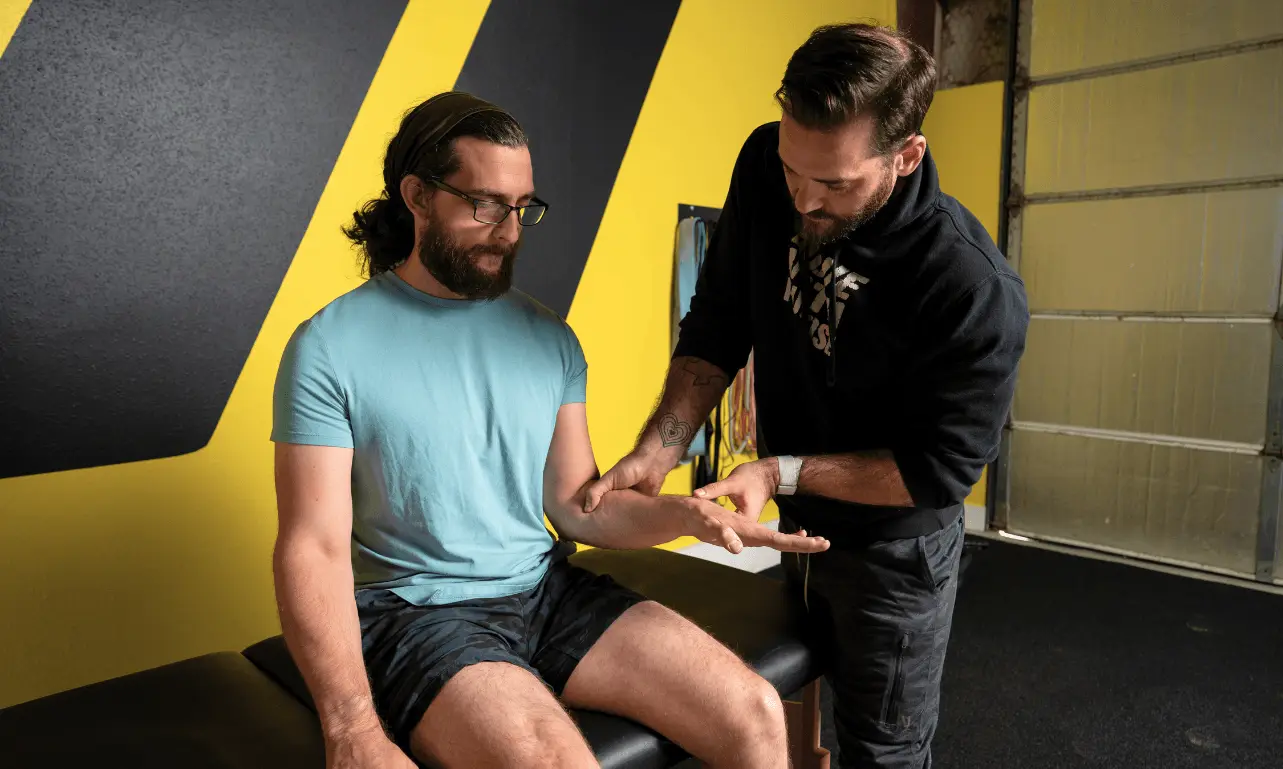
Most personal training gets built backward. The program comes first, borrowed from a template or whatever’s trending that month, and your actual joints get fit into it after the fact. We build in the other direction at Motive. Every program starts with data about how you specifically move, gathered before a single exercise gets programmed. The standard is simple: if it doesn’t change how you move or reduce what hurts, we stop doing it.
Why Assessment Comes Before Anything Else
No two people walk in with the same joints, injury history, or available range, and building identical programs for all of them treats that variation like noise instead of the information it is. That’s why every relationship starts with the Motive Movement & Mobility Assessment, a joint-by-joint measurement of your mobility and control rather than a five-minute movement screen.
We use that data to build the program from there. Restoring shoulder range so someone can get back on a tennis court looks nothing like opening up hip rotation so someone can finally squat below parallel, and running both people through the same plan would waste the first several weeks rediscovering what the assessment already told us on day one.
The Complaints We Hear Before Anyone Gets Assessed
New clients tend to arrive with one of a few frustrations already baked in. Some have been through a generic program that never accounted for their actual limitations, so progress stayed slow and inconsistent no matter how hard they pushed. Some are dealing with a lower back that aches, a shoulder that’s stayed tight for years, or a knee that acts up during ordinary movement, and most of that traces back to a joint that never had the range to do its job in the first place. No amount of extra volume fixes a range problem. And some have simply worked with trainers who counted reps without ever explaining why a given exercise was on the plan at all.
Most of what we build to answer all three runs through Functional Range Conditioning, a system built around expanding the range a joint can control and then loading real strength into that range. Lifting weight is part of the equation, but a heavier bar doesn’t fix a hip that can’t rotate far enough to squat safely under it.
Three Kinds of People Walk Through the Door
Over time our clients have sorted into a few recognizable groups, though the underlying principle stays the same across all of them.
People Who Have Already Tried Everything Else
These are clients who’ve lived with pain long enough to have a paper trail behind them: physical therapy, chiropractic visits, imaging that came back inconclusive. What usually changes the trajectory is someone willing to measure the joint instead of layering another treatment on top of the symptom, and that’s typically where the FRA and pain-focused programming start paying off within the first few sessions.
People Training for Performance
Golfers, powerlifters, jiu-jitsu competitors, people already strong who’ve hit a ceiling that looks technical rather than physical. The work here targets the range and stability a specific sport demands: more hip rotation for a golf swing that’s been stuck in the same groove for years, more shoulder stability for someone loading overhead positions their shoulder was never trained to hold. Because the program comes from assessment data instead of a generic athletic template, the changes tend to show up in the performance numbers a client is already tracking on their own.
People Who Just Want to Stay Capable
Not everyone training with us is chasing a sport or running from an injury. A good number of clients just want to keep doing what they already do: hike, garden, pick up a grandkid, get through a flight of stairs without a knee announcing itself. For this group the program builds strength and mobility side by side, with enough conditioning mixed in that staying independent stays realistic for decades, not just this year.
What Guides the Work
Your program changes as you do. If a hip gains real range in six weeks, the plan built around the old range is already out of date, so we retest and rebuild instead of running the same block on autopilot.
Evidence has to earn its place, not just get cited. We use methods with a real track record behind them, like PAILs and RAILs for building strength at end-range positions, and if the mechanism behind an exercise can’t be explained, it doesn’t belong in the program just because it looked good somewhere else.
We also want you to understand your own body well enough to catch problems early. Knowing what a specific ache means, instead of waiting until it turns into something that needs a full session to unwind, tends to save people months of frustration over the life of a training relationship.
None of this happens in isolation. Training one-on-one and showing up for KINSTRETCH Online between sessions both point at the same thing: a room, virtual or not, where doing the unglamorous joint work doesn’t feel like something nobody else bothers with.
We track range of motion and strength numbers the same way we track pain, because feeling like you’re making progress and making progress aren’t always the same thing, and the gap between those two is usually where a program either earns your trust or loses it.
How a Program Gets Built
The process itself isn’t complicated, even if the reasoning behind it is layered. The assessment sets the baseline. From there we build the plan around the goal you walked in with and whatever the assessment flagged as the actual limiting factor underneath it, which aren’t always the same thing. Every session blends mobility work with strength training, and we retest on a regular cycle to check if the plan is doing what we think it’s doing.
Retesting is what separates a program from a routine, since a routine keeps running long after it stops working, while a program gets rebuilt the moment the data says it should.
What Changes When the Work Is Working
The pattern we see most often is unremarkable in the best way: movement that used to hurt stops hurting, a joint that used to feel stuck starts moving through more of its actual range, and the daily tasks nobody thinks of as training get easier right alongside the sport-specific ones, because the same underlying capacity drives both.
Why Austin Shapes How We Program
Training in South Austin means most of our clients are already outside doing something: the Barton Creek Greenbelt on a Saturday morning, laps around Lady Bird Lake, weekend matches at Zilker. Summer adds its own variable, since training through stretches of 100-degree heat changes recovery timelines and how hard certain sessions can push, and ignoring that context would mean programming for a city we don’t train in.
Where to Start
You’ll leave every session knowing exactly what you worked on and why it mattered for your specific joints. If you want to find out what your own assessment turns up, schedule with us and we’ll walk you through it.
Written by

Brian Murray, FRA, FRSC
Founder of Motive Training
Motive Training is a coaching studio in South Austin built around assessment, joint health, and strength you can use. Train with us in the studio, come to a KINSTRETCH class, or work through the progressions in KINSTRETCH Online.