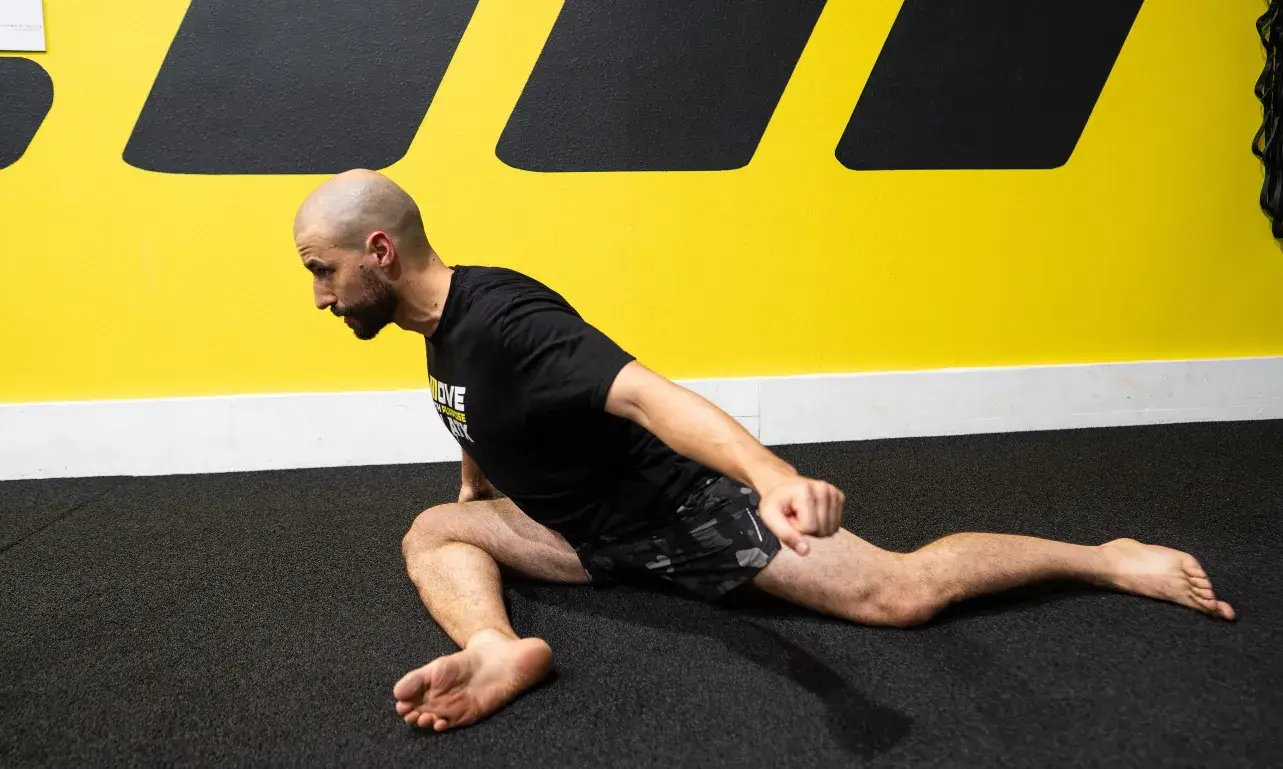
Spend a few weeks doing CARs every morning and the first thing you notice isn’t that you feel looser or that your joints have stopped bothering you. It’s that you can tell when something’s different. A hip that moved cleanly yesterday catches today. A shoulder that reached deeper last week stops short. You don’t usually have that kind of information about your own body, and once you have it daily, it’s hard to go back to training without it.
That’s most of why a morning CARs practice earns its ten minutes, and it’s most of why it tends to outlast almost every other mobility habit people pick up. Stretching feels like maintenance. CARs done well feel like information.
What CARs are actually doing
The full mechanics of controlled articular rotations live in the longer guide. The short version is that a CAR takes a single joint through its full active range while the rest of the body holds tension. You’re not swinging a limb through the air. You’re moving as far as the joint will allow under your own muscle, with everything around it kept engaged. That tension is what makes the work do anything. It’s the difference between casually circling a shoulder as a warm-up and producing a real signal at the joint that this range is being used, not just tolerated.
Two things follow from doing them well. The first is that the range you have stays accessible. Joints that don’t get taken through their full range regularly lose access to the outer portions of that range over time. The tissue isn’t dramatically shortening. The nervous system is quietly withdrawing permission to enter positions it doesn’t trust you to control. Daily CARs work against that withdrawal, consistently and without much fuss. The second is that you get a clean read on how each joint is functioning that day, which is the part the morning timing makes possible.
Why morning specifically
CARs are useful any time. As a warm-up before training, as a cool-down after, at a desk in the middle of an afternoon. The morning is worth doing on its own because of what it gives you that the other windows can’t.
After six or seven hours of sleep, the joints have been mostly still. Synovial fluid, the stuff that lubricates the cartilage in every articulation, distributes through movement. The joint surfaces about to be asked to manage a full day of load and prolonged sitting get the kind of active, full-range input they were built to respond to before the demands actually start. This isn’t about waking the joints up in some metaphorical way. It’s about giving them the specific thing they need, which is controlled motion through complete range, before anything else gets asked of them.
There’s also a nervous system arousal piece worth flagging, even though I’d cap how strongly to lean on it. Cortisol peaks naturally in the first thirty to forty-five minutes after waking, and that peak corresponds to a window of natural alertness and motor control readiness. The research is mostly about general cognitive performance and motor coordination in that window, not about CARs specifically, so I won’t claim it’s biochemically optimal in some clean settled way. But the lived experience tracks. Intentional, controlled movement tends to feel easier to do well in the morning than at the end of a long day, when fatigue has accumulated and the same drills feel sloppy no matter how much you concentrate. You’re working with the nervous system instead of against it.
The stronger case is the one about having a reference point. The practice becomes a baseline your nervous system encounters in the same context every day. A hip that’s been gradually losing internal rotation over three weeks doesn’t announce itself in a dramatic moment. It shows up as a daily check feeling subtly different, which you can only notice because you’ve been doing the same sequence in the same conditions. Without that reference, the restriction tends to accumulate quietly until it shows up under training load, by which point you’re past the point of catching it cheaply.
For people whose work means eight or more hours a day in sustained desk positions, which in Austin describes most of the people I coach, the morning also happens to be the only window where the joints aren’t already compressed into the same patterns they’ll hold for the rest of the day. Starting there gives you at least one full input of complete joint range before the compression begins.
What a good CAR actually looks like
The mechanism only works if the execution is honest, and execution is where most people get sloppy without realizing it. There are a few things worth self-monitoring as you move through the practice.
You should be producing tension throughout the rest of the body while the one joint moves. If you’re rotating the right shoulder, the left side should be holding strong. Abs, glutes, standing leg, all engaged. The whole point of a CAR is that everything around the working joint braces while one joint articulates. If everything around it is loose, you’re doing a joint circle, not a CAR.
Pace matters, because CARs are slow on purpose. A full shoulder rotation should take twenty to thirty seconds, sometimes longer. The rush hides compensations. Slow forces you to pass through every part of the range under control, including the awkward spots that get skipped when you’re moving fast.
The joint you’re rotating should be the only thing actually moving. For a hip CAR the pelvis stays neutral and the spine doesn’t help. For a shoulder CAR the scapula moves with the arm but the rib cage doesn’t shift around to make the motion easier. The body’s default is to cheat by recruiting adjacent joints to do work the target joint can’t or won’t, and catching yourself doing exactly that is most of what improves a CARs practice over time.
Breathing stays controlled throughout. People tend to hold their breath when the joint hits a hard spot in the range, which is exactly when they should be breathing through it. A held breath at end range is the nervous system bracing against the position rather than owning it. The breath is one of the cleanest signals you’re producing real controlled motion versus muscling through.
Hitting three of those most days is decent work. Hitting all four is what makes a CAR an actual training input rather than a movement you happen to be doing.
CARs as assessment, not just maintenance
Most people approach mobility work as maintenance, something you do to keep things from getting worse. A morning CARs practice is both maintenance and daily assessment at the same time, and the second part is the one that compounds.
When the internal rotation arc of a hip CAR shortens by a meaningful amount compared to last week, that’s information worth having. It might mean the joint is responding to accumulated training load. It might mean the surrounding tissue is changing. It might mean the nervous system has become more protective of that range for a reason worth investigating. None of that surfaces from how you feel generally. It surfaces specifically from movement quality in one plane at one joint, on a day you can compare to thirty days of yesterdays.
The pattern worth paying attention to isn’t a single morning that feels off. It’s the same restriction showing up across multiple days. A hip that catches in internal rotation once and clears the next morning is noise. A hip that catches in the same place every day for a week is a pattern, and patterns are what bring people in. This is also why the Functional Range Assessment uses CARs as part of how it evaluates joints. They reveal the gap between passive and active range in a way that’s reproducible and specific. The morning practice you build on your own gives you a running record of your own joint function over time. The formal assessment puts that record in context and identifies where the gaps are largest.
The sequence and what to expect
A reasonably complete CARs routine moves through the spine first, then the shoulders, then the upper extremity, then the hips, then the lower extremity. That order isn’t arbitrary. It’s the joint-by-joint logic the whole system sits on top of, and the nervous system organizes movement proximal to distal anyway. Working that way also keeps the bigger joints from being skipped when you’re running short on time.
Each joint gets taken through its full available range slowly and under control. The goal isn’t to push into new range. That’s a different tool. The goal is to move clearly and completely through the range you already have, notice the quality of it, and reinforce neurological access to the outer edges. Where the movement gets sticky, loses smoothness, or stops short of where it was yesterday, spend a few extra repetitions there and pay attention.
For most people new to the practice, the hips and thoracic spine surface the most obvious restrictions. Hip CARs in particular expose internal rotation limitations that people had no idea existed until the movement asked the question. Thoracic CARs make the cost of years of sitting suddenly legible in a way no amount of self-reported tightness ever does.
Why people drop it, and how the morning fixes that
The most common reason people don’t maintain a CARs practice isn’t that they stop seeing results. It’s that the practice doesn’t have an obvious shape in the day. It’s not intense enough to feel like training, not passive enough to feel like rest, and not built around an external deadline the way a class or a workout is. That ambiguity is what gets it dropped. Anything without a clear place in your schedule eventually loses to the things that have one.
The morning window solves most of that, which is most of why it’s the default I push. Before email, before the commute, before the first meeting, there’s a window that already belongs to the body before anything else gets first claim on it. The sequence fits there without competing with training, without needing a gym, and without requiring more than floor space. After a few weeks it stops being a deliberate effort and turns into something more like an orientation. A daily ten minutes of checking in with your joints before the day asks them to do anything.
If you want a structured sequence to follow rather than building one from scratch, the follow-along routines in KINSTRETCH Online are built around the same principles we use in person. Starting with a guided version tends to keep the habit alive longer than trying to assemble it from videos, mostly because someone else is making the decisions about order and pace while the practice is still new.
Written by

Brian Murray, FRA, FRSC
Founder of Motive Training
Motive Training is a coaching studio in South Austin built around assessment, joint health, and strength you can use. Train with us in the studio, come to a KINSTRETCH class, or work through the progressions in KINSTRETCH Online.