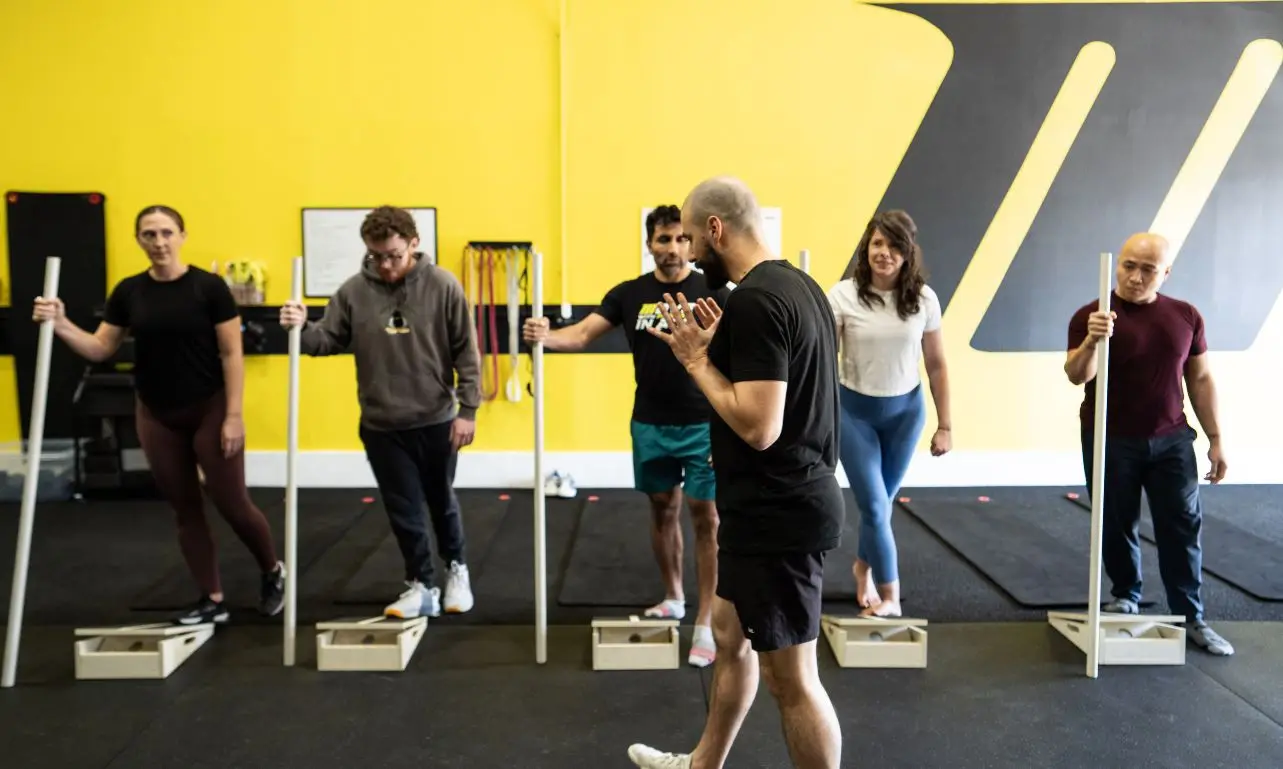
The first time I heard someone rattle off CARs, PAILs, RAILs, and FRCms in the same breath, my instinct was the same one most trainers have when a system shows up with its own vocabulary and its own certification ladder. The fitness industry has spent decades repackaging old ideas under new names and charging a premium for the label. Skepticism is the correct default position. It is also, frankly, good for business when a client asks me to defend what we do instead of just trusting the branding.
Functional Range Conditioning, developed by Dr. Andreo Spina, makes claims specific enough that skepticism can be resolved instead of just voiced. You can go check the mechanisms. So I did, joint by joint, claim by claim, and this is where each one lands.
The short version is that the core principles hold up. The longer version is that the supporting research did not arrive in one tidy package built for FRC. It comes from separate corners of neuroscience and exercise physiology that Spina synthesized into a training system, and some corners are better lit than others.
What FRC claims
Before weighing evidence, it helps to be precise about what is being proposed. If the system is new to you, the Functional Range Conditioning page covers the full framework. Underneath the branding sit three claims, and each one is doing distinct work.
The nervous system, not the tissue, sets the boundary on how much range you can access under your own control. Most people carry ten to fifteen degrees more passive range than the brain will allow them to reach actively, because the central nervous system brakes movement before it reaches a position it cannot verify is safe.
Static stretching mostly changes what the nervous system will tolerate, not the physical length of the tissue. That is why the range gained from stretching tends to be fragile. Nothing was ever trained to control it, so it disappears under load, fatigue, or speed.
Loading a joint isometrically at its end range teaches the nervous system that the range is controllable, which is what expands what you can use. PAILs, progressive angular isometric loading, and RAILs, regressive angular isometric loading, are the tools that do this. Spina calls the space between what you can passively reach and what you can actively control the injury gap, and closing it is the point of the whole system.
Each claim has its own research trail. Worth walking through separately.
The nervous system sets the limit on active range
This is the foundational claim, and it is also the one with the deepest roots in established physiology, decades older than the FRC brand itself.
Muscle spindles and Golgi tendon organs feed the central nervous system continuous information about joint position, muscle length, and tension. The CNS uses that feed to regulate the stretch reflex, braking movement before it reaches a range the body cannot yet verify it controls. None of this is FRC theory. It is baseline neuromuscular physiology, and it explains something almost everyone has felt without naming it. A physical therapist or training partner can push you into a hip position you cannot get into on your own two feet a minute later. The tissue reached that range. The nervous system did not grant permission to use it without help.
This has a direct practical implication that most stretching and rolling protocols miss. If the limiting factor for most people sits in the nervous system, working exclusively on tissue length through stretching or soft tissue work aims at the wrong variable. You can lengthen a hamstring all day and still not own the range if the nervous system never learns to control it there.
Stretching gains are mostly the nervous system getting comfortable, not tissue getting longer
This is one of the more counterintuitive findings in the sports science literature, and it has held up across more than one well-designed study.
Blazevich and colleagues put subjects through three weeks of stretch training and found a meaningful jump in ankle dorsiflexion range along with a matching increase in passive joint moment at end range. What they did not find was any measurable change in the muscle or tendon’s mechanical properties. The gain in range was real. The tissue itself had not changed (1).
Hayes and colleagues ran a longer protocol, six weeks of static stretching, and looked specifically at the Ia-reflex pathway for evidence of neuromuscular adaptation. Range of motion went up by a wide margin. The reflex pathway showed no significant change at any point in the study. The authors’ own conclusion was that the flexibility gain came from something other than neuromuscular adaptation, most likely stretch tolerance or mechanical changes unrelated to the reflex arc (2).
Zoom out further and the pattern repeats. A systematic review by Afonso and colleagues pooled eleven studies and 452 participants comparing resistance training against stretching for range of motion gains, and found no meaningful difference between the two (3). A smaller randomized trial in 2024 tested the same comparison directly on the hip and lower back, and got a similar result on flexibility, with one addition: only the resistance training group also gained strength (4). If stretching’s advantage over strength training on flexibility outcomes is this hard to find, the case that stretching is producing some unique structural change gets a lot weaker.
The most current word on this comes from a 2025 Delphi consensus statement, twenty international stretching researchers working through eight separate claims about what chronic stretching does and does not accomplish. They agreed stretching improves range of motion and reduces stiffness. They also agreed it does not meaningfully contribute to injury prevention, muscle growth, or lasting postural change (5). That is about as close to a settled answer as this field currently offers, and it lines up with what FRC has been saying about stretching’s limits for over a decade.
We go deeper on the comparison itself in FRC vs Static Stretching, but the practical read here matters more than the mechanism. If most of what stretching buys you is a nervous system more willing to tolerate a sensation, that tolerance can get revoked the moment you need the range under real load or real speed. This is why someone can look flexible sitting on a mat and still lose that same range the second they try to access it while sprinting or lifting.
Loading the end range is what makes the range yours
This is where FRC gets the most specific about mechanism, and where the research, while thinner, points in the same direction.
Isometric contraction held at end range does two things at once. It shows the nervous system direct evidence that the joint can generate real force in a position it had been protecting, which is the neurological half of the equation. And sustained loading in a lengthened position appears to drive actual tissue adaptation beyond what passive stretching produces. A systematic review by O’Sullivan and colleagues looked at six controlled trials on eccentric training and lower limb flexibility and found consistent evidence that loading a muscle while lengthened increased both range of motion and fascicle length itself, not just tolerance for the stretch (6).
That review was on eccentric training broadly, not PAILs and RAILs specifically, and I want to name that gap plainly instead of papering over it. Nobody has run a controlled trial isolating FRC’s isometric protocol against generic eccentric loading to see if the specific method matters or if any sufficiently loaded end-range work gets you there. What exists is strong support for the general principle, loaded lengthened positions beat passive ones, layered onto established motor learning research showing the CNS continuously updates its internal map of what a joint can safely do based on movement experience. Take a joint to its end range under active control often enough, with real tension, and the brain’s estimate of that joint’s safe operating range expands. This is the same mechanism behind CARs and PAILs and RAILs done as a daily practice. The protective braking starts later. The usable range gets bigger.
What FRC has not shown yet
FRC as a complete, branded system has not been run through the kind of large randomized controlled trials you would expect from a clinical intervention. The direct research literature on FRC by name is thin.
That is not unusual for a training methodology, and singling FRC out for it would be a little dishonest. CrossFit does not have that kind of trial base either. Neither does Pilates, or most structured strength programs people build careers around. What exists for FRC, same as most fitness methodologies with any real substance, is solid research support underneath its individual mechanisms, plus a growing pile of practitioner-reported outcomes that has not been formalized into trial data.
What is missing is comparative evidence, something showing FRC produces better outcomes than another structured mobility approach in a controlled population. I do not think the right response to that gap is dismissal. It is holding the methodology to the strength of its underlying principles while staying honest about what has not been tested yet.
Worth naming here, with the appropriate grain of salt: FRC’s own materials note that Dr. Spina has presented to NASA’s Human Health and Performance team, and the system has strength staff at organizations including the LA Dodgers and the New Jersey Devils on record endorsing it (7). None of that constitutes research evidence. High-performance organizations get things wrong too. But it is a real signal that the methodology has survived scrutiny from people whose job depends on getting this right, which counts for something even if it is not a controlled trial.
Where that leaves the question
FRC is evidence-based in the sense that matters for a training methodology. Its three core mechanisms, neurological control over active range, the tolerance-driven nature of static stretching gains, and the adaptations produced by loaded end-range work, each rest on legitimate, independently replicated research.
FRC has not passed the strict clinical trial standard, because the complete system has never been run through that gauntlet. Almost nothing taught in a gym has, if you hold every method to that same bar. The useful question is if the principles hold together and if the methods produce outcomes consistent with those principles. On both, the current research says yes, with real gaps still worth naming instead of glossed over.
If you want those principles applied to your own joints instead of argued about in the abstract, a Functional Range Assessment is where that starts, joint by joint, active range against passive range, so you know exactly where the gap is instead of guessing at it.
References
- Blazevich AJ, Cannavan D, Waugh CM, Miller SC, Thorlund JB, Aagaard P, Kay AD. Range of motion, neuromechanical, and architectural adaptations to plantar flexor stretch training in humans. J Appl Physiol. 2014;117(5):452-462. PubMed
- Hayes BT, Harter RA, Widrick JJ, Williams DP, Hoffman MA, Hicks-Little CA. Lack of neuromuscular origins of adaptation after a long-term stretching program. J Sport Rehabil. 2012;21(2):99-106. PubMed
- Afonso J, Ramirez-Campillo R, Moscão J, Rocha T, Zacca R, Martins A, Milheiro AA, Ferreira J, Sarmento H, Clemente FM. Strength training versus stretching for improving range of motion: a systematic review and meta-analysis. Healthcare (Basel). 2021;9(4):427. PMC
- Rosenfeldt M, Stien N, Behm DG, Saeterbakken AH, Andersen V. Comparison of resistance training vs static stretching on flexibility and maximal strength in healthy physically active adults, a randomized controlled trial. BMC Sports Sci Med Rehabil. 2024;16:142. PMC
- Warneke K, Thomas E, Blazevich AJ, Afonso J, Behm DG, Marchetti PH, et al. Practical recommendations on stretching exercise: a Delphi consensus statement of international research experts. J Sport Health Sci. 2025;14:101067. PMC
- O’Sullivan K, McAuliffe S, DeBurca N. The effects of eccentric training on lower limb flexibility: a systematic review. Br J Sports Med. 2012;46(12):838-845. PubMed
- Functional Anatomy Seminars. FRC adoption notes, including NASA Human Health and Performance, LA Dodgers, and New Jersey Devils. functionalanatomyseminars.com
Written by

Brian Murray, FRA, FRSC
Founder of Motive Training
Motive Training is a coaching studio in South Austin built around assessment, joint health, and strength you can use. Train with us in the studio, come to a KINSTRETCH class, or work through the progressions in KINSTRETCH Online.