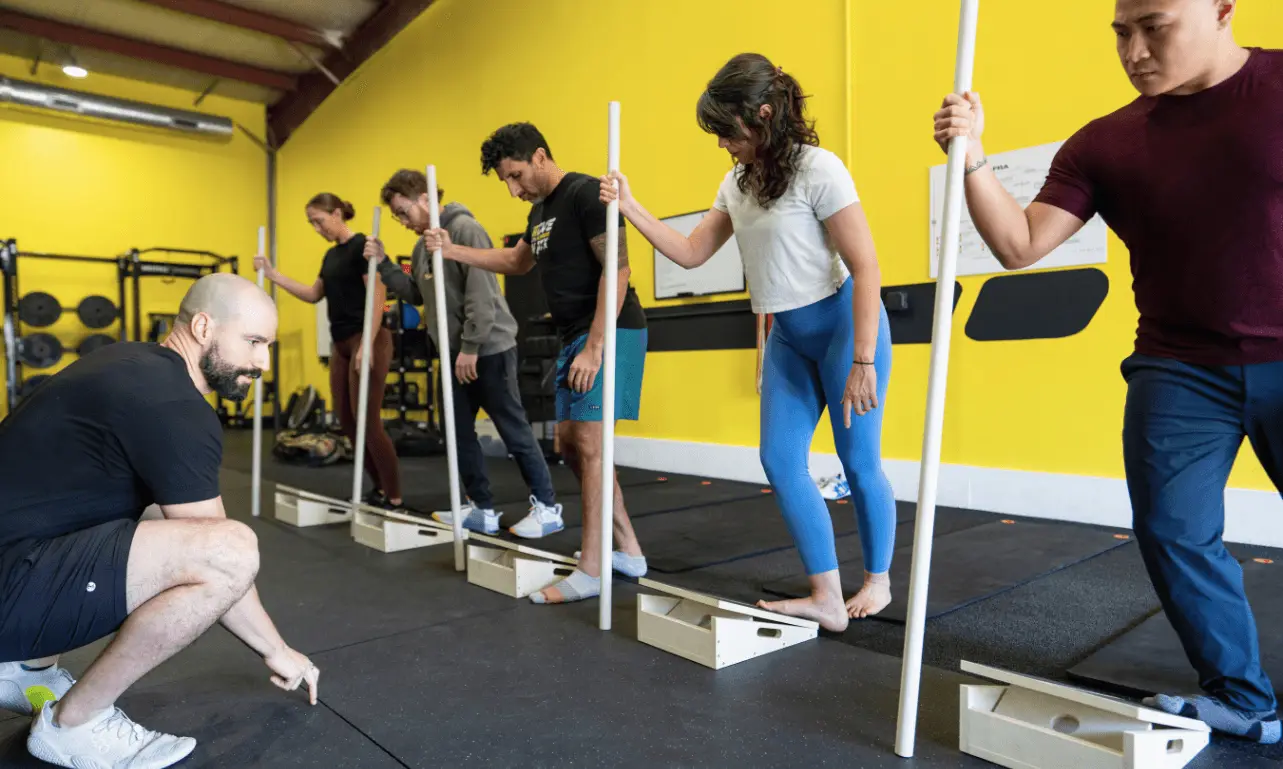
Most people think about movement in terms of exercises.
Squats, presses, deadlifts, running, and other familiar patterns tend to dominate the way training is structured. While these movements are important, they are ultimately just combinations of smaller pieces working together.
Those pieces are joints.
Every movement the body performs is the result of multiple joints coordinating with each other. The hips rotate, the spine stabilizes, the shoulders articulate, and the ankles adjust to maintain balance and force transfer. When these joints move clearly and independently, the entire system functions smoothly.
When they do not, movement becomes inefficient, and in many cases irritation or pain begins to appear.
Joint-by-joint training focuses on improving how each individual joint contributes to movement, so the body can function as a more efficient and resilient system.
Rather than jumping directly into complex exercises, this approach develops control over the individual pieces that make movement possible.
The Goal: Improving the Efficiency of the Kinetic Chain
The kinetic chain refers to the way forces travel through the body during movement.
When you walk, run, lift, or throw, energy moves through a sequence of joints. If each joint can move and control force effectively, movement feels smooth and coordinated. Strength can be expressed more easily, and stress is distributed throughout the body instead of accumulating in one area.
However, if one joint cannot move well or cannot control force effectively, other joints begin to compensate.
For example:
- Limited hip rotation may cause additional movement in the lower back
- Poor thoracic mobility may force the shoulders to work harder than they should
- A restricted ankle can change how the knee and hip behave during squatting or running
Over time these compensations often create inefficiencies or chronic irritation.
Joint-by-joint training works to reduce these issues by improving the function and control of each joint individually. As joint function improves, the entire kinetic chain becomes more efficient.
Why Many Movement Problems Start with Poor Joint Control
Many people can perform common exercises without obvious difficulty.
A squat may look acceptable at first glance, and an overhead press may seem strong enough. But if you observe the movement more closely, subtle compensations often appear.
The pelvis may shift during a squat. The lower back may extend excessively during pressing. The shoulders may elevate when the thoracic spine should contribute more motion.
These patterns usually occur because the body has not developed strong control of specific joints. Instead of clear articulation, the nervous system blends movements together in order to complete the task.
This allows the movement to happen, but it often reduces efficiency and places stress on structures that are not meant to handle it repeatedly.
Joint-by-joint training addresses this by helping people learn to move joints independently before integrating them into larger movement patterns.
Segmentation: The Ability to Move One Joint Without Compensation
One of the most important qualities developed through joint-by-joint training is segmentation.
Segmentation refers to the ability to move one joint or body segment while keeping surrounding areas stable.
For example:
- Rotating the hip without twisting the spine
- Moving the shoulder without arching the lower back
- Flexing the ankle without the knee collapsing inward
When segmentation improves, movement becomes far more precise. The intended joints are able to contribute to the movement instead of relying on surrounding structures to compensate.
One of the most common tools used to develop this ability is Controlled Articular Rotations, a foundational practice within mobility training systems like Functional Range Conditioning. CARs allow individuals to explore and strengthen the full range of motion of individual joints through controlled movement.
If you want a deeper explanation of how these rotations work, you can read our article on Controlled Articular Rotations.
Over time, improved segmentation allows the body to coordinate larger movements with much greater efficiency.
How Joint-by-Joint Training Improves Strength and Mobility
Joint-by-joint training does not replace traditional strength exercises. Instead, it improves the foundation those exercises rely on.
When joints have better mobility and control, strength training becomes far more productive.
A hip that can rotate freely and generate force at end range will contribute more effectively during squats, lunges, and athletic movement.
A shoulder that can move smoothly through its full range allows pressing and pulling exercises to develop strength without unnecessary strain on surrounding tissues.
An ankle that can articulate clearly improves balance, force absorption, and lower-body mechanics.
In each case, the improvement does not come from simply adding more exercises. It comes from improving the quality of movement at the joint level.
This is one reason training systems like Functional Range Conditioning place such a strong emphasis on strengthening joints through their full available range of motion.
Joint Training and Long-Term Joint Health
Another major benefit of joint-by-joint training is its impact on long-term joint health.
Joints rely on regular movement to maintain the quality of their internal structures. Controlled movement helps circulate synovial fluid, maintain cartilage health, and reinforce the nervous system’s ability to coordinate movement.
When joints lose mobility or control over time, certain areas may become overloaded while others are rarely used. This imbalance can contribute to stiffness, discomfort, or reduced performance.
Training joints through controlled ranges helps maintain the health of the structures inside the joint and improves the body’s ability to tolerate load over time.
For individuals experiencing movement limitations or chronic discomfort, a Functional Range Assessment can help identify which joints are not contributing effectively to movement patterns.
From Joint Control to Integrated Movement
While joint-by-joint training begins with individual joints, the goal is always to return to integrated movement.
Once joints can move clearly and independently, they can be combined into larger patterns more effectively.
Squats become more balanced. Rotational movements become more powerful. Athletic skills feel smoother and more coordinated.
This happens because the body no longer needs to compensate for missing joint function.
Instead, each joint contributes what it is designed to contribute.
The result is movement that is stronger, more efficient, and far more resilient over time.
Improving Movement Starts With Understanding the Pieces
Complex movement is built from simple components.
By improving how each joint moves and functions, the entire movement system becomes more capable.
Joint-by-joint training provides a framework for understanding these components and developing them intentionally. It helps people build mobility, strength, and control in ways that translate directly to better performance and healthier movement over time.
For many people, this approach reveals limitations that traditional exercise programs often overlook. Once those limitations are addressed, progress tends to become both faster and more sustainable.
Written by

Brian Murray, FRA, FRSC
Founder of Motive Training
We’ll teach you how to move with purpose so you can lead a healthy, strong, and pain-free life. Our headquarters are in Austin, TX, but you can work with us online by signing up for KINSTRETCH Online or digging deep into one of our Motive Mobility Blueprints.