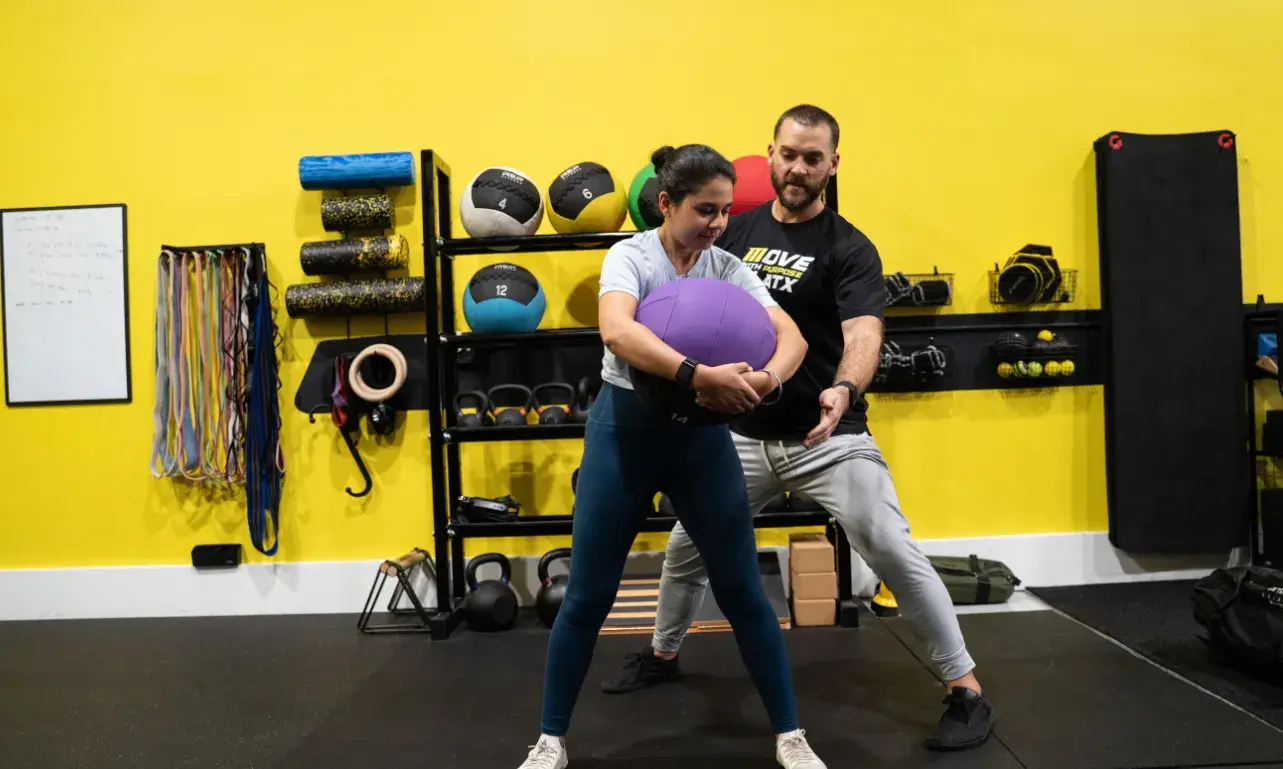
Pickleball found Austin earlier and harder than most cities, and the consequences of that have been showing up in our studio for the last two seasons. Whitaker Courts has forty outdoor courts. Austin Pickle Ranch runs sixteen indoor with leagues running every weeknight. Lesson demand keeps climbing. Most of the players showing up at any of those facilities are between forty and sixty, picking up a paddle for the first time since they last played a real racquet sport in college, if then. The sport itself is forgiving on the surface. The injury picture, when you look at it carefully, is not.
The pattern we see most often in the studio is not a violent acute injury. It is a slow accumulation. Someone starts playing twice a week. By week three they have a tight outer hip. By week six their knee is sore on the lateral cuts. By week ten the shoulder is barking on the overhead. They keep playing because none of it is bad enough to stop, and somewhere around month four something finally tweaks hard enough to make them call. When we look at the body, the diagnosis is almost never that they did something wrong on the court. The diagnosis is that the court asked questions of their joints that the joints had not been asked in twenty years, and the joints answered the only way they could, which was with progressively louder protest.
The sport is not the problem. The sport is a very efficient stress test. What it tests, specifically, is the quality of mobility you have at the joints it loads most.
What the sport actually asks for
Pickleball, played at a real intensity, is a sequence of short reactive movements in a small space. You sprint two steps and stop hard. You shuffle laterally and reverse direction without warning. You lunge low to dig out a dink and then push back out of that lunge to recover. You rotate fast through the trunk to drive a forehand, then rotate the other way to backhand. You reach overhead to put away a high ball, often with momentum already going somewhere else. You do all of this on hard outdoor surfaces, sometimes for ninety minutes straight, often in ninety-degree heat.
None of those individual demands are extreme on their own. The issue is that they get repeated. The hip never gets a long stretch of time in any one position. It gets dragged through internal rotation, then external, then deep flexion, then extension, then frontal-plane loading, then back to internal rotation, in cycles that last three or four seconds each. The same is true of the ankle, the thoracic spine, and the shoulder. The sport does not just demand range. It demands range that you can produce, under speed, in unpredictable combinations, for a long enough time that fatigue becomes a factor.
That is a fundamentally different demand than the one most adult bodies are trained for. A regular gym practice, even a good one, usually involves a relatively narrow movement vocabulary. Squats. Deadlifts. Rows. Bench press. The same shapes, repeated, mostly in the sagittal plane. Running adds volume but stays in roughly the same plane. Cycling does the same. None of that prepares the joints for the rotational, lateral, deceleration-heavy demands of a racquet sport. So when the body shows up to pickleball, it has the cardiovascular fitness to play and the strength to swing the paddle, but the joint vocabulary is not there. The body covers the gap with whatever it can find. That improvisation is where the injuries come from.
Why mobility, not flexibility, is the relevant property
The ranges pickleball requires are not extreme. The deep lunge to a low ball is well within most adults’ anatomical capacity. The thoracic rotation needed for a swing is easily inside what tissues will allow. The shoulder flexion required for an overhead is normal. The question, in every case, is not about the range itself. It is about what the body can produce inside that range under speed.
This is the core distinction we have written about elsewhere in our piece on mobility versus flexibility, and it is the distinction that matters most for understanding pickleball injuries. The player who tweaks something on a low dink is rarely the player whose tissues were too short. It is the player whose hip had the passive range to lunge that low but no active control to decelerate the load and push back out. The shoulder injury is rarely a length problem. It is usually an end-range strength problem, where the shoulder has the flexibility to reach overhead but not the active control to handle a powerful overhead swing while the rest of the body is still moving.
The training that addresses this is not stretching, and it is not generic mobility work. It is range-specific control work, built around the joints the sport actually loads. This is what Functional Range Conditioning does, and it is the framework we use with most of the pickleball players who train with us. The work expands joint workspace and then teaches the nervous system to produce force inside that workspace. For a pickleball player, the practical result is a hip that can lunge low and push back out without something pulling, a thoracic spine that can rotate fast under load without the lower back picking up the slack, and a shoulder that can hit hard overhead without setting up a slow accumulation of soreness.
The five areas that drive most pickleball injuries
There are dozens of joints involved in pickleball, but in the studio we end up working on the same five areas with most players. Each one corresponds to a specific failure mode that shows up reliably as the volume of play increases.
Hip internal and external rotation
This is the biggest one, by a wide margin. Lateral movement, rotational hitting, and the recovery from a deep lunge all demand both internal and external rotation at the hip, often loaded and at speed. Most adults lose internal rotation first, usually well before they notice. The combination of long sitting hours and a training history that rarely loads the hip in rotation produces a population in their forties and fifties whose hip internal rotation is significantly compromised on at least one side.
When that happens, lateral cuts get harder to absorb. The femur cannot rotate cleanly inside the socket, so the load travels outward instead. That is a common mechanism for the lateral hip pain that shows up two or three weeks into regular play. The 90/90 position is one of the better assessment positions for both rotations, and the same shape, used as a training position, builds the rotational capacity that lateral movement actually requires. We have written more about adjacent positions and what they reveal in our piece on frog position and hip mobility, and the same general principles apply.
Hip extension and end-range hip flexion
Hip extension is the range that gets eaten by sitting. Eight hours a day at a desk gives the hip flexors a steady diet of shortened input, and over years the active extension range narrows. Pickleball asks for that range back when you push out of a lunge or sprint forward off a stopped position. If the hip flexors are tight in the active sense, meaning they will not release while the glutes work, you do not get full extension and you do not get clean glute force production. The result is a stride that loads the lower back instead of the hip, which is one of the most common reasons new pickleball players develop low back tightness in their first month.
End-range hip flexion is the other side of the same problem. Lunging deep to a low ball requires the hip to flex past the range most desk-based adults visit on any normal day. If the active range is not there, the body finds the depth somewhere else, usually by rounding the spine or rolling the pelvis. Both are ways of stealing range from places that should not be giving it.
Ankle dorsiflexion
Ankle dorsiflexion is the range that limits everything below the hip. When you decelerate from a lateral cut, the ankle has to absorb load through dorsiflexion combined with frontal-plane control. If the dorsiflexion range is not there, or the active control inside it is missing, the load travels up the chain. The knee is the next stop. This is the mechanism behind a large share of the knee pain that shows up in new pickleball players. The knee is not the problem. The knee is paying for what the ankle and hip cannot do.
The Achilles is the other casualty when ankle mobility is limited. A stiff ankle that cannot dorsiflex well asks the calf to handle deceleration through brute tension instead of through range. Over a few weeks of high-volume play, that tension turns into Achilles soreness, and from there it can progress quickly. Texas heat compounds this. Hot tissue is more compliant in the moment but more dehydrated over a session, and a calf that was already tight starts to cramp and then to ache.
Thoracic rotation
Pickleball is a rotational sport. Every forehand and backhand requires trunk rotation, and most overheads add a rotational component as well. The lumbar spine, by anatomical design, has very limited rotational capacity. Most rotation is supposed to happen at the thoracic spine and the hips. When the thoracic spine cannot rotate well, the lumbar spine takes the load it should not take. This is one of the most reliable mechanisms for low back tightness and pain in racquet sport athletes, and it explains why so many new pickleball players who never had back issues before suddenly develop them after a few weeks of regular play.
Thoracic rotation is also one of the easier ranges to lose without noticing, because you do not need it for most daily activities. People can go years without producing real thoracic rotation, and the system adapts to that. The fix is active rotational work at the thoracic spine. Stretching the lower back does not solve a thoracic problem.
Shoulder external rotation and overhead control
The overhead smash and the high reach both require shoulder flexion combined with external rotation. The shoulder has to hit a position close to one hundred and eighty degrees of flexion, with external rotation, and produce force from there. Most adults who do not regularly load overhead lose active range in this combination. The passive range is often there. The active range, particularly the strength to produce force at end range, is usually not.
The injury picture here is rarely acute. It is a slow accumulation. The shoulder feels tight after the first session. By week four it is sore the next day. By week ten it pinches during the overhead motion itself. The rotator cuff and surrounding stabilizers are doing too much work because the joint cannot organize itself cleanly at the position the swing requires. Some of this is a thoracic problem, because shoulder flexion overhead requires thoracic extension to clear the way. Some of it is direct shoulder work that has been missing from the training picture for years.
What training for pickleball actually looks like
A useful pickleball mobility practice is not a long stretching session before a match. It is a daily, low-volume joint training habit that keeps the relevant ranges available and the relevant control patterns active. The simplest version is a daily CARs practice covering the hips, ankles, thoracic spine, and shoulders. Five to ten minutes a day, done with attention, gives the nervous system a daily map of what you own at each joint. CARs are not a warm-up in the conventional sense. They are an active assessment of joint quality that doubles as maintenance.
For players who already have restrictions or low-grade discomfort, the daily work expands to include end-range isometric training. Hip 90/90 PAILs and RAILs build internal and external rotation under contractile load. Half-kneeling hip flexor work expands active extension. Loaded ankle dorsiflexion drills build range and the strength to use it. Thoracic rotation drills with progressive resistance teach the upper back to do its job during a swing. The framework is the same one we use across our KINSTRETCH classes and our personal training programs, and it is built around the same logic of expanding range and then training control inside it.
Pre-match work is its own category. A short, active warm-up that takes the major joints through their full range under control beats static stretching every time. Long static stretches held before play have been shown to slightly reduce force production for some time afterward, which is the opposite of what you want before a fast, reactive sport. Active CARs and dynamic mobility prime the system without that downside. Five minutes of focused warm-up at the courts, on top of a daily practice that lives off the court, is enough.
The post-match piece is also worth doing, because the body has just spent ninety minutes in repeated rotational and lateral patterns. A few minutes of CARs and a few of restorative breathing helps the system come down from the sympathetic state the sport produces. It does not need to be elaborate. It needs to be consistent.
Austin specifics that actually matter
Texas heat changes the equation in real ways. Outdoor pickleball in Austin during summer means playing in conditions that regularly hit one hundred degrees. Heat reduces tolerance for sustained effort, which often means players warm up less, hydrate poorly, and recover slower. The mobility practice that holds up in those conditions is one that lives off the court, because warming up at the courts when it is one hundred and four out is its own kind of stress test. If your daily ten minutes of joint work is already done before you arrive, the on-court warm-up can be brief, and the body shows up ready.
The demographic in Austin pickleball skews heavily toward forty and up, which is also the population most likely to have spent twenty years in office work. The combined load of long sitting hours and a high-intensity rotational sport is a specific recipe for hip, knee, and shoulder issues. We see this combination often in clients who pick up the sport mid-life, and the same general framework that helps with mobility training after sixty applies to the forty-five-year-old who just started taking pickleball seriously. The principles do not change with age. The pace changes. The need for daily input gets more important, not less.
The court culture in Austin matters too. Pickleball is social. People play in groups, sign up for leagues, and add volume faster than their joints can adapt to. The most common pattern we see is someone going from zero hours of pickleball to four to six hours a week in their first month. That is a steep volume jump for any sport, and it is often the volume curve rather than any single bad movement that produces the first injury. Building joint capacity ahead of the volume, rather than after the first tweak, is the goal.
When something already hurts
A new ache that goes away with a day of rest is usually fine. A pattern of soreness that returns each session, gets a little worse over a week, or starts limiting your daily life is a different signal. The pickleball injuries we see most often in the studio are lateral hip pain, posterior knee tightness, Achilles soreness, anterior shoulder pinching during the overhead, and low back tightness that develops two to four weeks into regular play.
In most of those cases, the trigger is volume colliding with a control gap. The fix is rarely rest alone, because rest does not address the gap. It usually involves a short period of reduced playing time combined with targeted mobility work for the joints that are doing too much and the joints that are not doing enough. If you are not sure which is which, that is exactly what a Functional Range Assessment sorts out. We have also written about how to think about the line between training and clinical care in our piece on personal trainer versus physical therapist, which is worth reading if you are uncertain about where you fall.
A grounded place to start
If you play pickleball regularly, or you are picking it up this season, the single most useful habit is a daily mobility practice covering the joints the sport demands most. CARs for the hips, ankles, thoracic spine, and shoulders, done daily, with attention to where the movement gets noisy. Add end-range isometric work for whichever joint feels most restricted. Build a brief active warm-up into the time before play and a short cool-down into the time after.
If you want a structured plan tied to your specific patterns, we work with a number of Austin pickleball players in personal training and in our group classes. You can book an assessment and start training with us at the studio in South Austin, or join our online mobility classes through KINSTRETCH Online if you want a daily practice you can run from home.
FAQ
Why does my back hurt after pickleball even though my back is not what I am hitting with?
Usually because the thoracic spine is not rotating enough during the swing, so the lumbar spine takes the load instead. The lumbar spine has very limited rotational capacity by anatomical design, and asking it to do thoracic-spine work for an hour or more of play is a reliable way to produce stiffness or pain. The fix is thoracic rotation work, not more lower-back stretching. Stretching the area that hurts often makes the underlying problem worse, because it does not address the joint that should be moving instead.
Should I stretch before pickleball?
Long static stretches held before play are not ideal. Research suggests they slightly reduce force output for some time after, which is the opposite of what you want going into a fast reactive sport. A better warm-up is active joint work that takes the hips, ankles, thoracic spine, and shoulders through their full range under your own control. Five to ten minutes of CARs and dynamic mobility prepares the system without the downside.
How often should I do mobility work if I play three to four times a week?
Daily, ideally. The volume does not need to be high. Ten minutes a day of focused joint work outperforms an occasional long session by a wide margin. The point is to give the nervous system regular input across the relevant joints so the ranges stay available and the control stays sharp. The off days are when most of the adaptation happens, so consistency on those days matters more than what you do at the courts.
I am over fifty and just started pickleball. Is it too late to build mobility?
No. Joints are trainable across the lifespan. The principles do not change with age, though the pace of adaptation can be slower and the need for daily input gets more important. The framework applies broadly to anyone who picked up the sport later in life, and many of the strongest pickleball players we work with started after fifty.
How do I know if pain is a mobility issue or something I should see a doctor about?
A general rule. Soreness that improves with movement, eases with a day or two of rest, and is symmetrical between sides is usually a training and mobility issue. Sharp pain, swelling, pain that wakes you at night, instability, popping or locking sensations, or pain that gets worse over a week despite reduced volume are all signals to see a clinician. When in doubt, see a clinician first and a coach after. A good clinician will often refer you back to a coach for the post-rehab work, which is exactly the gap we are built to fill.
Written by

Brian Murray, FRA, FRSC
Founder of Motive Training
Motive Training is a coaching studio in South Austin built around assessment, joint health, and strength you can use. Train with us in the studio, come to a KINSTRETCH class, or work through the progressions in KINSTRETCH Online.