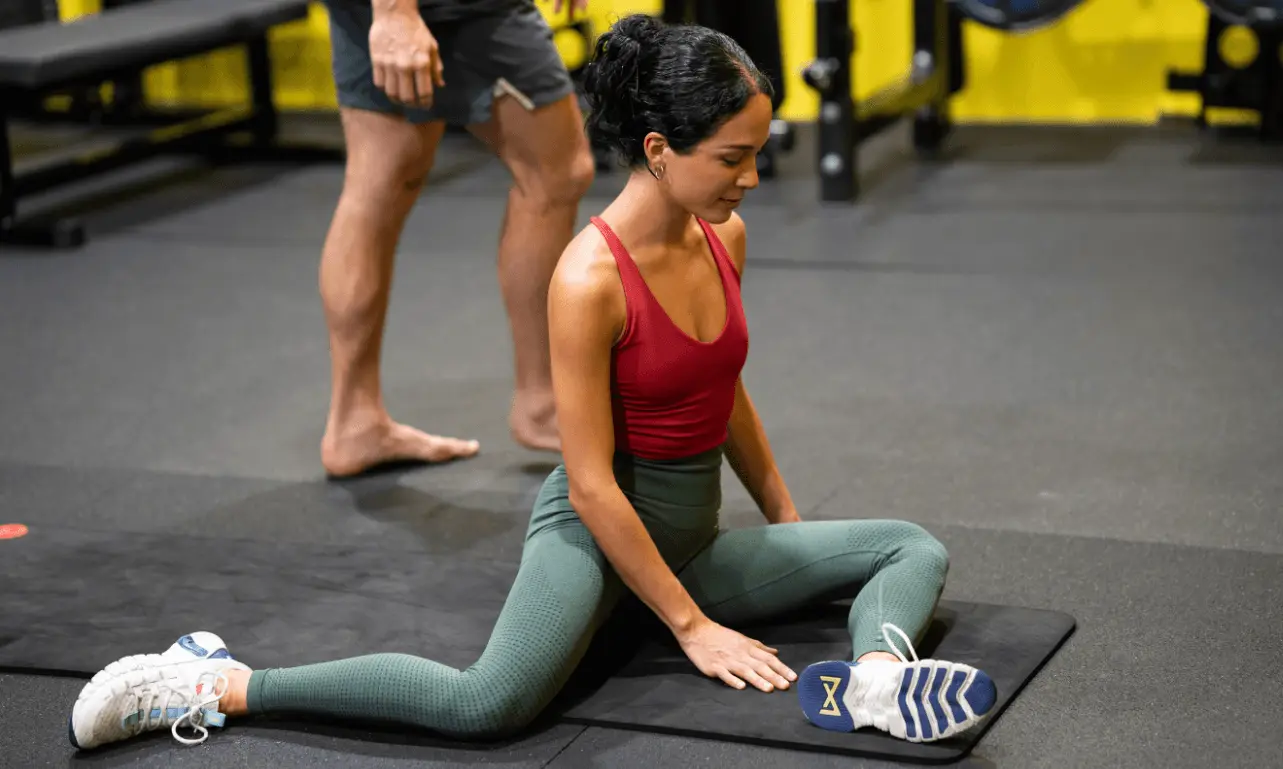
Many people leave a StretchLab session feeling noticeably better. Hips move more freely, the back feels lighter, and shoulders often reach positions that previously felt restricted.
The improvement can feel immediate.
By the next day, the tightness frequently returns.
This experience is extremely common. It does not mean the session was ineffective. It highlights an important limitation of passive stretching.
If you’re still deciding whether assisted stretching studios are worth trying, the breakdown in Should You Use StretchLab? covers what those sessions do well and where they fall short.
Understanding why the results sometimes fade requires looking at the difference between temporary changes in range of motion and lasting improvements in mobility.
Temporary Range of Motion vs Lasting Mobility
Assisted stretching sessions primarily improve passive range of motion.
Passive range refers to positions a joint can reach with outside assistance. During a StretchLab session another person moves the body into positions that may not normally be accessed during training or daily activity.
Several things occur during this process. Muscular tension decreases, the nervous system relaxes, and the body temporarily tolerates larger ranges of motion.
This explains why many people feel immediate relief.
The difficulty appears after the session ends. If the body cannot actively control the newly accessed range, it often returns to the range it already trusts.
This is one of the reasons mobility programs emphasize building usable movement capacity rather than only increasing flexibility, a topic explored in What Is Mobility Training and Why You Need a Coach in Austin.
Flexibility and Mobility Are Not the Same
Flexibility and mobility are often treated as interchangeable terms, but they describe different qualities.
Flexibility refers to the amount of motion a joint can reach passively.
Mobility refers to the amount of motion a joint can actively control and produce force within.
Assisted stretching can improve flexibility temporarily. Long-term improvements require building strength and control in those ranges.
Methods used in Functional Range Conditioning are built around this principle. Instead of simply accessing range of motion, the goal is to develop the strength required to control it.
Without that control, the body has little reason to maintain the additional motion.
Why the Body Tightens Again
The nervous system constantly evaluates stability and safety. Positions that lack strength or coordination may be interpreted as unstable.
One way the body protects itself is by increasing tension around the joint.
That increase in tension is often perceived as tightness.
After assisted stretching creates temporary range, the body may restore tension if it cannot control the new position. The joint gradually returns to the range the nervous system recognizes as stable.
This pattern appears frequently in people who have spent years trying different stretching routines without seeing lasting change, something discussed further in Why Studio Personal Training Is the Best.
Passive Change Does Not Equal Adaptation
Temporary improvements in range are not the same as lasting physical adaptation.
Temporary change occurs when tension decreases and the body allows access to a larger position for a short period of time.
Adaptation occurs when the body develops the strength and coordination required to repeatedly control that position.
Passive stretching sessions typically produce temporary change. Adaptation requires training that reinforces the position with strength and control.
That process often begins by measuring how joints actually move through a Functional Range Assessment, which identifies the specific joints responsible for mobility limitations.
Strength Is What Makes Mobility Last
One of the most effective ways to create lasting mobility improvements is to strengthen the outer limits of joint motion.
When the body can produce force in those positions, the nervous system begins to recognize them as stable and usable.
Techniques like PAILs and RAILs are designed specifically for this purpose. They combine stretching with muscular contractions so the body learns to produce force inside the position that was just accessed.
Instead of briefly visiting a position, the joint begins to own it.
Training approaches like KINSTRETCH focus on developing this type of joint control through structured mobility work.
Maintaining Joint Motion With CARs
Another important tool for maintaining mobility improvements is Controlled Articular Rotations, often abbreviated as CARs.
These are slow, controlled joint rotations performed with high levels of tension and focus. The goal is to move each joint through the range you currently control while keeping the rest of the body stable.
Practicing Controlled Articular Rotations regularly helps reinforce the motion your joints already possess while strengthening the tissues that support them.
Over time, this daily input helps maintain joint health and prevents gradual losses of motion that often lead to stiffness.
Where StretchLab Still Fits
Assisted stretching can still play a useful role.
Many people enjoy it for relaxation, recovery, or temporary relief from muscular tension. The sessions can improve how someone feels in the short term and may help people become more aware of how restricted certain areas of the body feel.
The limitation appears when passive stretching is expected to create lasting mobility improvements by itself.
In practice, assisted stretching tends to work best when combined with training that reinforces range through strength and control.
Mobility Training Options in Austin
People in Austin who have tried stretching studios often begin looking for a more structured approach to improving mobility.
Rather than focusing exclusively on passive stretching, mobility training typically combines assessment, strength development, and joint-specific exercises.
At Motive Training this process begins with understanding how each joint moves and identifying the areas most responsible for limitation. That information allows training to target the joints and positions that will create the greatest change.
For many people, this process becomes the bridge between physical therapy-style analysis and long-term strength training, which is explored further in Our Approach to Personal Training at Motive Training.
The Takeaway
StretchLab sessions often produce noticeable short-term improvements in how the body feels. Reduced tension and assisted positioning allow joints to access ranges that may not normally be reached.
When those ranges are not reinforced with strength and control, the nervous system frequently restores the previous level of tension. The tightness people experience afterward is often the body returning to positions it can safely manage.
Lasting mobility improvements usually require more than passive stretching. They require training that develops strength, control, and resilience throughout the full range of joint motion.
Understanding this distinction helps explain why temporary relief is common and why structured mobility training produces more lasting change.
Written by

Brian Murray, FRA, FRSC
Founder of Motive Training
Motive Training is a coaching studio in South Austin built around assessment, joint health, and strength you can use. Train with us in the studio, come to a KINSTRETCH class, or work through the progressions in KINSTRETCH Online.