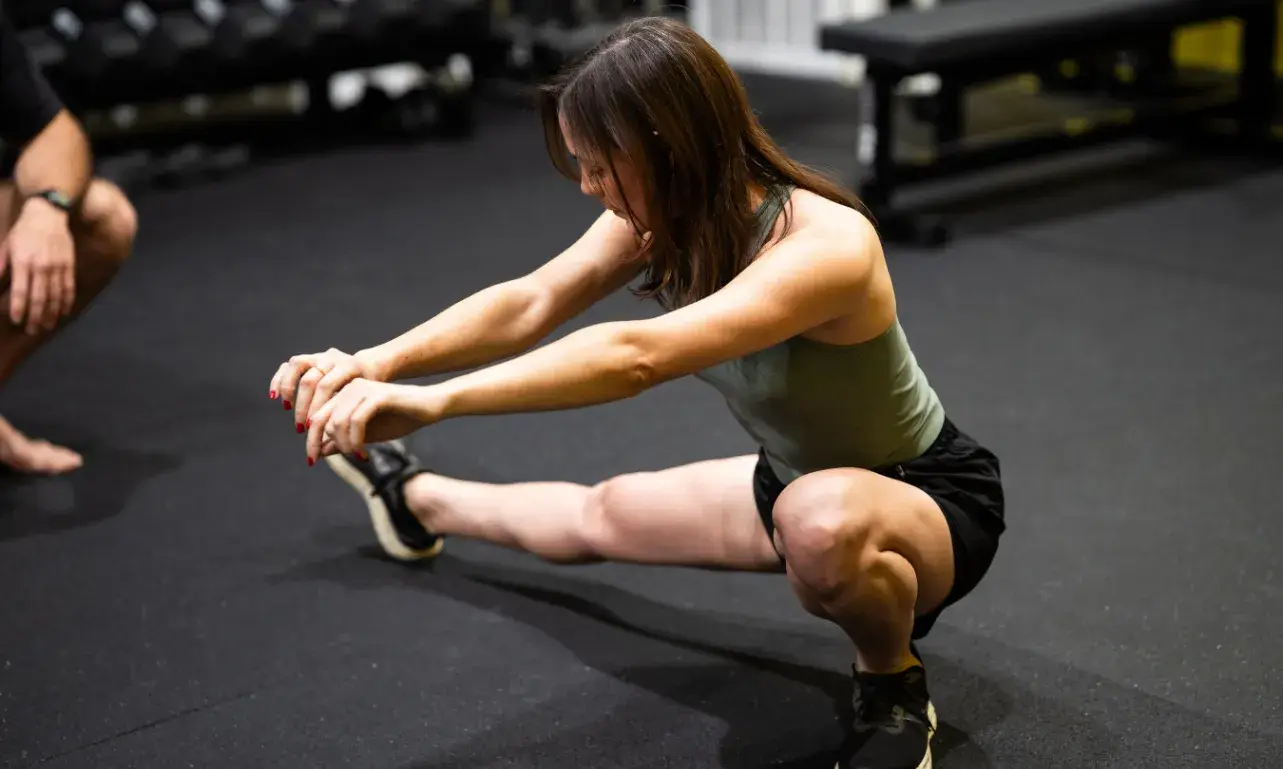
You stretch your hips every day. Maybe you do the half kneeling hip flexor stretch before every workout, spend time in the 90/90 position, foam roll your psoas until it’s sore. And two hours later, your hips are tight again.
This isn’t a flexibility problem. It’s a strength problem—and stretching alone will never fix it.
The Tightness That Never Goes Away
There’s a specific kind of hip tightness that doesn’t respond to stretching. You know the one. You can spend 10 minutes in a hip flexor stretch, feel temporary relief, stand up, take a few steps, and within minutes that familiar pull is back—deep in the front of the hip, or dragging through the glute, or radiating into the lower back.
Most people assume they just need to stretch more. Longer holds. More frequently. Better technique. So they do more of the same thing and get more of the same result.
What’s actually happening is that your nervous system has decided it doesn’t trust your hip to move freely. And until you give it a reason to change that decision, it will keep the range locked down regardless of how much time you spend on a mat.
Tightness in this context isn’t a tissue problem. It’s a protection response. Your brain is limiting your available range of motion because it doesn’t believe you have the muscular control to use that range safely. Passive stretching can temporarily override that protective mechanism—but the moment the stretch ends, the nervous system reasserts control. You didn’t earn the range. You just borrowed it.
This is why people stretch the same muscles for years without ever actually fixing the problem. The solution isn’t more stretching. It’s building strength and neurological control at end range so the nervous system stops seeing that range as a threat.
What the Psoas Is Actually Doing
The psoas is the most misunderstood muscle in the body. Most people know it as a hip flexor that gets tight from sitting. That’s true, but it dramatically undersells how much influence this one muscle has on the way your entire body moves.
The psoas runs from every lumbar vertebra—L1 through L5—down through the pelvis and attaches to the top of the femur. It is the only muscle in the body that directly connects the spine to the leg. Which means when it’s shortened and overactive, it doesn’t just affect hip mobility. It compresses the lumbar spine. It pulls the pelvis into anterior tilt. It alters the mechanics of the knee. It changes how you breathe.
For anyone sitting eight or more hours a day—which describes most of Austin’s tech workforce—the psoas is essentially never at full length. The hip is held in approximately 90 degrees of flexion all day. The psoas adapts to that position. Over time, what was a temporary shortening becomes a resting state, and the nervous system starts treating that shortened length as normal.
Foam rolling the psoas feels like you’re doing something. Stretching it feels productive. But neither addresses the underlying issue, which is that the psoas has lost the ability to function through a full range of motion under load. Training that capacity back is a different task entirely—one that’s difficult to do correctly without guidance, which is a big part of what we address in KINSTRETCH online and in our in-person sessions.
Anterior Pelvic Tilt and Why It Matters More Than You Think
Anterior pelvic tilt is when the front of the pelvis tips downward and the back tips up, creating an exaggerated arch in the lower back. It’s one of the most common postural adaptations in people who sit for long periods, and it’s almost never as simple to correct as “just squeeze your glutes and tuck your pelvis.”
Here’s what’s actually happening: the hip flexors—primarily the psoas and rectus femoris—shorten from sustained sitting. The glutes, which are supposed to counterbalance them, become inhibited through a process called reciprocal inhibition. When the hip flexors are chronically overactive, the nervous system dials down the glutes in response. The pelvis gets pulled forward by the front and left unsupported from the back.
This matters for more than just posture. Anterior pelvic tilt changes the angle of the hip socket relative to the femur, which directly affects how freely the hip can move. People with significant anterior tilt often feel impingement-like symptoms at the front of the hip when they try to flex beyond 90 degrees—squatting, cycling, sitting cross-legged. That sensation isn’t always a structural problem. It’s often a positional one driven by the pelvic tilt.
Correcting it requires retraining the neuromuscular relationship between the hip flexors and glutes, not just stretching the front of the hip. That’s a process that takes time and—honestly—is much easier to understand and execute when someone can watch you move and give real-time feedback. If you want to work through it properly, that’s exactly the kind of thing we cover in person.
The 90/90 Position: What It’s Testing and What It’s Training
The 90/90 position has become popular in fitness circles for good reason. It’s one of the most efficient positions for simultaneously accessing hip internal and external rotation—two ranges of motion that are critically important for lower back health, athletic performance, and pain-free movement, and that almost no traditional exercise addresses directly.
To understand what’s happening in the 90/90, picture sitting on the floor with both knees bent at 90 degrees—one leg rotated outward in front of you, one rotated inward behind you. The front hip is in external rotation. The back hip is in internal rotation. Most people immediately notice restriction on the back hip side, which is the hip in internal rotation. That’s the clinically significant finding.
Hip internal rotation loss is one of the strongest predictors of lower back pain, hip impingement, and knee injury in the research literature. When the hip can’t internally rotate well, those forces get absorbed somewhere else—usually the lower back or the knee. So the 90/90 isn’t just a stretch. It’s a diagnostic. The side that feels restricted is telling you something.
The passive version—just sitting in the position and breathing—has some value. But the higher-value work happens when you start to actively load the position: lifting the back shin off the ground to train hip internal rotation strength, lifting the front shin off the ground to train hip external rotation strength. These movements expose whether you actually own the range or are just sitting in it.
Getting the active loading right is genuinely hard to describe in text. The compensations are subtle—a hip that hikes, a lower back that rotates to make up for what the hip can’t do, a knee that shifts. In KINSTRETCH online, we walk through these progressions step by step so you can actually feel the difference between passive and active range. That’s where the real learning happens.
The Half Kneeling Hip Flexor Stretch, Done Right
The half kneeling hip flexor stretch is one of the most commonly performed and most commonly butchered exercises in fitness. Most people get some benefit from it. Very few people are actually doing what they think they’re doing.
The standard version goes like this: drop into a kneeling lunge position, shift your weight forward slightly, and feel a stretch in the front of the back hip. That does create a stretch sensation. But in most people, what’s actually happening is lumbar extension compensation—the lower back arches to produce the sensation of hip flexor length when the hip flexor itself isn’t lengthening much at all.
The corrected version requires establishing a posterior pelvic tilt before any forward shift happens. Squeeze the glute of the back leg, tuck the pelvis under, and maintain that pelvic position as you shift forward. The stretch should be felt deep in the front of the hip and groin, not in the lower back. If you feel it in your lower back, the lumbar spine is compensating and you’re not actually stretching what you think you’re stretching.
From there, the more productive progression adds an isometric contraction at end range—what we’d call a PAILs contraction in Functional Range Conditioning. You pull the back knee into the floor as hard as possible for 10 to 20 seconds without moving, then relax and attempt to move further into the range. This signals to the nervous system that you have muscular control at end range, which is exactly the information it needs to stop guarding the position.
Coaching the posterior pelvic tilt and the isometric contraction correctly in text is genuinely difficult—there are too many moving parts and too many ways to compensate without realizing it. If you’ve been doing this stretch for a while and still feel it in your lower back, it’s worth getting eyes on your technique. That’s a conversation we have regularly in our in-person sessions.
What a Real Hip Mobility Practice Looks Like
A stretching routine treats symptoms. A mobility practice addresses the system.
The difference is intent. Stretching is passive—you put the tissue under tension and wait. A mobility practice is active—you’re training the nervous system to accept and control ranges it currently won’t allow. The positions can look similar from the outside. What’s happening inside them is completely different.
For the hips specifically, a real practice includes daily controlled articular rotations to assess and maintain joint health, progressive end-range loading in the 90/90 position for both internal and external rotation, half kneeling work with correct pelvic position and isometric loading, and targeted glute work to rebalance the anterior pelvic tilt pattern. Each of those components has a specific purpose in the progression. None of them are optional if you want lasting change.
This doesn’t require an hour a day. Ten to fifteen minutes done consistently, with the right intent, outperforms an hour of passive stretching done occasionally. The investment is small. What it asks of you is attention and precision—which is exactly why having a structure to follow makes such a significant difference.
If you want to work through this systematically, KINSTRETCH online gives you that structure with coaching built in. If you’d rather start in person and get hands-on feedback on your specific restrictions, we can do that too.
Tight hips aren’t permanent. But they won’t respond to the same approach that created them.
Written by

Brian Murray, FRA, FRSC
Founder of Motive Training
Motive Training is a coaching studio in South Austin built around assessment, joint health, and strength you can use. Train with us in the studio, come to a KINSTRETCH class, or work through the progressions in KINSTRETCH Online.