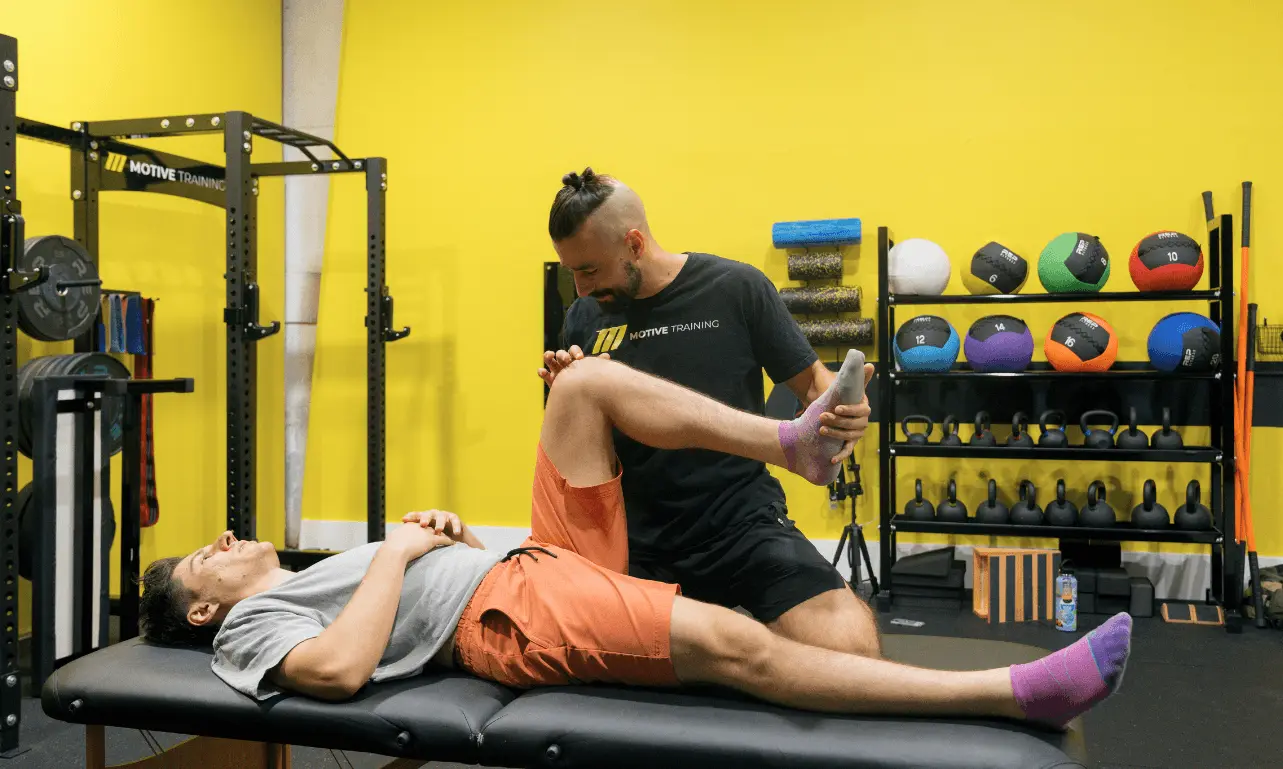
There’s a moment in the gym I see often enough that it’s become a tell. Someone with a long history of training, decent strength, no obvious limitations, gets put into a deep hip position passively. Knee to chest, leg externally rotated, the kind of position you’d assume an athletic person could produce on their own. Then I ask them to hold the position with their own muscle alone. No assist. No hand on the shin to help. Just hold it. And the leg falls. Sometimes by half a foot. Sometimes the position can’t be sustained at all.
That gap between where a body can be placed and where it can act on its own is the entire premise of end-range mobility training. Most strength work, most stretching, even most mobility programs miss it, and the gap is where almost every preventable injury lives.
What end-range mobility actually means
End-range mobility isn’t just being able to reach a position. It’s being able to produce force, sustain tension, and control movement at the outermost limits of a joint’s range. A flexible shoulder can be placed overhead. An end-range mobile shoulder can be placed there, hold itself there under load, and move out of that position deliberately under control. Two different things, even though they look identical in a still photograph.
This is the distinction most fitness writing fumbles. We’ve made the longer case that flexibility and usable range aren’t the same thing, and the relevant point for end-range work is this: range without strength to defend it is borrowed range. You can get into the position because someone or something put you there. You can’t keep yourself there, can’t move out of it under control, can’t load it. The body knows this even if you don’t, which is why it doesn’t really let you access the position on your own. The protective limiting is the body’s way of refusing to write checks the muscles can’t cash.
End-range mobility training is the work of closing that gap. Building strength in the lengthened tissue. Teaching the nervous system that the position is owned, not borrowed. Converting flexibility into something that survives load, fatigue, surprise, and the messiness of actual sport and life.
Why this gap exists in the first place
Most people who train do it almost entirely in the middle of their available range. Squat to a comfortable depth. Press to where it feels strong. Pull from a position the back can stabilize. Nothing wrong with any of that, and a lot of valuable work happens in the middle ranges. The cost is that the ends, the deep positions, the long positions, the outermost arcs, never get trained. The nervous system isn’t stupid about this. It limits what it doesn’t have a reason to trust, and time spent away from a position is a reason to trust it less.
There’s also a research thread worth flagging without overstating. People generally have somewhere around ten to fifteen degrees more passive range than the nervous system permits them to use actively. Don’t quote me on the exact number, the methodology varies study to study, but the pattern is well-documented. That gap doesn’t exist because the tissue can’t be there. It exists because the protective braking system has decided the active version of the position isn’t safe yet. Stretching can move the passive ceiling. It doesn’t change the brake. The brake only eases when you spend time producing force in the position the brake was hiding.
This is most of why static stretching alone doesn’t transfer to better movement, and it’s the core premise of Functional Range Conditioning, the system most of the end-range training language comes from. The work isn’t about making the joint more flexible. It’s about making the available range usable.
The toolkit, in concept
There are a handful of distinct tools used to train end-range mobility, and each one does a specific job. The deep mechanics of each live in their own articles. What matters at the pillar level is understanding what each tool exists to do and why the order matters.
Controlled articular rotations, or CARs, are the daily check-in. Slow, deliberate movements through the full active range of a joint, under tension. They serve as both maintenance and assessment, which is why a daily morning practice tends to outperform an occasional intense session. CARs aren’t the heavy work of end-range training, but they’re the practice that keeps the range you have accessible and reveals when something’s changing. We’ve covered the full mechanics of CARs elsewhere.
Passive range holds are the simplest active reclaim. You get into the deepest end-range position you can tolerate, then drop the external assist, and hold the position using only your own muscle. No partner help, no prop, no leverage. Just the muscle being asked to hold a position the body normally relies on outside support to maintain. This is the entry-level work for owning a range you couldn’t previously control on your own, and it’s the cleanest bridge between passive flexibility and active mobility.
Progressive and regressive angular isometric loading, PAILs and RAILs, are the strength work. PAILs is contracting the muscle being stretched, in the direction of the stretch, while held at end range. RAILs is contracting the antagonist, the muscle that would actively pull you deeper into the range. Together they build neurological ownership of the end position by demonstrating force production from both sides of the joint. They’re the most demanding tool in the kit, and they’re where most usable range actually gets built. The deeper version of how they work lives in the PAILs and RAILs guide, and the programming logic of how often, how many rounds, and where they sit in a week is in the programming guide.
Hovers and lift-offs are the precision layer. Once range has been claimed through the heavier tools, these refine active control within the new territory. A lift-off involves producing slight active motion from a position your passive range allows. A hover is moving through a small arc near end range under strict control. Both teach the nervous system to operate cleanly inside the range you’ve expanded, which is the difference between owning a position and just visiting it.
The order matters. CARs maintain. Passive holds claim. PAILs and RAILs build strength. Hovers and lift-offs refine. Skipping the middle layers and jumping straight to precision work is how people end up loading positions they don’t actually control yet, which is exactly the pattern this work is meant to prevent.
What end-range mobility actually gives you
The injury prevention argument is the one that usually gets people interested, and it’s a real one, but it’s worth being specific about why. Most non-contact injuries don’t happen in the middle of a range. They happen at the edges, in the positions the body got dropped into without having the strength to defend. An ankle that gets forced past its trained range during a misstep. A shoulder that ends up overhead during a fall. A hip that takes a load in a position the squat never prepared it for. End-range mobility training is the preparation for those moments, because it’s the work that makes the edges of your range as defensible as the middle.
There’s a performance argument too, but it’s less universal. For athletes whose sport demands end-range positions, the value is obvious. A baseball pitcher needs external rotation that holds under speed. A grappler needs hip flexion that produces force. A swimmer needs shoulder mobility that doesn’t collapse under load. End-range mobility is the difference between technique that holds up at competition and technique that breaks down when the position gets harder.
For the general population, the relevant outcome is durability over time. The ranges most people lose first as they age, hip rotation, shoulder elevation, thoracic extension, ankle dorsiflexion, are exactly the ranges end-range mobility training maintains. Losing those ranges is most of what makes older bodies move like older bodies. Keeping them is most of what doesn’t.
Where to start
If this is new territory and you’re not sure where to begin, the practical answer is that most people benefit from starting with CARs as a daily habit and a passive range hold or two in the joints that feel most restricted. That’s enough to build the awareness and baseline control to start adding the heavier tools without spinning into something you can’t program. Three to five sessions a week of focused end-range work, ten to fifteen minutes at a time, is enough to produce real changes in usable range over the first few months.
If you’re not sure which of your joints actually need the work, that’s most of what the movement assessment is for. The gap between passive and active range is rarely uniform across the body. Most people have one or two joints where the gap is large and several where it’s small, and the smart use of training time is to spend it on the joints where the gap is widest, not the ones that feel tightest. Those aren’t always the same place.
End-range mobility is one of the highest-leverage investments you can make in long-term joint health, and the work is more straightforward than the terminology suggests. Once you understand what each tool exists to do, the practice gets easier to build. The principle stays the same throughout. Get into the range, produce force there, do it consistently, and let the body figure out what it now owns.
Written by

Brian Murray, FRA, FRSC
Founder of Motive Training
Motive Training is a coaching studio in South Austin built around assessment, joint health, and strength you can use. Train with us in the studio, come to a KINSTRETCH class, or work through the progressions in KINSTRETCH Online.