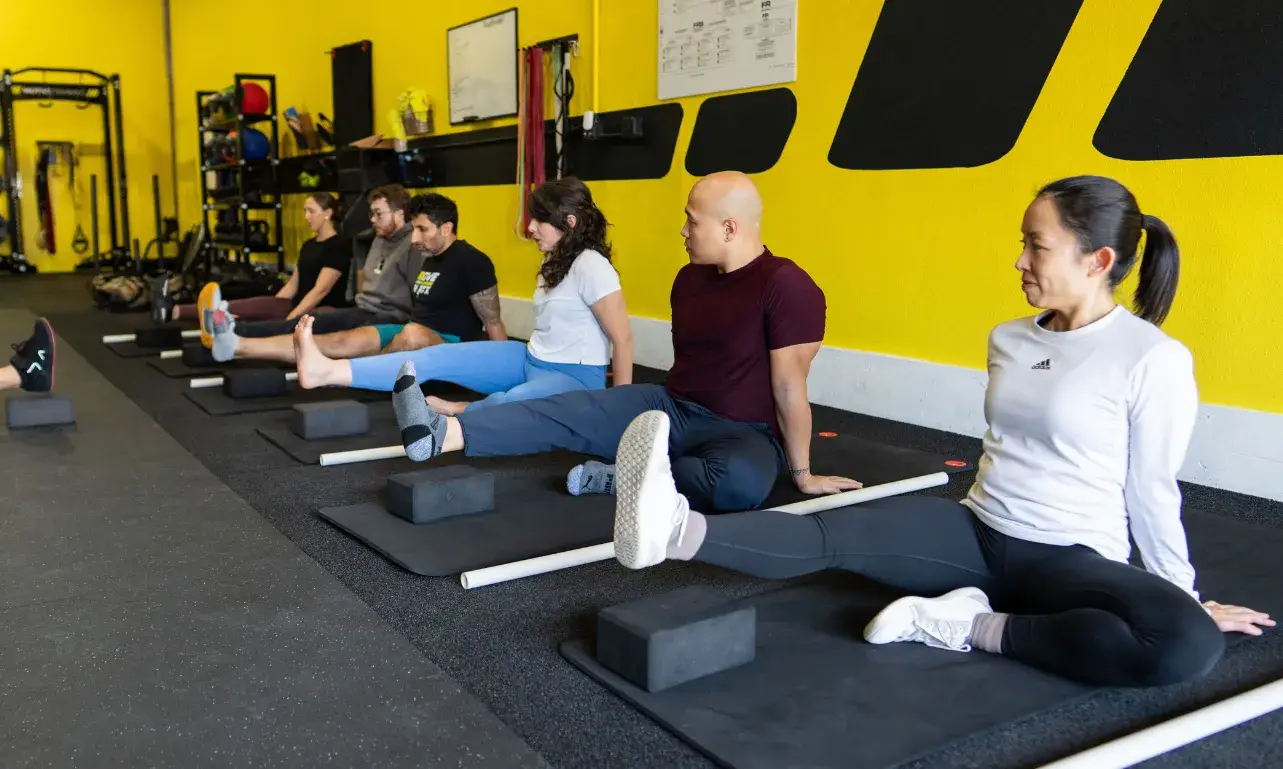
A pattern shows up so often in the studio that it has become a kind of recognition test. Someone walks in, usually in their late thirties or forties, and tells me they have been stretching for years. They can touch their toes. They have done yoga. Maybe they have a foam roller and a lacrosse ball at home and a small repertoire of moves they cycle through. And yet their hips feel locked up by mid-morning. Their lower back tightens after they sit. Their shoulders feel restricted overhead even though, on paper, the flexibility is there. They tell me this with genuine confusion. The story they have been told is that stretching solves stiffness, and they have done the stretching, and the stiffness is still there.
The frustration is real, and the underlying assumption is one that most fitness culture reinforces. The assumption is that stiffness is a measure of how short your tissues are. That if you can lengthen the tissue, the stiffness goes away. That more range equals less tension. None of that is wrong exactly. It is just incomplete in a way that matters for most adults who train.
If you are flexible and still stiff, the problem is not the amount of range your tissues will allow. The problem is the difference between the range your tissues will allow and the range your nervous system will let you produce on your own. That gap is the thing you are feeling. Closing it requires a different kind of work than the one that opened the passive range in the first place.
The two ranges your body has at every joint
At every joint, you have two different range numbers. They almost never match.
The first is passive range of motion. That is the number you produce when something else does the work. A partner pushing your knee toward your chest. Gravity sinking you into a seated forward fold. The wall holding your foot up while you stretch your calf. Passive range tells you what the surrounding tissues will tolerate without active resistance from the muscles around the joint. It is a measure of capacity.
The second is active range of motion. That is the number you can produce on your own, without help, without leverage, without momentum. Lift your leg as high as you can without using your hands. Reach overhead without arching your low back to fake it. Take your shoulder through a full slow circle while standing tall. Active range tells you what your nervous system trusts you with under your own control. It is a measure of ownership.
For most people who feel stiff despite being flexible, the passive number is fine. Sometimes more than fine. The active number is much smaller. The body is essentially walking around with a large pool of unused real estate. The brain knows the range is technically available, but it does not consider that range usable, so it limits access through tension. That tension is not a malfunction. It is the body doing something protective. It just feels like stiffness.
This is the distinction at the center of how we think about mobility versus flexibility. Flexibility describes how far you can be moved. Mobility describes how far you can move yourself. The two are related, but they are not the same property, and they respond to very different kinds of training.
Why stretching does not close the gap
The research on long-term stretching is more inconvenient than most people realize. Static stretching does produce range gains. That part is real. But when researchers have looked carefully at what actually changes during a stretching program, the answer has not been muscle length, at least not in any structurally meaningful way. The dominant change is something called stretch tolerance. The nervous system simply gets more comfortable with the sensation of stretch. The muscle does not get appreciably longer. The brain decides that being in a deep stretch is not as threatening as it used to be, and so it allows you a bit further before pulling the brake.
Tolerance is not a useless adaptation. There are real reasons to want a nervous system that does not panic at end range. The problem is that tolerance and control are different skills. Stretching trains tolerance. It does not train control. So when you finish your stretching session and stand up and try to lift your leg high without help, the body has no reference for how to organize itself there. The hamstring has not learned to produce force at that range. The hip flexors have not learned to operate against gravity at that height. The glutes do not know how to stabilize the pelvis while the leg holds itself up. So the body falls back on whatever active range it actually controls, which has not changed much, and you produce a leg lift that looks roughly the same as it did last year.
This is why someone can stretch every day for ten years and still feel locked up the moment they ask their body to do anything dynamic. The passive range opens, slowly. The active range stays where it was. The gap between them grows. And that gap, that exact distance between what your tissues will tolerate and what your nervous system will let you produce, is what your brain reads as risk. Risk shows up as tightness. Tightness shows up as the feeling that you need to stretch more. And the loop continues.
What stiffness actually is
Stiffness, as a sensation, is not a description of muscle length. It is a description of nervous system output. When your brain decides a position is unprotected, that the joint capsule cannot be relied on, that the surrounding muscles cannot produce force fast enough, or that the proprioceptive map of the area is unclear, it raises the resting tone of the local musculature. Tone is a constant, low-level contraction. It limits how far you can go and how fast you can get there. The muscle is not anatomically short in those moments. It is being held tight on purpose, by the system that is trying to keep you intact.
Once you understand that, a lot of confusing experiences start to make sense. Why does your back feel tight only after you sit? Because sitting deprives the local tissues of the input they need to feel mapped, and the brain compensates by raising tone. Why do your hips feel looser after a hard set of training and tighter after a long meeting? Because training gave the system clear input about what the joint can do, and the meeting did not. Why does the same hip flexor stretch you have done a thousand times still produce the same tight feeling at the end of every day? Because the stretch is not what the system is asking for. The system is asking for evidence that you can produce force in those positions. A stretch is the wrong reply.
This framing also explains why stiffness is often most stubborn in people who have been training for years. The muscles are not the problem. The muscles are perfectly capable. What is missing is daily input across a wide enough variety of joint positions to give the nervous system a reason to trust ranges it does not normally see. Modern adult life provides almost no such input. Eight hours at a desk, an hour at the gym in repeatable patterns, evenings on a couch. The body adapts to what it sees most. It does not adapt to what it might want.
The patterns that produce a flexible-but-stiff body
Several common patterns push someone into the flexible-and-stiff category in particular.
The first is a long history of yoga or static stretching without complementary loading work. The passive ranges open, sometimes considerably. The active ranges do not keep up. People with this background often have very large gaps at the hips, hamstrings, and shoulders. They can fold deeply. They cannot lift a leg. The nervous system has learned to relax into positions, but it has not learned to control them.
The second is the desk-and-gym combination. Most of the day spent in flexion at a computer, an hour spent training with a fairly narrow movement vocabulary, no daily input outside those two settings. Hips never see end-range extension. Thoracic spine never sees end-range rotation under load. Shoulders rarely see overhead under control. The result is a body that has reasonable flexibility in many places but a very narrow band of usable range. People with this profile feel stiff almost as a baseline state, even when they are clearly fit.
The third is the runner profile. High aerobic capacity, repeatable gait, a relatively narrow range of joint positions visited at high volume. Runners often have hamstrings and calves that pass any flexibility test you give them but feel persistently tight because the active control work has been displaced by miles. The system is well-trained at a narrow range of motion and undertrained at the edges.
The fourth pattern is the post-injury body. After a knee surgery, a back episode, a shoulder problem, the area heals but the brain often does not fully reissue trust. The passive range comes back. The active range lags, sometimes for years, because no training has explicitly closed the gap. People with this history tend to feel stiff in the area that was injured long after the underlying tissue is fine.
In all of these cases, the common feature is the same. The flexibility is acceptable. The control is missing. The body does what it always does in the absence of control. It tightens up.
What actually works to close the gap
The training that addresses this directly is not more stretching. It is not foam rolling. It is not deep tissue work. Those things can be useful as adjuncts, but they do not solve the core problem. The core problem is a control gap, and the only thing that closes a control gap is producing force inside the range you want to own.
This is what Functional Range Conditioning is built around. The methodology was designed specifically to address the active-passive gap, and the work is built on three layers that operate together. The first is expanding the joint workspace, which means giving each joint regular daily input across its full available range. The second is building active strength inside that workspace, which means producing force at end ranges where most training never goes. The third is convincing the nervous system, through repeated evidence, that those new ranges are safe to load. None of those layers are optional. Skip any one and the gains do not stick.
CARs, or controlled articular rotations, are the entry point. Done well, a CARs practice gives the nervous system a daily map of every major joint, taken slowly through its largest accessible circle under your own active effort. CARs are not stretching. They are not warm-up in the conventional sense. They are an active exploration of what you currently own at each joint, and they steadily expand that ownership when done with intent over weeks and months.
PAILs and RAILs progress the work into territory stretching cannot reach. The protocol pairs a passive end-range position with brief, hard isometric contractions, first into the floor or wall (the PAILs portion) and then up into the air against gravity (the RAILs portion). The mechanism is precise. The isometric contraction at end range tells the nervous system, in a language it understands, that you have force production capacity at this position. Repeated over time, the system updates its map. The active range expands to match more of the passive range. We cover the mechanism in more depth in our PAILs and RAILs explainer, and the underlying logic is the same one that drives our KINSTRETCH classes.
The work has to be active and it has to be specific. Hip stiffness almost always requires hip work, not just back work. Shoulder stiffness usually requires both shoulder and thoracic work. The areas that feel tight are often paying for control gaps elsewhere in the chain, which is one of the patterns we see most clearly in clients with persistent low back tightness, and is something we have written about in more detail in why back pain is often a hip and thoracic problem.
What this looks like in real training
A client who has been flexible for years but still feels stiff is usually surprised by how hard the active work feels at first. They can sit in a deep hip stretch comfortably, breathing normally. Then we ask them to lift their leg into the same range without help and hold it there for ten seconds, and they cannot. They get to about sixty percent of their passive range and start shaking. Their hip flexor cramps. They drop the leg. That contrast is the point. It shows them, in real time, the size of the gap they have been carrying around. It also reframes the entire training conversation. The problem was never that they needed more flexibility. The problem was that their flexibility was a gift their nervous system had not accepted.
The training response usually moves quickly, but not in the way people expect. The flexibility number does not change much. They could already touch their toes. What changes is how their body feels during the day. The morning stiffness eases. The lower back stops tightening up by lunch. The hips feel quieter when they sit at a meeting. The shoulders feel more available overhead. None of that comes from gaining new flexibility. It comes from the nervous system letting go of protective tension because the brain finally has reason to trust ranges that were already there.
The other thing that changes is how their training feels. Squats settle deeper without effort. Overhead pressing stops feeling like a fight. Lateral movement gets easier. Sport carries over more cleanly. This is not because the muscles got stronger in any new way. It is because the body finally has access to range it can use, which means more options under load and less internal friction during movement.
How to know which side of the line you are on
A simple way to check is to compare passive and active range at any joint that bothers you.
For the hip, lie on your back and let someone bring your knee toward your chest as far as it goes comfortably. Note that range. Then drop the leg back, keep the knee straight, and lift the leg as high as you can on your own without bending the knee or rolling your pelvis. The size of the difference is your control gap. For most desk-based adults, the difference is significant, often thirty to forty degrees or more.
For the shoulder, stand against a wall with your low back flat against it. Reach one arm overhead and try to touch the wall behind your head without arching your back or shrugging. Most people cannot. Then, lying down, see how far the arm goes when gravity helps. The difference is the gap.
For the thoracic spine, sit in a chair with your hips squared and try to rotate your torso to one side without letting your hips turn. Note the range. Then have someone gently rotate you to a deeper end range. The difference is the gap.
You can do versions of this at most major joints. If passive is much larger than active across multiple joints, more stretching is not going to solve the stiffness. The work that matters is whatever closes that gap. If you want a structured assessment of where those gaps live in your specific body, that is what a Functional Range Assessment is built for. It is the most efficient way to figure out which joints are pulling weight, which joints are not, and where to spend your training time.
A grounded next step
The path forward, if you have been flexible and stiff for years, is a different category of work. You need range that you can produce on your own, hold under load, and access without thinking about it. That is mobility, in the precise sense of the word. It is trained, not stretched into existence.
A reasonable starting point is a daily CARs practice covering the major joints, ten minutes done with attention. Add end-range isometric work for the joints that bother you most, twice a week. Give it six weeks before judging the results, because the change you are looking for is not a flexibility number. It is a quality-of-feeling change in how your body sits and moves through a normal day.
If you want a more structured approach with eyes on your specific patterns, you can book an assessment and start training with us at the studio in South Austin, or work through our online classes inside KINSTRETCH Online if you want a daily practice you can do from home.
FAQ
Why do I feel tight even though I can stretch easily?
Because flexibility and mobility are not the same property. Stretching trains your tolerance to a position. It does not train your ability to produce force or maintain control at that range. If your active range is much smaller than your passive range, the body protects the gap with elevated muscle tone, and that elevated tone is what you feel as stiffness. The fix is active control work at the relevant ranges, not more stretching.
How long does it take to close the gap between passive and active range?
Most people notice meaningful reductions in daily stiffness within four to six weeks of consistent CARs and end-range isometric work. Real expansion of usable joint space is a longer project, usually three to six months of regular training to see substantial change at a given joint. The pace depends on the size of the gap, how often someone trains, and how much daily input the joints get from work and life outside training.
Should I stop stretching entirely?
No. Stretching has real uses. It can maintain passive range, help settle the nervous system, and serve as a small piece of a larger practice. The point is not that stretching is bad. The point is that stretching alone will not solve the kind of stiffness that comes from a control gap. Use stretching where it helps. Add active mobility work to actually close the gap. The two can coexist.
Is yoga the same as mobility training?
Not really. Yoga can build a lot of useful capacity and is genuinely valuable for some people, but most styles emphasize passive holds and end-range positions without the loaded, isometric, joint-specific work that builds active control. We get into the difference more in our piece on KINSTRETCH and yoga. The two practices can complement each other, but they are doing different jobs, and yoga alone tends to widen the active-passive gap rather than close it.
Where do I start if I have never done active mobility work before?
A daily CARs practice is the simplest, lowest-cost entry point. Five to ten minutes covering the major joints gives the nervous system new input and starts revealing where your control gaps live. From there, end-range isometric work for the joints that need it most is the next layer. If you want help building a plan that fits your specific body and history, an in-person assessment is the most direct way in.
Written by

Brian Murray, FRA, FRSC
Founder of Motive Training
Motive Training is a coaching studio in South Austin built around assessment, joint health, and strength you can use. Train with us in the studio, come to a KINSTRETCH class, or work through the progressions in KINSTRETCH Online.