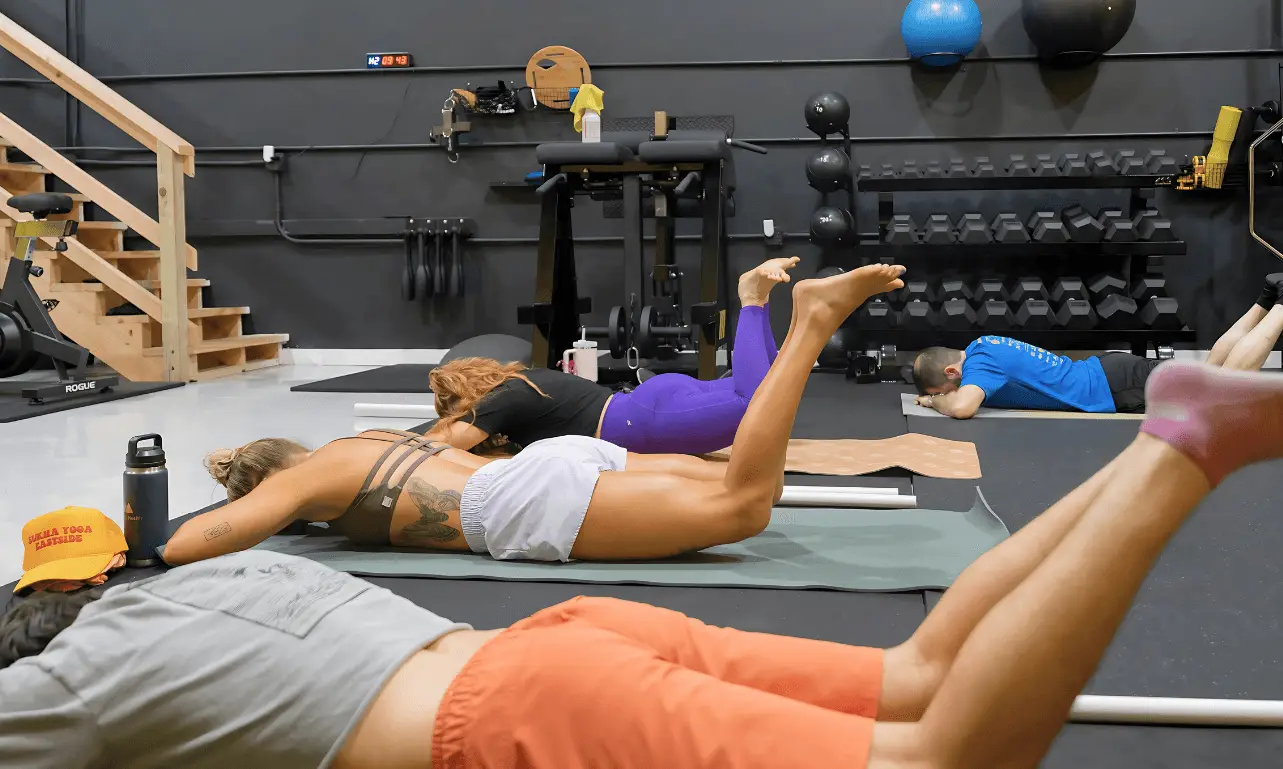
People who come to KINSTRETCH from yoga usually ask the same question in the first two weeks: is this the same thing with a different name? The honest answer is no, with some overlap depending on what kind of yoga you’ve been doing.
Both practices ask you to spend time in positions most adults rarely visit. Both can leave you feeling looser. Both can quiet a busy nervous system in the right context. But the underlying goal is different, and that difference shows up in what your body actually keeps once class is over.
If your goal is a consistent movement practice, breath work, or stress relief, yoga is doing something real. If your goal is to change what a specific joint can do under load, KINSTRETCH is built for that more directly. The two can coexist, and for a lot of our clients they do.
What yoga is actually good at
The first thing worth saying: yoga isn’t one thing. Hot vinyasa, slow Iyengar with prop work, athletic Ashtanga, restorative. These are different practices that happen to share a name. Some look closer to a strength class with breathing emphasis. Some look closer to a guided rest. The variation matters because it changes what you can reasonably expect from regular practice.
Across most styles, yoga tends to do a few things well. It gets people moving consistently, which is more than most adults manage on their own. It introduces positions and patterns that everyday life doesn’t, so the body stops feeling unfamiliar in basic shapes. And the breath and pacing component does real work for stress regulation. People who practice regularly often report sleeping better, handling stress better, and feeling more at home in their bodies. That isn’t placebo.
Where yoga can also build something closer to mobility is in the styles that emphasize active positions, longer holds, and load through the joints rather than just sinking into stretches. Iyengar with prop work is doing more than passive lengthening. Athletic vinyasa puts you in positions under your own bodyweight, repeatedly, which is a kind of training.
The limit is also real. Most general yoga classes are designed for the room, not for your specific joint. That’s a feature for a group setting. It’s also why the same hip, shoulder, or thoracic issue can persist through years of yoga without changing much. The class can’t isolate what your particular limitation is, and the cues are written for the average body, which is no one’s actual body.
Flexibility and mobility aren’t the same thing
Most of the confusion in this conversation comes from collapsing two different things into one word. We’ve covered this in more depth in our piece on mobility vs flexibility, but the short version is worth restating because it sits at the center of why yoga and KINSTRETCH lead to different outcomes.
Flexibility is the passive range you can reach. If someone pushes your leg toward your chest while you relax, the angle they get to is your passive hip flexion. Stretching tends to increase this number over time.
Mobility is the range you can actively produce and control. If you lie on your back and lift your own leg as high as it will go without help, the angle you reach with your own muscles is your active hip flexion. That gap between passive and active, the range you can reach with assistance but can’t own under your own power, is where most “I’m flexible but still feel tight” complaints actually live.
The research on this has been around for a while. Static stretching changes range of motion primarily by increasing your tolerance to stretch sensation, not by lengthening tissue in any meaningful structural way. Your brain stops braking the movement as aggressively. That’s a real change, but it’s a nervous system change, and without strength to back it up, it doesn’t transfer to how you move under load.
This is why someone can deepen a pancake stretch for a year and still get pinched in a deep squat under a barbell. The range exists; the control doesn’t.
What KINSTRETCH is built to do
KINSTRETCH comes out of Functional Range Conditioning, which is a system built around the idea that range without control isn’t useful range. It’s borrowed range. To make a position your own, you have to be able to produce force in it, return to it without compensation, and recruit the right tissue at the joint angles where most people are weakest.
A few things make KINSTRETCH structurally different from a typical yoga class.
It’s joint-specific. A given class spends serious time on a particular joint and works the positions that joint actually struggles with. The cues land on your limits, not the room’s average. The format is designed so you find your own restrictions and train into them, rather than chasing a teacher’s depth.
It trains end-range strength on purpose. The hardest place to produce force is at the end of your range, which is also where most people get hurt. PAILs and RAILs, which we cover in our PAILs and RAILs piece, are isometric contractions at end range that teach the nervous system you can hold and own a position, not just visit it. This is the piece that converts passive range into something usable. Without it, mobility work tends to feel productive without changing much.
It gives you measurable feedback. CARs (Controlled Articular Rotations) take a joint through its full active rotation, slow and deliberate, with the rest of the body braced so the joint has to do its own work. This gives you a way to assess your own joint health over time and notice when something is restricted, weaker on one side, or skipping a portion of its range. There’s more on the daily practice in our CARs guide if it’s useful.
The point of all of this isn’t to chase deeper positions. It’s to close the gap between passive and active range, so the range you have is range you can actually use under load, at speed, in sport, or at fifty-eight years old when you bend down to pick something up off the floor.
Where they overlap and where they don’t
It would be inaccurate to say yoga can’t build any of this. A serious Iyengar practice with good cueing can train end-range positions with control. Some teachers integrate strength elements deliberately. The line between styles isn’t clean.
The honest difference is intent. Yoga’s organizing principle, across most styles, is the practice itself; the flow, the breath, the experience of moving through a sequence. Mobility gains often happen, but they’re a byproduct, not the target. KINSTRETCH’s organizing principle is the joint. The whole class is built to change something specific at the joint level, with a structure that gives you feedback on whether it’s working.
So if a yoga class makes you feel calmer, more mobile, more present, and that’s what you wanted, the class did its job. If you’ve been practicing for three years and still feel pinchy in the same hip every time you squat, the class isn’t broken. It just isn’t built for that problem.
Who each one is actually for
The practical answer comes down to what you’re trying to change.
If your goal is consistency in a movement practice, stress reduction, and the general benefit of spending forty minutes a few times a week doing something embodied, yoga is a good answer. It’s accessible, available everywhere, and has decades of community and instruction behind it. From what I’ve seen, people who stick with a practice for years tend to do well across general health markers, and that consistency matters more than the specific method in a lot of cases.
If your goal is a specific joint that’s not behaving, a hip that pinches in your training, a shoulder that grinds overhead, an ankle that won’t load, KINSTRETCH is going to get at that more directly. Not because yoga is wrong, but because yoga isn’t trying to solve that problem. KINSTRETCH is.
If you lift, run, play a sport, or have a body that needs to do things under load, the end-range strength piece matters more than it does for general fitness. That’s where KINSTRETCH carries over in ways pure flexibility work usually doesn’t.
The version that works well for a lot of our clients is using both, with each one doing what it’s built for. Yoga for the practice, the consistency, the stress side. KINSTRETCH for the joint-by-joint capacity and the strength at the edges of range. You’re not picking a winner in that case. You’re letting each tool do its job.
What to do next
If you’ve been stretching, doing yoga, or doing some version of mobility homework for a while and the same restrictions keep coming back, the issue usually isn’t effort. It’s that the work is improving how a position feels without changing what the joint can actually do under its own power. The fix isn’t a deeper version of the same stretch. It’s adding the strength piece.
If you’re in South Austin and curious what KINSTRETCH looks like in practice, you can reach out to schedule and we’ll point you to the right starting place. For most new clients, that’s a Movement and Mobility Assessment first, so the work matches what your specific joints actually need.
Written by

Brian Murray, FRA, FRSC
Founder of Motive Training
Motive Training is a coaching studio in South Austin built around assessment, joint health, and strength you can use. Train with us in the studio, come to a KINSTRETCH class, or work through the progressions in KINSTRETCH Online.