
Movement Assessment in Austin
Most people who come to Motive in South Austin have already tried things. They’ve trained, stretched, seen someone, or just pushed through.
What they haven’t had is a movement assessment that gives them a clear picture of how their body actually moves, where range is genuinely limited, where control is missing, and what those gaps mean for training and daily life.
That’s what assessment gives you. It’s the information your program has to be built on to actually work.
Every Motive client starts here.
The case for assessment
Why movement assessment comes first
Movement problems get diagnosed by feel. Something pinches when you squat, your shoulder catches when you reach overhead, and your back tightens after a long day at a desk. The temptation is to attribute the issue to whatever's most obvious and train through it, around it, or away from it.
Why feel isn't enough
Where something hurts and what's actually contributing to it are not always the same thing. A complaint at the shoulder might involve the thoracic spine, or it might not. Knee pain during a squat might radiate to the ankle, hip, or the knee itself. We don't know without looking. The assessment is how we look.
What we measure
Three things at every joint we screen: passive range (how far the joint moves when something else moves it), active range (how far you can move it under your own control), and the gap between the two. That framework holds across both assessments. What varies is scope. The Motive Movement & Mobility Assessment focuses on the areas connected to what brought you in. The FRA covers every major joint.
Why the gap matters
A joint with a large passive range but limited active control is range you don't own. Range you don't own is range you can't use well under load, speed, or fatigue. It tends to be where compensations show up and where injuries tend to land. That framework, drawn from Functional Range Conditioning, is the foundation of how we coach.
01
Motive Movement & Mobility Assessment
This is where most Motive clients begin. In 90 minutes, we evaluate how the joints connected to your situation actually move, how well you control those ranges, and how those findings connect to your training and daily life.
What happens in the session
The session opens with conversation. Primary complaint, training history, what you've already tried, what you're hoping to do more of.
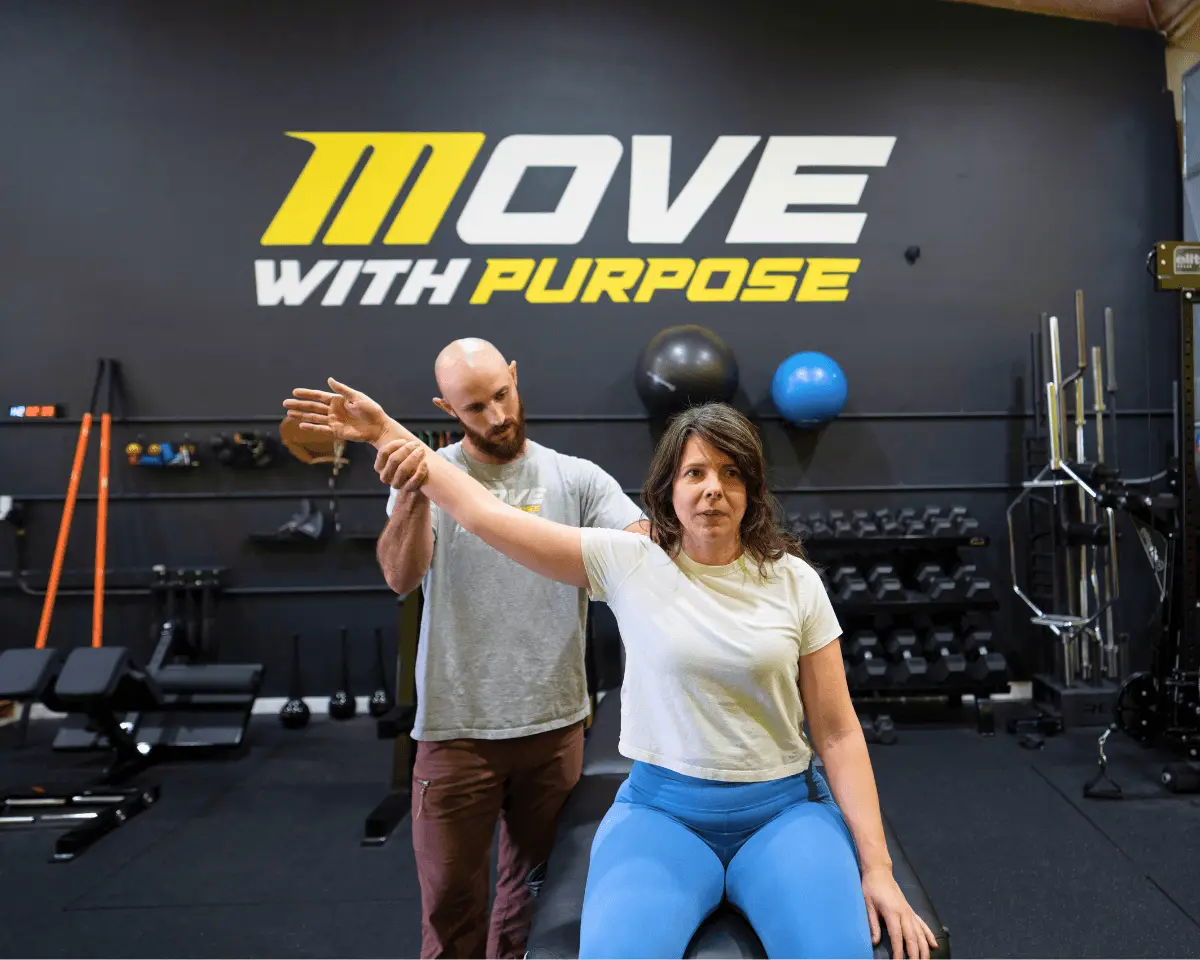
From there, we screen the relevant joints and go deeper where the data warrants. You'll feel the difference between passive range and what you can actively control. The protocol is the same as the one we use in the FRA, applied to a focused set of areas rather than the entire body.
What you leave with
A clear picture of what's happening at the joints we looked at, where to focus first, and how the work should be structured from here.
The program is built directly on those findings, not a generic template.

02
Functional Range Assessment (FRA)
The FRA is a comprehensive joint-by-joint evaluation built on the Functional Range Conditioning methodology.
We test passive and active range at every major joint in the body, then take each joint through Controlled Articular Rotations to further assess capacity and quality of motion. The entire assessment is documented, and you receive a written summary of the findings.
The three-session structure
Session one is the assessment itself. We work through the full joint inventory of the hips, shoulders, spine, knees, ankles, and wrists, capturing passive and active range of motion, followed by CARs at each joint.
Session two is a one-hour follow-up that walks you through the written summary. What the numbers mean, where the gaps between passive and active are widest, and which restrictions matter most for what you're training for.
Session three is a one-hour follow-up that teaches you the specific protocols (CARs, PAILs/RAILs) that address what the assessment surfaced. You leave knowing how to maintain and progress the work, with a documented baseline you can retest in 12 weeks.
Who it's for
People who want a complete picture of their movement capacity. People already familiar with FRC who want objective baseline data across every major joint. People dealing with complex or longstanding restrictions who want a thorough look. It's the deeper of the two assessments, and the right call when you want measurable baselines to track and retest over time.
What comes next
What assessment leads to
Assessment isn't a separate product. It's the first step of how we coach. What it leads to depends on what shows up.
Personal training
For many clients, that means one-on-one work built around what the assessment surfaced. Programs address one or two priority areas first, with reassessment every 8 to 12 weeks to confirm we're moving the right needles. Every block has a purpose tied back to what the assessment revealed.
Group mobility
For others, group classes are the right primary tool. This tends to be the case when limitations are widespread rather than localized, and the goal is long-term joint health.
Hybrid
For some, the assessment becomes the entry point to both. One-on-one work on the highest-priority restrictions, group classes for ongoing maintenance.
Whichever path you take, you come out of the assessment with information you didn't have before, and a path that fits your body instead of a generic one.
FAQ
Common questions.
- Which assessment should I choose?
-
For most people, the Motive Movement & Mobility Assessment is the right entry point. It's built around whatever brought you in, so if a shoulder's been bothering you or your squat doesn't feel right, that's what we're screening.
The FRA is the full joint-by-joint version, every major joint in the body, with two follow-up sessions and a written baseline you can retest. That depth makes sense if you want a complete picture regardless of where you're symptomatic, or if you're already familiar with FRC and want objective numbers to track over time.
If you're not sure which one fits, start with the smaller assessment. We'll tell you honestly if the FRA would add something that the first one didn't cover.
- What should I wear, and how long does it take?
-
Athletic clothes you can move in, close to what you'd wear to train.
The Motive Movement & Mobility Assessment runs 90 minutes. The FRA's first session runs longer, since we're covering the hips, shoulders, spine, knees, ankles, and wrists in one sitting, followed by two one-hour sessions to walk through the results and teach the protocols.
- Do I need to be in pain or dealing with an injury to get assessed?
-
No. Some clients come in because something specific hurts. Just as many come in because they want to know what's actually going on with their body before something does.
Range that looks fine on paper can still be range you don't control under load, and that's not always something you'd feel yet. The assessment measures how you move right now. Diagnosing an injury is a different job, and not what this is for.
- What happens after the assessment? Am I locked into training?
-
No. The assessment stands on its own. You leave with a written picture of what we found and guidance on what to prioritize; what you do with that is up to you.
Most clients move into one-on-one training or group mobility classes because the assessment gives them a clear starting point, but booking an assessment doesn't commit them to anything past it.
- How often should I get reassessed?
-
Every 8 to 12 weeks for personal training clients, which lines up with how programming blocks are structured.
For the FRA specifically, we recommend a 12-week retest window, long enough for the work to show up in the numbers without losing the thread of what changed.
- Can I use HSA or FSA funds for an assessment?
-
Yes. We work with Truemed to help clients apply for a Letter of Medical Necessity, which qualifies the assessment for HSA or FSA reimbursement.
It's not a checkout-time discount; you pay for the assessment as usual, then get reimbursed. We'll walk you through the Truemed application after you book, and it's a quick process.
Pricing
Choose your movement assessment
Every program at Motive begins with an assessment. Both options give you an objective picture of how your body actually moves, so you can pick the depth that fits what you're dealing with.
90-minute assessment
Motive Movement & Mobility Assessment
$149 one-time
90 minutes, fully guided. You move the entire session.
- Hands-on evaluation of the joints connected to what brought you in
- Built around your training history, your goals, and how your body is actually moving
- A clear direction for what to prioritize and how to structure the work from here
Comprehensive joint-by-joint
Functional Range Assessment (FRA)
$549 one-time
Initial assessment plus two one-hour follow-up sessions.
- Passive range, active control, and the gap between them, full body
- Full documentation with a written summary you can take with you
- Two follow-up sessions to review the data and teach the protocols
- Objective baselines you can retest and track over time