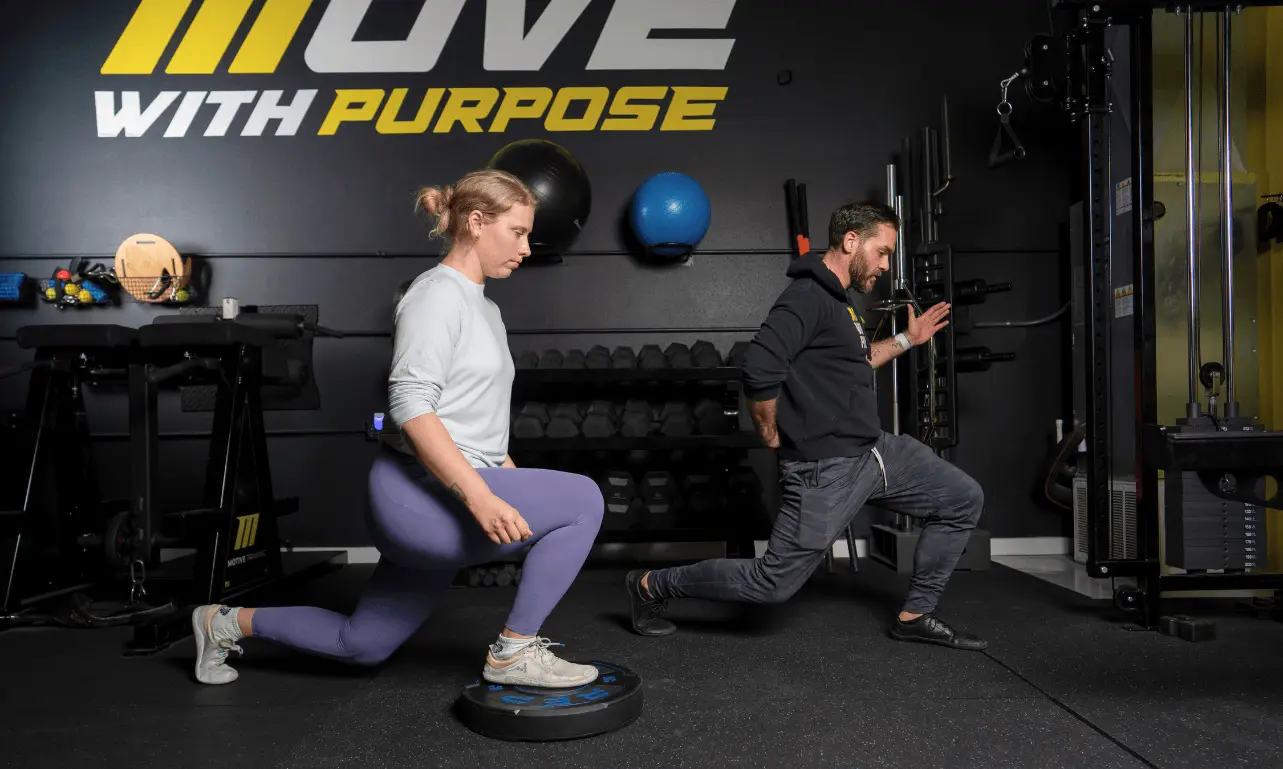
Strength training is not complicated. Progressive overload works. Muscle responds to load, adapts, and gets stronger. None of that is in question, and none of it needs reinventing.
What is missing from most strength programming is a straightforward idea: the muscle is not the only thing under load. The joint is too, and the joint’s readiness for that load is rarely checked before someone hands you a program built around sets, reps, and a rotating list of exercises.
Why the same program helps one person and hurts another
Two people can walk into a gym with the same goal, follow the same squat and deadlift progression, and end up in completely different places six months later. One gets stronger and feels better. The other gets stronger and starts feeling something catch in a hip or ache in a low back that was not there before. The program was not the variable. What each person’s joints could actually control before the load went on top of them was the variable, and almost nobody checks that before starting.
This is the part strength training culture tends to skip. A muscle can produce force in a range its joint does not actually control. That gap, between what a joint can passively access and what the nervous system will let you use under real load, is where a lot of “this came out of nowhere” injuries actually come from. They did not come out of nowhere. They came from a range that was available but never trained.
A squat is not one exercise
Treat a squat as a single movement and you miss what it is actually demanding. A working squat needs hip internal and external rotation, enough ankle dorsiflexion to keep the torso upright without the low back compensating for it, and a spine that can hold position under increasing load rather than folding to find range it does not have anywhere else. Take away any one of those and something else in the chain starts covering for it, usually the low back, because the low back is a generous and terrible compensator.
This is why “just squat more to get better at squatting” only works for people who already have the underlying joint capacity. For everyone else, more reps just grooves the compensation deeper. The fix is not a different squat variation. It is identifying which piece of that chain is actually missing and building it directly.
Where the assessment actually changes the program
A Functional Range Assessment is how we find out, joint by joint, what someone is actually working with before we build anything. It tells us where someone has range they cannot control, which is functionally more dangerous than having no range at all, because a joint with no range simply will not move into a bad position. A joint with unowned range will, the first time someone gets tired, distracted, or pushed past what they have practiced.
Once we know where that gap is, the programming decision is simple to state and takes real work to execute. Controlled Articular Rotations map what a joint can access on its own. PAILs and RAILs build isometric strength at the edges of that range, closing the gap between what is available and what is controlled. Only once that control exists does it make sense to load the joint through that range with a compound lift. Skip that sequence and you are loading a position the nervous system has not agreed to yet, which is a bet that usually pays off for a while and then does not.
What this changes about a normal training week
In practice, this does not mean endless mobility work instead of lifting. It means the mobility work has a specific, short-term job: prepare a joint for what the strength block is about to ask of it. A session built this way still centers on real strength work, squats, hinges, presses, carries. What changes is the five to ten minutes before that, targeted at whatever the assessment flagged as the actual limiting factor, instead of a generic warm-up that touches nothing in particular.
This also changes what “advanced” programming looks like. Most lifters chase more load or more volume once the basics feel automatic. That is the wrong lever for a lot of people, because the actual ceiling on their training is not strength, it is the range they can get strong through. Building end-range control through PAILs/RAILs and integrating it into KINSTRETCH work, either in KINSTRETCH classes or through KINSTRETCH Online, often unlocks more usable strength than another six weeks of the same lifts with slightly heavier plates.
What actually holds up
Strength training done this way is not faster. It is not more exciting to watch. What it produces is training that keeps working for years instead of training that works well until it does not, usually right around the point someone starts feeling good enough to stop being careful.
The muscle was never the limiting factor for most people. The joint underneath it was, and it still is, until someone actually checks.
Written by

Brian Murray, FRA, FRSC
Founder of Motive Training
Motive Training is a coaching studio in South Austin built around assessment, joint health, and strength you can use. Train with us in the studio, come to a KINSTRETCH class, or work through the progressions in KINSTRETCH Online.