Most articles on hiring an online fitness coach are lists of twenty or thirty questions you should ask, and most of those questions are presented as if they carry equal weight. They do not. After years of running both in-person and online coaching at Motive Training, my honest take is that some questions cut to the core of how good a coach is, some confirm you are dealing with a real business, and some surface useful texture without changing the decision. All of them are worth asking. The trick is knowing what each answer is actually telling you.
This is the full list of twenty, grouped by what they reveal. I will mark the six that carry the most weight so you know where to spend your attention. The rest still belong on the list. Skipping them is not the move. Misreading them is.
I am writing this from the position of someone who runs an online program (KINSTRETCH Online) and who refers people to other coaches when our offer is not the right fit. The questions below are the ones I would ask if I were the one hiring.
The six questions that carry the most weight
These are the questions where the coach’s answer is supposed to do real work. If the answers are vague, generic, or scripted, that tells you almost everything.
1. What is your assessment process?
This is the first question because the answer tells you almost everything else. A coach who has a real assessment process has a method. A coach who jumps straight to writing your program after a goal-setting call has a template.
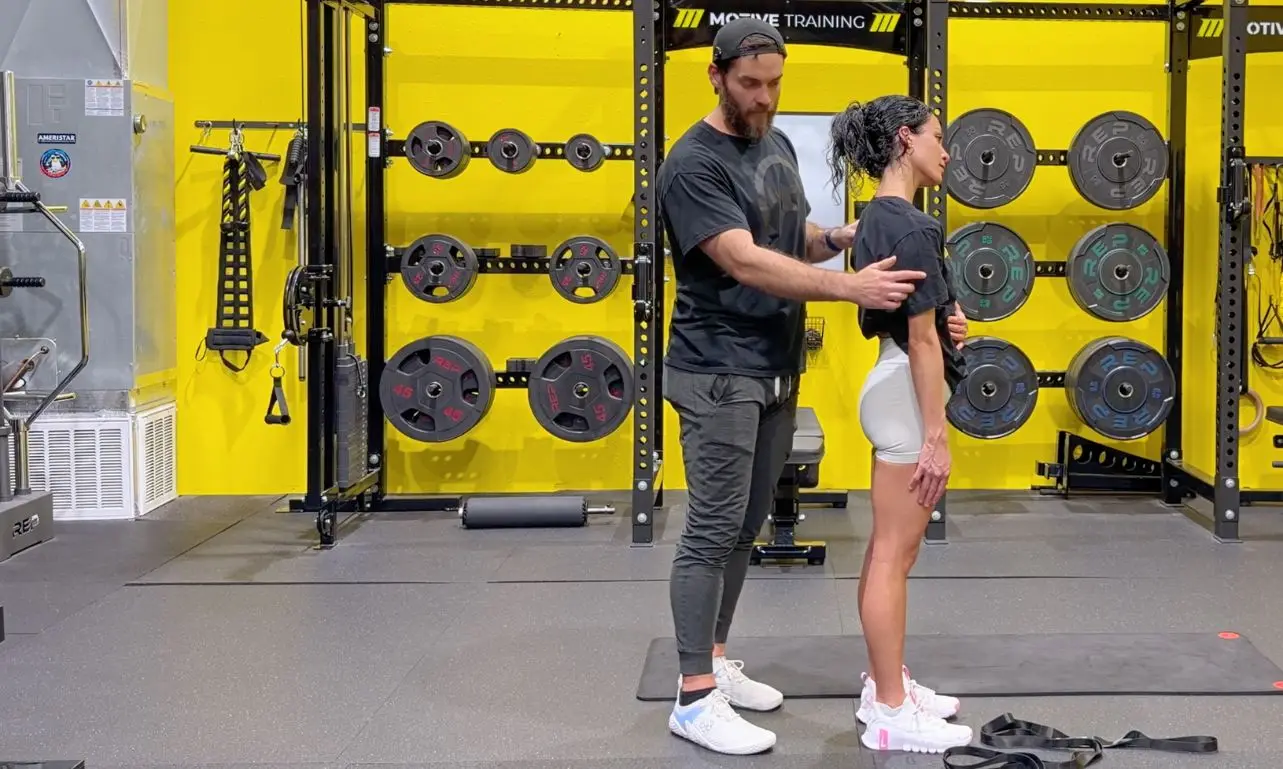
What a real assessment looks like online varies. Some coaches send video tasks: specific positions and movement tests they want you to record so they can see what you actually do, not what you tell them you do. Some run a live video session and walk you through tests in real time. Some do both. The goal is the same in any version: build a baseline of what your body can do before deciding what it should be doing more of.
If the answer is some version of “we will talk through your goals and history and start training,” that does not mean the coach is bad, but it does mean the program is going to be based on what you say, not what your body shows. That works for some people and fails for others. The people it fails for are usually the ones with recurring pain, asymmetries, or histories that make a generic plan a poor fit.
Our online work leans on a process built around the Functional Range Assessment when possible, and on video-based movement screening when an in-person session is not realistic.
2. How do you write a program for someone you cannot see in person?
Once a coach has the assessment data, what do they actually do with it.
Good answers are specific. They name a programming structure: blocks, phases, cycles. They name how they prioritize (limiting joints first, weakest qualities first, sport demands, goal demands, whatever the framework is). They name what gets cut when the plan does not fit your time. They name how often they revisit the program and what triggers a change.
Bad answers are generic. “We build a personalized plan based on your goals” is not an answer; it is a slogan. Push past it and ask what the program actually looks like in your first month versus your third. If the coach cannot describe the difference, the program is probably not changing.
The reason this matters online is that in-person coaching is forgiving. You see the client, you adjust on the fly, and the workout corrects itself in real time. Online, the program is the product. If the program is generic, the coaching is generic.
3. How do you handle pain or limitations?
This question separates coaches who understand their scope from coaches who do not. The honest answer involves the word “refer.” A coach should know what they can train through, what they need to modify around, and what is outside their scope.
What we do when someone comes in with pain is assess the joints involved, train the tissues and ranges we can train, and refer to a physical therapist or physician when the issue is medical. Personal trainers in Texas cannot diagnose, and the good ones do not try to. If a coach is willing to write you a “pain protocol” without sending you to anyone else, that is a sign they do not understand the boundary, and the boundary is the part that protects you. We have written elsewhere about how the FRC approach handles back pain specifically, and the same logic applies across most joint complaints.
The other side of this is how the coach handles training around limitations productively. Most pain is not a stop sign for training; it is a redirect. A coach who knows the joint-by-joint approach, who understands what passive range and active range mean, who can build end-range strength through tools like PAILs and RAILs, can usually keep you progressing while the symptomatic stuff settles down. A coach who only knows “stop and rest” or “push through it” is missing the middle, which is where most of the actual work happens.
4. What does communication look like between sessions?
The structure of communication tells you what the coaching is actually selling. Some online programs sell access. Some sell programming. Some sell community. They are different products, and they cost different things.
Access-based coaching means you can message the coach with questions, video clips for form checks, and problems that come up during your week, and you get answers within a reasonable window. This costs more because it scales poorly for the coach. It is worth it if you have real questions and will actually use it.
Programming-based coaching means you get a program, you execute it, you check in on a schedule, and the program adjusts based on what you report. This costs less and works well for self-directed people who do not need their hand held.
Community-based coaching is usually group programs or class-based offerings, where the structure is the program and the community is part of the value. This is the cheapest tier and works for people who need the structure of a class to actually show up.
None of these are wrong. The wrong move is paying for one and expecting another. Ask what the communication structure is. Ask how fast they respond. Ask what the touch points look like. Then decide if that matches what you actually need.
5. How will I know if it is working?
Most people skip this question and most coaches dodge it. The answer should be specific.
For mobility work, the answer involves measurable changes in passive range, active range, and the gap between them. We reassess every twelve weeks because that is enough time for a real change in a joint, and the numbers tell us what moved.
For strength work, the answer involves load progression, volume tolerance, and the ability to express strength at positions you could not previously hold.
For weight loss or body composition work, the answer involves a measurement strategy that does not rely only on the scale, because the scale lies on short timescales and tells you nothing about what is changing underneath it.
For general health work, the answer involves something measurable: resting heart rate, sleep quality, energy through the day, the ability to do something at month three that you could not do at month one.
A coach who cannot tell you how the program will be evaluated is a coach who is asking you to evaluate it on feelings. Feelings matter, but they are a poor primary metric.
6. Who is the coach not a fit for?
This is the question that tells you the coach knows their lane. Every good coach has people they are not the right fit for, and they should be able to name them quickly.
For us, the obvious answer is that we are not the right fit for someone whose primary goal is weight loss with no interest in how their body moves. We will get you stronger, more mobile, and probably leaner along the way, but if the only metric is the scale we are not the optimal choice. We are also not the right fit for someone who wants a 90-day transformation. The mobility work is slow because the tissue is slow, and the timelines we work on are quarterly, not weekly.
A coach who answers this question with “I can help anyone” is a coach who has not thought carefully about their offer. That is a flag. The most useful coaches I know can name the exact client they are not the right fit for, often in detail, and that clarity is part of what makes them useful to the clients they do fit.
Eight questions that confirm you are dealing with a real business?
These are reasonable, important questions that establish baseline credibility. The answers tell you the coach has the credentials, the structure, and the operational basics you would expect from any professional. Ask them. The answers protect you from amateurs and bad-faith operators.
7. What certifications do you hold?
Certifications are a baseline, not a guarantee. NASM, ACE, NSCA, ISSA are reputable general certifications and confirm the coach has gone through a structured education program. For movement-specific work, specialty credentials like FRC, FRCms, FRA®, or KINSTRETCH instructor certifications signal a deeper investment in joint and mobility training. The deeper signal, though, is the assessment process, which is question one.
8. How long have you been coaching?
More experience is generally better, but the curve flattens fast. A coach with three to five years of dedicated practice can often outperform a coach with fifteen years of going through the motions. What matters more than years is the diversity of clients the coach has worked with and the depth they have gone into their specialty.
9. What types of clients do you usually work with?
You want a coach who works with people like you. Not identical to you, but similar in the variables that matter: similar age range, similar training history, similar goals, similar life circumstances. A coach who specializes in competitive powerlifters and rarely sees general population clients is not your best match if you are a desk worker with a bad shoulder. The reverse is also true.
10. Can you provide references or testimonials?
You should be able to find these without asking. Good coaches have social proof on their site, on Google reviews, on social media, in case studies. If you have to dig for evidence that the work produces results, that is information in itself.
11. How much does it cost?
You need to know what you are spending before the conversation gets too far. Pricing varies widely. Class-based online programs typically run around $30 to $80 a month. Programming-only services with monthly check-ins run roughly $150 to $300. One-on-one online coaching with full programming and ongoing communication usually starts around $300 and goes up significantly from there.
12. What is your cancellation policy?
Twenty-four hours is the industry standard for cancellations and reschedules. Anything wildly different from that (longer notice, no cancellations allowed, draconian fees) is worth asking about. Most legitimate businesses are flexible within reason.
13. What technology do you use?
How will the program be delivered. Is there an app, a portal, a shared document, video check-ins, or some combination. This is logistical, not predictive, but worth confirming so you do not end up frustrated by the platform. Our online clients use our app for programming, video demonstrations, and class delivery.
14. What happens if I am not satisfied?
Most quality coaches do not offer money-back guarantees because the work depends on the client doing the work, and a guarantee creates the wrong incentive structure. What you should expect is a clear cancellation policy, transparent pricing, and an explicit off-ramp if the work is not landing. If a coach is promising a specific outcome on a specific timeline regardless of your effort, that is a sales pattern, not a coaching pattern.
Six more questions worth asking, and how to read what you hear
These questions show up on most lists, and they are worth asking. The answers tend to be more revealing of how the coach thinks than of what their program will look like, which is its own kind of useful information. Listen for tone, specificity, and how much of the answer is a real take versus a stock response.
15. What is your coaching philosophy?
Most coaches will give some version of “holistic, individualized, evidence-based, sustainable” because they have heard the question a hundred times and have a stock answer ready. What you are listening for is how they go beyond the stock answer. A coach with a real philosophy can name what they prioritize and what they deprioritize, and they can connect that philosophy to how they run a session. A coach whose philosophy is fully realized in how they answer questions one through six is fine. A coach whose philosophy contradicts those answers is a red flag.
16. How will you motivate me?
Motivation is largely your problem, but how the coach answers this question tells you a lot about how they think about adherence and consistency. A good answer involves structure: scheduled check-ins, accountability mechanisms, clear progress markers, and a plan for what happens during the inevitable rough weeks. A poor answer involves cheerleading: “I will keep you fired up” or “I will be your hype man.” A coach cannot manufacture your desire to show up. A coach can build the systems that make showing up easier when the desire dips.
17. Do you offer nutrition advice?
This question reveals how the coach handles scope. We do not offer detailed nutrition coaching beyond general principles, because nutrition is not our specialty and we would rather refer you to a registered dietitian whose specialty it is. That is the honest answer, and it is the answer you want to hear from a coach whose primary expertise is training. If nutrition is a major part of what you need, ask the question, and listen for how the coach handles the boundary: claiming expertise they actually have, or referring you out. The latter is usually the more careful sign.
18. Can you create a meal plan?
Same logic as the nutrition question. We do not write meal plans because they tend to teach the client to follow a list rather than learn the underlying skill, and most behavior change comes from learning the skill. If a coach offers meal plans as a major part of their service, ask how they approach the handoff between following the plan and building independent nutrition habits. A coach who has a real answer there is doing the harder, more useful work. A coach who treats the meal plan as the product is selling a deliverable.
19. How will you prevent injury?
The honest answer is that injury prevention is mostly a function of programming that respects your current capacity and progresses appropriately. A coach with a good answer talks about how they manage load, how they monitor for warning signs, how they modify when something feels off, and how they decide when to push and when to back off. A coach whose injury prevention amounts to “we will warm up properly” is giving you a surface answer. A coach who can describe their actual decision-making around load management and progression is showing you their work.
20. What should I expect from my first session?
A good first session involves an assessment, a real conversation about your goals and history, a clear sense of where the priorities are, and a recommended next step. You should leave with a better understanding of your body than you came in with, and you should have a sense of what the next month of training is going to look like. If a coach’s answer here is vague, or if the first session is described as primarily a sales conversation, that is information. The first session is a preview of every session that comes after it.
The shorter version of all twenty
Ask all twenty. The decision on a coach mostly comes down to four things: if they have a method, if they know their scope, if the communication structure matches what you need, and if they can tell you what is supposed to change and how you will know. Questions one through six get you to those answers most directly. Questions seven through fourteen confirm you are dealing with a real business. Questions fifteen through twenty add texture, and the texture matters more than people give it credit for. The way a coach answers a generic question is often the most honest signal you get.
If you want to see what our version of this looks like, start with a conversation. We will tell you straight if we are the right fit, and if we are not, we will usually know who is.
Written by

Brian Murray, FRA, FRSC
Founder of Motive Training
Motive Training is a coaching studio in South Austin built around assessment, joint health, and strength you can use. Train with us in the studio, come to a KINSTRETCH class, or work through the progressions in KINSTRETCH Online.