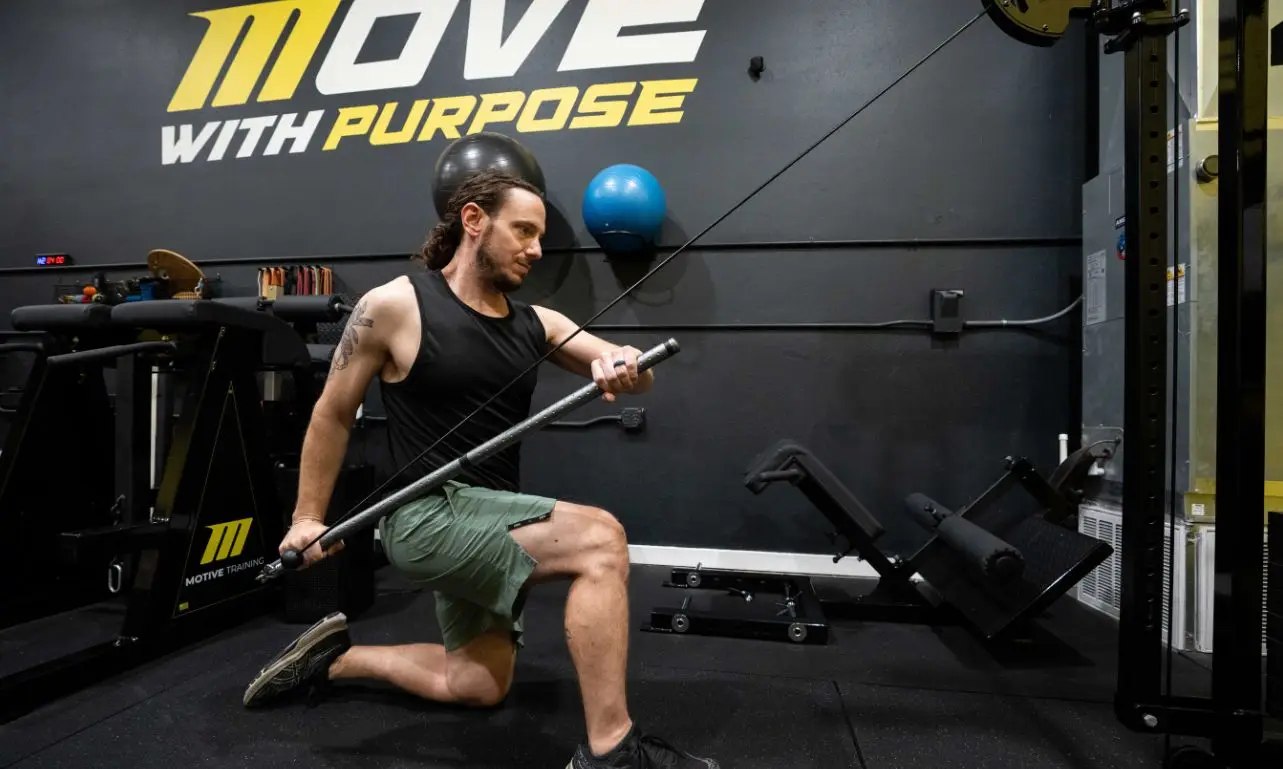
I’ve watched people walk into a gym for the first time and know within about ninety seconds if they’ll last six months there. It’s rarely the equipment that tips it one way or the other. It comes down to if anyone in the building is going to ask them a real question about their body before handing them a program.
Austin has no shortage of places to train. Big-box gyms, CrossFit boxes, boutique studios, a small army of independent trainers working out of shared spaces. Most of them will get you sweating. Fewer of them will get you anywhere.
Sweat is not a plan
A hard workout and a good training plan aren’t the same thing, and it’s worth separating them before you sign anything.
You can walk into almost any gym in this city, do sixty minutes of something intense, and leave sore. That’s not difficult to manufacture. Intensity is the easiest thing in fitness to sell, because it’s the easiest thing to feel. You know you worked hard. What you don’t automatically know is if that work moved you toward anything, or if you were just spending effort in the same patterns you always spend it in.
The gyms that actually change how someone’s body feels and performs a year out are the ones building toward something specific. That requires knowing where you’re starting from, which is the part most gyms skip entirely.
Where the real cost shows up
Nobody quits a gym on day one because the programming was generic. It takes longer than that to notice, and by the time it shows up, it looks like this: the same shoulder that’s been cranky for two years is still cranky. You’ve adjusted your squat stance four different times because your hip never stopped catching. You’ve started quietly avoiding certain movements and calling it “listening to your body,” when what’s actually happening is you never got help figuring out why the movement bothered you in the first place.
That’s the cost of a program built for the room instead of for you. Most gyms hand out the same handful of templates regardless of who walks in, because assessing people individually is slower and harder to scale. It’s not usually malicious. It’s just easier to write one program for a hundred people than a hundred programs for a hundred people.
The problem is bodies don’t average out. Two people can have the exact same goal and need almost opposite things to get there, because one of them has a hip that rotates freely and a shoulder that doesn’t, and the other is built the opposite way. A generic program treats both of them the same. One of them will do fine. The other will spend a year training around a limitation nobody ever identified.
What coaching is actually supposed to do
A lot of what gets sold as coaching in this city is really just supervision. Someone standing near you while you do exercises, occasionally correcting your form, generally making sure you don’t get hurt in an obvious way. That’s not nothing, but it’s a lower bar than most people think they’re paying for.
Real coaching starts earlier than the workout. It starts with figuring out what your joints can actually do before deciding what you’re going to ask them to do. We use a Functional Range Assessment for exactly this reason. It’s a joint-by-joint look at where you have range, where you don’t, and where you have range you can’t yet control, which is its own kind of problem most screens don’t catch at all.
That last part matters more than people expect. Passive range of motion and usable range of motion aren’t the same thing. You can have a hip that moves fine when someone else pushes it there and still lose control of it the moment you’re the one generating the force. That gap between what you have and what you can use is where a lot of nagging injuries live, and it’s invisible on a standard fitness assessment because most standard assessments never test it.
Why joint-level training changes the math
This is where Functional Range Conditioning comes into what we do. FRC isn’t stretching, and it isn’t a warm-up you do to get to the “real” training. It’s a system for building strength at the outer edges of a joint’s range, specifically because that’s where most injuries actually happen. Nobody blows out a shoulder in the middle of its comfortable range. It happens at the edge, under load, in a position the nervous system never learned to trust.
Controlled Articular Rotations give us a daily read on how a joint is doing before anything else gets loaded onto it. PAILs and RAILs build strength in the ranges that a body has access to but has never been asked to control. None of this is complicated, but it does take longer than handing someone a template, and that’s exactly why most gyms don’t do it. It doesn’t scale the way generic programming scales.
If a gym never touches joint-level work, you can absolutely get fitter there. You can also end up fitter and still beat up, which is a strange outcome most people don’t expect until they’ve lived it.
What to actually check before you commit
Skip the tour of the equipment. None of it tells you what you need to know. Instead:
Ask what happens in your first session. If the answer is some version of “we’ll get you started right away,” that’s a business optimized for quick starts, not for your specific body. A first session should look more like an investigation than a workout.
Ask what changes if something hurts. A gym with no real answer here is a gym that hasn’t thought past the sales pitch. A gym that says “we adjust the plan around what your body’s telling us” has actually built a system for it.
Ask how they decide what you train next. If nobody can explain how last week’s session informs this week’s, you’re not getting a program. You’re getting a rotation.
Who tends to end up here
People usually find Motive Training after one of two things has already happened. Either they’ve been training hard somewhere else and quietly stopped trusting their own body, or they’ve never really started because every gym they’ve tried felt like showing up to guess.
We built the studio in South Austin around the opposite of both problems. Every relationship starts with an assessment, not a sales tour. Training gets built from what that assessment actually shows, which means two people with the same goal can end up with genuinely different programs, because their bodies aren’t the same. And for the days you’re not in the gym, we use short daily Input Sessions to keep reinforcing whatever your joints are working on, so progress doesn’t reset every time life gets busy.
If you want a sense of what that actually looks like from the inside, our client testimonials are a more honest read than anything I can tell you here. The pattern that shows up across them isn’t dramatic transformation. It’s people who stopped guessing.
Where to start
If you’re choosing between gyms in Austin right now, the equipment list and the price point are the least useful things you can compare. What predicts if you’ll still be training in a year, feeling better instead of worse, comes down to if the place you pick is actually built around your body or just built around a room full of equipment and a schedule of classes.
Start with an assessment, wherever you decide to train. If you want that assessment to be ours, book a free strategy session and we’ll show you exactly where to start.
Written by

Brian Murray, FRA, FRSC
Founder of Motive Training
Motive Training is a coaching studio in South Austin built around assessment, joint health, and strength you can use. Train with us in the studio, come to a KINSTRETCH class, or work through the progressions in KINSTRETCH Online.