Most people call about personal training with a goal attached to a date. A wedding. A summer. A doctor’s appointment that didn’t go the way they wanted. That’s a completely reasonable way to get in the door, and it’s also the exact framing that sets a lot of people up to lose their progress six months later.
Here’s the problem with training toward a finish line: your joints don’t know the event is over. The hip that finally opened up, the shoulder that stopped catching overhead, the back that quieted down, none of that stays without upkeep. Treat training like a program you complete and you’re back where you started within a year. Treat it like maintenance and it holds.
Fitness isn’t something you do, it’s something you keep
The standard model in this industry still frames fitness as a project with a start and an end. Get in shape for the summer. Complete a twelve week program. Hit a number on the scale and move on. That model works fine for motivation. It works badly for the actual joints and tissue doing the work, because your body doesn’t stop needing rotation, hip control, and spinal mobility once the goal is met.
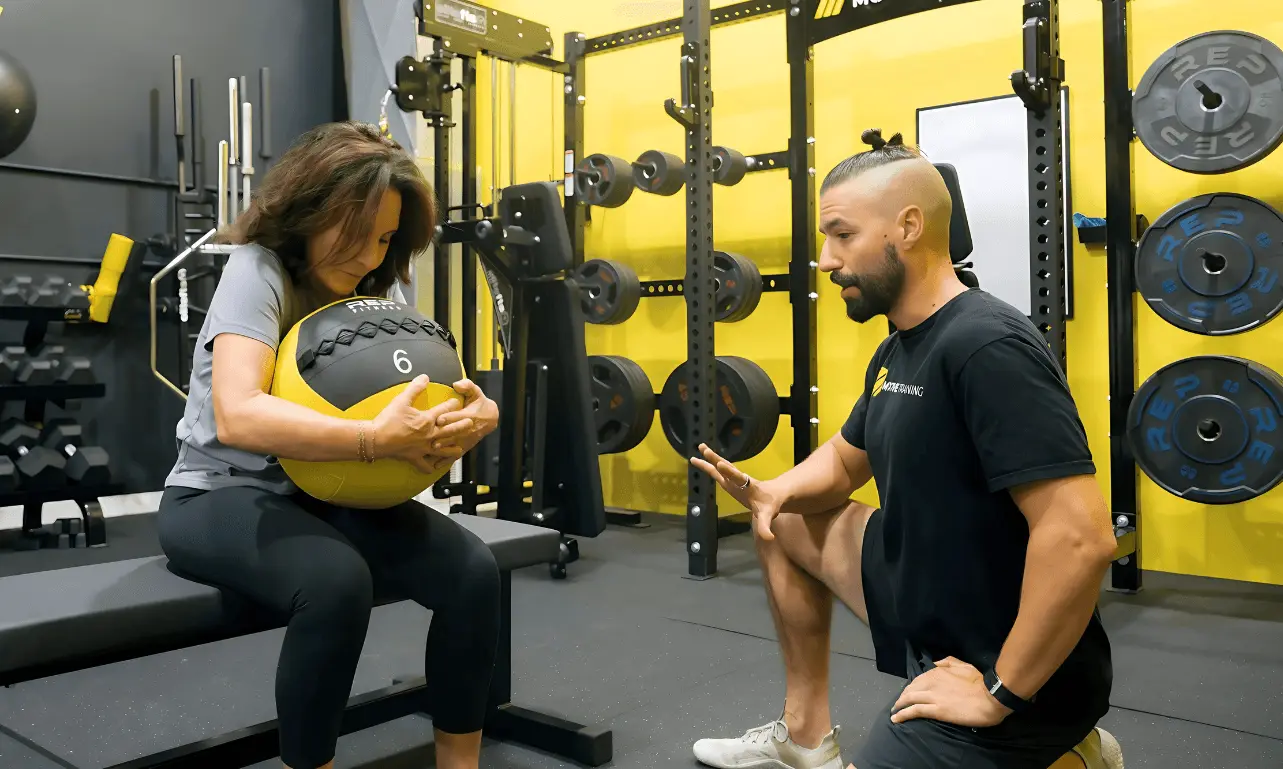
At Motive Training, the starting point isn’t a goal conversation. It’s a Functional Range Assessment, a joint by joint look at what your body can actually do right now, passively and actively. That assessment tells us where the real limitations are, which is usually a very different list than the one someone walks in with. Somebody who came in wanting to “get back in shape” often turns out to have a hip that’s been quietly limiting them for years, well before it ever showed up as a goal they could name.
Pain gets addressed, not pushed through
A lot of personal training still treats pain as something to grind past. That’s backwards, and it’s not how we approach it here. Pain is information. In most chronic cases, it means a joint is being asked to move in a range it doesn’t currently have the strength or control to handle safely.
The fix isn’t working around a sore shoulder by avoiding it forever, and it isn’t ignoring it and pressing through anyway. It’s building strength and control in the range that’s actually been avoided, so the joint stops needing to protect itself. We go deeper on how that applies to chronic low back pain specifically here, since it’s the single most common complaint we see walk through the door.
Who this actually serves
The people training at Motive fall into a few overlapping groups. People managing a specific pain pattern who are tired of being told to just stretch it or rest it. Lifters and athletes who hit a mobility ceiling their strength work never addressed. And a large share of Austin’s desk-bound tech workforce, sitting eight hours a day and slowly losing hip extension and thoracic rotation without noticing until something starts to hurt.
None of those groups needs a different philosophy. They need the same assessment and the same joint-first approach, applied to wherever their body actually is right now.
What starting actually looks like
If you’re new to this kind of training, the honest expectation is that the first conversation isn’t about picking exercises. It’s an assessment, a real look at your joints, followed by a plan built from what that assessment shows rather than a generic template. From there, training becomes something you maintain, not something you finish.
If you’re in Austin and want to see what that actually looks like for your body, start with an assessment rather than another workout plan built around a deadline.
Written by

Brian Murray, FRA, FRSC
Founder of Motive Training
Motive Training is a coaching studio in South Austin built around assessment, joint health, and strength you can use. Train with us in the studio, come to a KINSTRETCH class, or work through the progressions in KINSTRETCH Online.