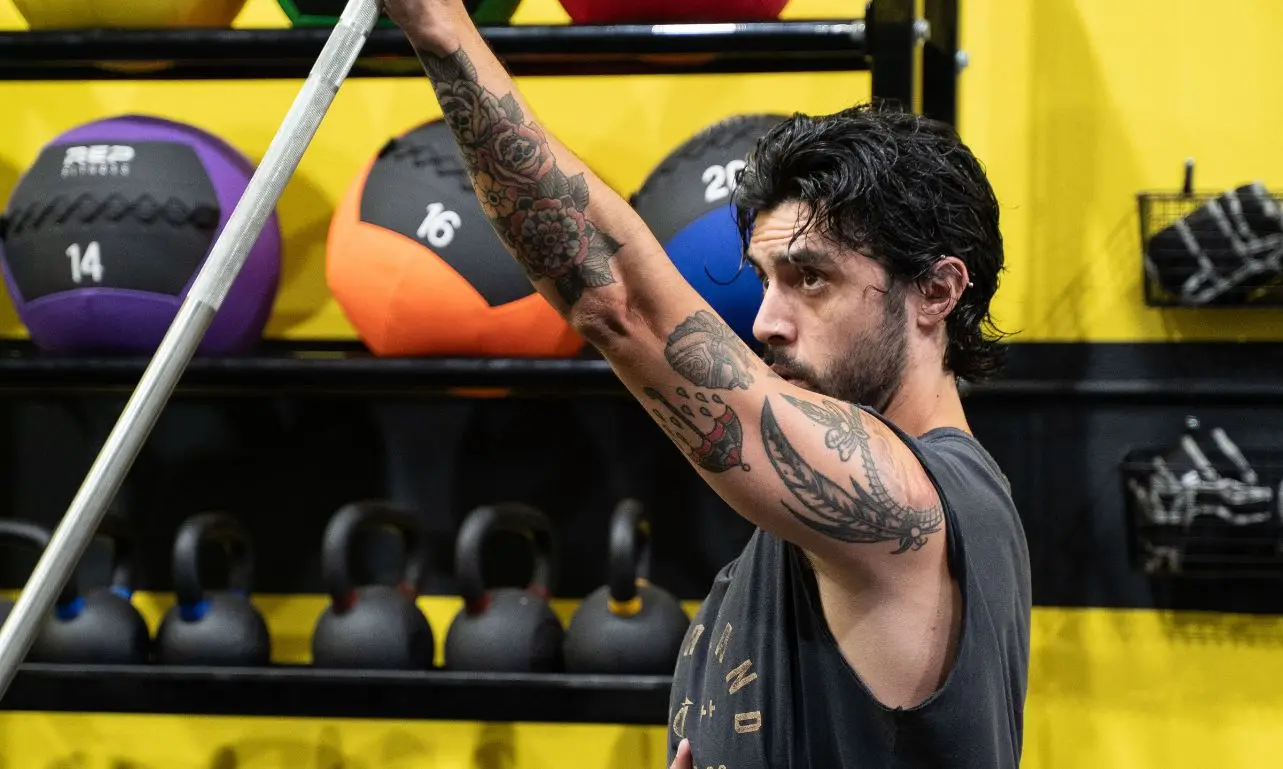
I get some version of this question from people who’ve been going hard at F45 or Orangetheory for a year, feel fitter than they did, and still can’t explain why their shoulder catches overhead or why their low back tightens up on the same exercise every single class. The workouts are legitimately effective at what they’re built for. The question is if what they’re built for is the same thing you need.
What each format is doing
Orangetheory runs on heart rate zones. You wear a monitor, the coach guides the room through blocks of treadmill work, rowing, and floor exercise, and the goal is spending a set number of minutes in the higher zones to drive the metabolic effect the brand is built around. It’s a well-designed conditioning format, and the heart rate feedback gives people something concrete to chase.
F45 runs on rotating stations instead. Circuits change daily or weekly, blending strength movements with HIIT intervals across 45-minute sessions, with less reliance on cardio machines and more on kettlebells, dumbbells, and bodyweight work moving through stations as a group. Where Orangetheory optimizes for time in a heart rate zone, F45 optimizes for variety, so you rarely repeat the same session twice.
Both formats share the same underlying structure. One coach programs a class in advance for a room full of people, the movements are scaled up or down for individual ability, and the workout itself doesn’t change based on who’s in the room that day.
What that structure can’t account for
Scaling a squat pattern down for someone with less strength is a solved problem. Scaling it for someone whose hip doesn’t rotate the way the pattern assumes is a different problem entirely, and it’s one a rotating-station format has no real mechanism to catch. The coach can see that your knee caves in on a lunge. What they usually can’t do, in a room of twenty or thirty people moving through stations on a clock, is trace that back to where the restriction sits: your ankle, your hip, or somewhere in how your foot is loading the ground.
This isn’t a knock on the coaching in these formats, and it isn’t an argument that group HIIT is unusually dangerous. A systematic review and meta-analysis pooling 28 studies and more than 11,000 participants across high-intensity functional training programs found an overall injury rate around 4.3 per 1,000 training hours, with the most commonly injured areas being the shoulder, back, and knee (1). That’s broadly in line with other popular training formats, not a dramatic outlier. A separate cross-sectional study of 606 practitioners found a similar rate of 3.51 injuries per 1,000 hours, and notably found that experienced participants got injured more often than beginners, which the researchers attributed partly to training volume and partly to the fact that scaling gets loosened as people gain confidence (2). The injury risk isn’t the interesting part of this comparison. The interesting part is what these formats are structurally unable to individualize, even when the coaching is good.
The strength ceiling nobody talks about
There’s a second limitation that has nothing to do with injury risk and everything to do with results. Both formats are built around conditioning and variety, not progressive overload, which is the principle that drives long-term strength adaptation: a measured, tracked increase in the demand placed on a specific movement over time. A rotating station format that changes what you’re doing every session makes that kind of tracked progression difficult by design, because you’re rarely repeating the same lift under the same conditions long enough to know if you’re getting stronger at it or just getting better at a broader range of movements. That’s a fine trade if your goal is general conditioning and variety. It’s a real ceiling if your goal is building strength in a joint or a pattern that’s specifically been a problem for you.
Where assessment-based training does something different
The starting question in one-on-one training isn’t what workout to run today. It’s what your body can do right now, measured directly instead of inferred from watching you move through a group circuit. That’s the entire premise behind the Functional Range Assessment, and it’s why a program built from that assessment looks different from person to person even when two people came in with the same complaint. One person’s shoulder catching overhead might trace back to thoracic rotation that never got trained. Someone else’s identical symptom might trace back to a scapula that isn’t moving through its full range. The rotating-station model can’t tell those two people apart. An assessment can.
If your training history includes some old injury, a joint that’s been cranky for years, or a body that just doesn’t move the way a generic circuit assumes, that gap matters more than it does for someone starting from a clean slate. You can read more on how that shapes an actual program in what makes personal training work, or on how a joint-specific mobility system fits underneath strength work in functional range conditioning.
Where each option fits
If your main obstacle has been motivation and consistency, not a specific physical limitation, F45 or Orangetheory are reasonable, well-built answers, and there’s no reason to talk yourself out of a format that’s getting you to show up. If you’ve hit a plateau you can’t explain, or you’re carrying a restriction that keeps showing up in the same spot no matter which class you take, that’s a signal the format isn’t the problem you need solved next. Assessment-based personal training is built for that second problem specifically.
If you want to find out what’s driving a restriction that group classes haven’t touched, schedule with us.
References
- Knapik JJ. Injuries during high-intensity functional training: systematic review and meta-analysis. J Spec Oper Med. 2022;22(1):121-129.
- Serafim TT, Maffulli N, Migliorini F, Okubo R. Epidemiology of high intensity functional training (HIFT) injuries in Brazil. J Orthop Surg Res. 2022;17:522.
Written by

Brian Murray, FRA, FRSC
Founder of Motive Training
Motive Training is a coaching studio in South Austin built around assessment, joint health, and strength you can use. Train with us in the studio, come to a KINSTRETCH class, or work through the progressions in KINSTRETCH Online.