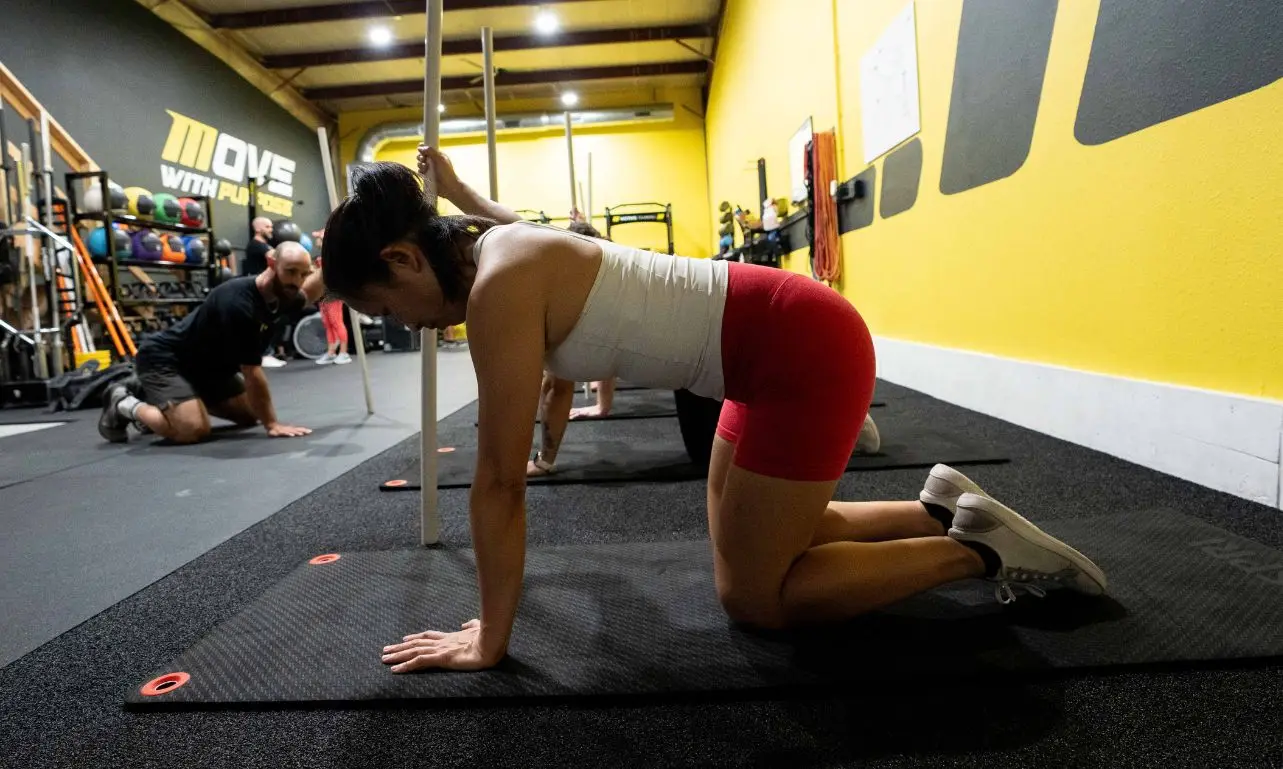
People ask me about the KINSTRETCH certification path more than almost anything else I get asked as a coach, usually from another trainer who’s already sold on the method and wants to know where to start. The order matters more than most people assume going in. Skip ahead to KINSTRETCH before you’ve done the underlying system, and you end up running a class that looks fine from the outside while you’re improvising most of the actual decisions.
The Path, In Order
FRC comes first. The Functional Range Conditioning seminar runs $999 and covers CARs, PAILs and RAILs, and joint assessment across the whole body. This is the part everything else gets built on. Skipping straight to KINSTRETCH without it is close to coaching a lifting program you were never taught how to build; you can run the sessions, but you don’t know why any of the choices were made.
KINSTRETCH Level 1 comes after, also $999, and this is where the group class format gets layered onto the FRC system. FRS won’t take your registration without the FRC certification finished first, though they do sometimes run the two seminars back to back, and you can register for both at once when they do. The online version is two live five-hour days with FRS instructors, lecture plus a lot of breakout practice. The seminar only gets you partway there. You also submit a practical video showing you can teach the material, which is the part that separates people who understood the seminar from people who can run a room with it.
Once you’re certified, using the KINSTRETCH name costs $100 a month in licensing ($1,000 if you pay for the year up front), billed for as long as you want to keep using it. That’s the trade-off for building classes under a name people already recognize instead of putting your own label on the same ideas and starting from zero on awareness.
Why FRC Has To Come First
KINSTRETCH is the delivery format for FRC principles, built specifically for groups. Take a shoulder-focused class as an example. Without FRC underneath it, you’re running a set list, external rotation CARs, a couple of PAILs holds, maybe a band drill, in whatever order the seminar showed you. With FRC underneath it, you’re reading the room in real time: half your class is stuck in internal rotation, so you spend more time there and cut something else short, because you understand what the drills are assessing and not just what order they go in.
That’s the real value of doing it in order. You walk away with a system flexible enough to build your own class plans on the fly, week to week, joint to joint, instead of one script you run the same way every time regardless of who showed up.
Where FRA Fits
The Functional Range Assessment certification runs alongside this rather than after it, and it solves a different problem entirely. FRC and KINSTRETCH are built around groups and general application. FRA is what you need if you’re assessing someone one-on-one and need to know exactly which joint, which direction, and how far off from typical that person is before you program anything for them.
Group-class coaches are covered by FRC into KINSTRETCH on its own. Anyone doing individual assessment and programming should add FRA regardless of where they are in the KINSTRETCH track.
What Level 2 Adds
Level 2 isn’t a harder version of Level 1. It’s an expansion of what you have tools to do inside a class. Level 1 stays almost entirely bodyweight and positional. Level 2 brings in bands, ankle weights, yoga straps, and other loading tools that add resistance and range in ways bodyweight alone can’t reach. For a coach who’s been running Level 1 classes for a while and is starting to feel the ceiling on what bodyweight positions can accomplish, Level 2 is where that ceiling moves.
Is It Worth Doing
If you’re already coaching and running any kind of group stretching, mobility, or warmup work, yes, without much hesitation. What FRC and KINSTRETCH change is your ability to look at a joint, understand what it’s restricted in, and build something on the spot instead of running the same five drills because that’s what you know. That skill carries into everything else you coach, not just the KINSTRETCH classes on the schedule.
The same system applies wherever you’re coaching from too, since it’s a training format and not something tied to a single room. We run our own version of it as KINSTRETCH Online for exactly that reason, worth a look if your schedule or location doesn’t support in-person group classes.
Written by

Brian Murray, FRA, FRSC
Founder of Motive Training
Motive Training is a coaching studio in South Austin built around assessment, joint health, and strength you can use. Train with us in the studio, come to a KINSTRETCH class, or work through the progressions in KINSTRETCH Online.