Between the masters programs at Nitro and Longhorn Aquatics, the lap lanes at Barton Springs and Deep Eddy, and every triathlete in this city treating the swim leg as the thing they tolerate before the bike, Austin has a lot of people putting repetitive overhead load through their shoulders in the water. And a lot of them eventually show up with shoulder pain, assume it means a torn rotator cuff or sloppy stroke mechanics, and start doing more band work hoping it fixes itself.
Sometimes that’s the right instinct. More often, the chain reaction starts further back than the rotator cuff.
The Shoulder Swimming Asks For
Swimming puts an enormous number of shoulder revolutions through a joint that wasn’t built for that kind of volume. Over time, the shoulder adapts by shifting toward more external rotation and less internal rotation than a non-swimmer’s shoulder would have (1). That adaptation lets the stroke happen, but it comes at a cost: more external rotation means more laxity, and more laxity means the rotator cuff has to work harder to keep the humeral head centered where it belongs. Fatigue that cuff enough, over enough yardage, and the shoulder starts losing that centering job partway through a set, not at the start of one.
That’s the setup. It’s not yet the injury.
Posterior Capsule Tightness Is Doing More Than It Gets Credit For
The part that gets missed constantly: the back of the shoulder capsule tends to tighten in swimmers even as the front stays loose. That combination, a lax anterior capsule paired with a tight posterior one, changes how the humeral head moves in the socket. Research on scapular kinematics has found that posterior capsule tightness specifically alters scapular position and rotation, which is a mechanical problem before it’s ever a pain problem (2). You can have zero pain and still be sitting on this pattern for months.
Once it’s built up enough, it starts crowding the rotator cuff against the back of the socket during the parts of the stroke that ask for the most rotation, which is a fair description of what most people mean when they say “impingement,” even if nobody used that word out loud (3).
The Scapula Takes the Blame the Thoracic Spine Deserves
Here’s where it usually goes sideways in how people try to fix it. The scapula sitting in the wrong position, elevated, over-retracted, not protracting the way it should through the stroke, gets treated as the problem to correct directly. But scapular position is downstream of two things: capsule tightness, which we just covered, and thoracic spine mobility. A stiff thoracic spine limits how well the scapula can glide and rotate against the rib cage no matter how much scapular stability work gets programmed on top of it (4).
This is also where this piece needs to split from other shoulder content on this site. Why your shoulder feels stuck covers the broader picture of shoulder stiffness for a general population, mostly desk-driven postural patterns. Swimmer’s shoulder is a different animal, load-driven rather than disuse-driven, and the fix has to match the actual mechanism instead of borrowing a generic shoulder protocol.
What Helps
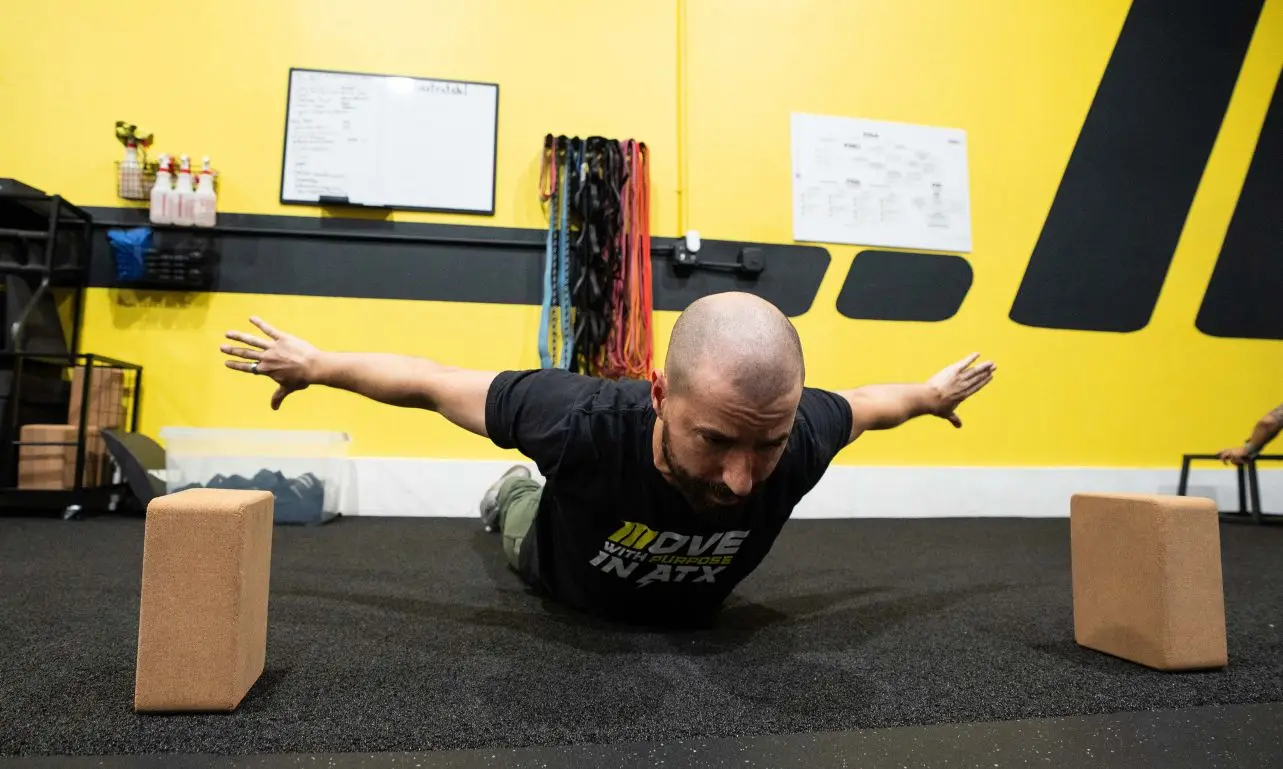
Three things, roughly in order of how often they get skipped. Posterior capsule work specific enough to change tissue length, not a generic cross-body stretch done for ten seconds between sets. Thoracic spine rotation and extension work, since a scapula stuck on a stiff rib cage will keep fighting you no matter how much serratus and lower trap work gets added. And control through end-range positions the stroke uses, not just strength in the middle of the range where it’s easy to feel strong.
A basic shoulder external rotation pattern is a reasonable entry point if none of this has been trained before. For anyone stacking real yardage every week, though, a Functional Range Assessment is going to find the specific restriction faster than guessing which of the three above is the real limiter, since it’s rarely all three equally.
None of this means every ache in the water is capsule-driven or that band work is useless. It means the shoulder pain that keeps coming back despite the band work is worth looking at from the capsule and thoracic spine first, before assuming the cuff itself is where the problem lives.
References
- Swimmer’s Shoulder, StatPearls, NCBI Bookshelf
- Effect of flexibility deficit on scapular asymmetry in individuals with and without shoulder pain
- Shoulder Pain in Swimmers, IntechOpen
- Swimmer’s Shoulder: An Update on Pathogenesis, Risk Factors, Clinical Assessment, and Management, Current Physical Medicine and Rehabilitation Reports
Written by

Brian Murray, FRA, FRSC
Founder of Motive Training
Motive Training is a coaching studio in South Austin built around assessment, joint health, and strength you can use. Train with us in the studio, come to a KINSTRETCH class, or work through the progressions in KINSTRETCH Online.