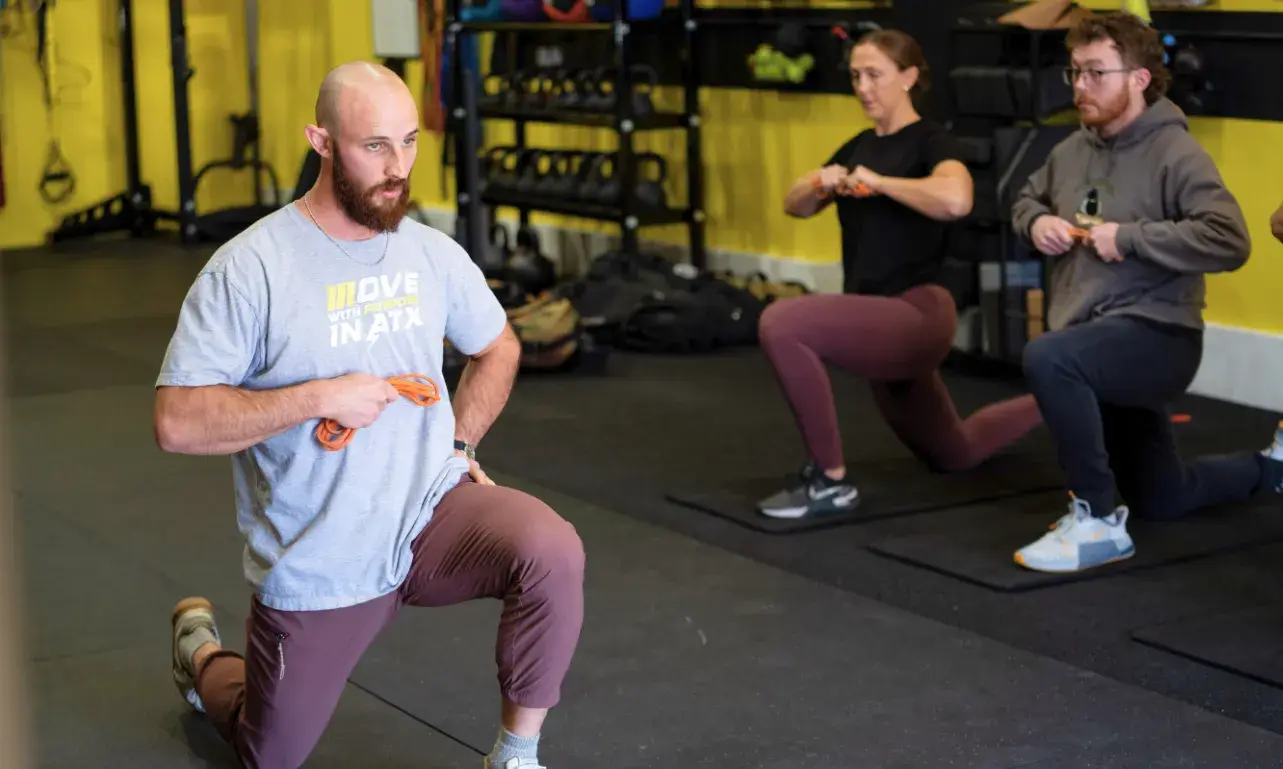
Couples personal training is one coach working with two people in the same session. Usually that means partners or spouses, though it works just as well for friends, siblings, or a parent and adult child. You split the hour and you split the cost, which is the main reason most people ask about it.
For a lot of pairs it is a good setup. You pay less per person than you would for private sessions, you keep each other showing up, and training stops being a thing one of you disappears to do alone. Those are real benefits and they are why couples training has gotten popular.
But there is one factor that decides whether it actually works for you and your partner, and it has nothing to do with cost or motivation. It is whether the trainer can still account for two different bodies inside one shared session. That is the part worth understanding before you book, so the rest of this article is about how couples training works in practice and how to tell if it fits you.
How couples personal training works
In a couples session, a coach runs both of you through a workout at the same time. Some of that work is shared. Some of it is staggered, where one of you is doing a set while the other rests or works a different movement. A good trainer structures the hour so neither person is standing around and both of you get coached on the things that matter for you.
The cost is lower because you are sharing the trainer’s time. With a private personal trainer it is one coach, one client, full attention. A couples session is one coach, two clients, attention divided. That division is the whole reason the per-person price drops. You are not getting a discount on the same thing. You are getting a different thing at a lower price, and for many people that thing is plenty.
What you are really paying a coach for is not the exercises. Exercises are free and everywhere. You are paying for their eyes on your positions, their memory of what your body did last week, and their judgment about what to push and what to ease off. In a couples session that attention gets split two ways. A skilled coach manages the split well, the way a good small group instructor keeps a class of several people all moving and corrected. But the math is honest: each of you gets roughly half the direct coaching of a private hour. For healthy people running a smart program, half is enough. For someone working around pain or a real restriction, it might not be.
Two bodies rarely need the same session
Here is the part most couples training advice skips. It treats “different fitness levels” as the only difference between two people, as if the problem is just one partner being stronger. That version is easy to solve. A coach scales load up and down without much thought.
The harder version is that two people usually have different movement histories and different things they should be working on. One partner might need real time spent on hip rotation and ankle mobility before loading a squat. The other might load fine and instead need work on overhead positions because of an old shoulder. Those are not two intensities of one workout. They are two different priorities, and a session that ignores that is a session built for an average person who is not in the room.
This is where a real movement assessment for each person stops being optional. When a trainer assesses both of you individually first, they can find where your needs genuinely overlap, build the shared portions of the session around that overlap, and split the plan for the parts that have to be individual. Skip the assessment and you get a generic couples workout. It will not hurt most people. It also will not move the needle on the specific things either of you actually needs, which is the entire reason to hire a coach instead of following a program off the internet.
If you take one question into a consultation with any trainer, make it this one: how do you handle two people who need different things? Their answer tells you more than any pitch about savings or accountability.
When couples training is the better choice
For the right pair, sharing a coach is not a compromise. It is the stronger option, and the reasons run deeper than splitting a bill.
Consistency is the first. The biggest predictor of results is showing up over months and years, not the cleverness of any single program. A booked session with a partner is harder to skip, because skipping it means leaving someone standing in a gym waiting on you. That small social cost compounds. Over a year it can be the difference between training that holds and training that fades by spring. We have written before about how consistency beats intensity over a long enough timeline, and a training partner is one of the most reliable ways to buy yourself that consistency.
There is also the matter of how the work feels. A hard set goes down easier with someone grinding through it next to you. A correction lands a little softer when you are not the only one being corrected. For people who find private training intense or self-conscious, a partner takes the edge off without dropping them into a large class where individual attention nearly disappears. Couples training sits in a useful middle: more eyes on you than a group setting, less spotlight than a one-on-one.
And when both partners learn the same cues and the same reasons behind the work, the conversation about training continues at home. A shared vocabulary tends to make the habit more durable than it is for one person training alone in a house where nobody else gets it.
When it can quietly go wrong
An honest answer has to name the failure modes, because they show up often enough to matter.
The first is comparison. Training beside your partner means watching your partner train. If one of you progresses faster, the gap is visible every session. Usually that is fine. Sometimes it curdles into one person feeling behind, training to keep up instead of training for their own body, and pushing into loads or ranges they do not control yet. That gap, between the range you have and the range you can actually access under load, is where people get hurt. A good coach manages it by keeping each person anchored to their own assessment and their own progressions. Still, it is worth knowing the dynamic exists before you are inside it.
The second is scheduling. Two calendars are harder to line up than one. Couples who start strong often slip because finding a weekly time that works for both people is genuinely difficult. If your schedules are a poor match, individual sessions you can each actually make will beat couples sessions you keep rescheduling.
The third is the relationship itself. Training together can be good for a partnership. It can also carry existing friction into a setting where you are both tired, working hard, and being corrected. If competition or criticism is already a sore spot between you, the gym will not smooth that over on its own. None of this argues against couples training. It argues for an honest conversation with your partner about what you each want from it before you start.
How to decide if it is worth it
Strip away the marketing and the decision comes down to a few real questions.
How much hands-on correction does your body need right now? If either of you is working around pain, coming back from an injury, or carrying significant movement restrictions, the assessment matters more and the case for starting with individual sessions gets stronger. You can move into couples training later, once each of you has a plan a shared session can carry. If you are both reasonably healthy and mainly need a smart, consistent program with good coaching, couples training fits from day one.
Do your schedules genuinely line up? Be honest about it. A standing time you can both protect is the foundation of the whole thing.
What do you want training to feel like? Some people want the full focus of a private session. Others want company, a lighter spotlight, and a partner in the habit. Neither answer is wrong.
If you go the couples route, the trainer is the variable that matters most. You want someone who assesses each of you as an individual, builds the shared session around real overlap, and splits the plan when your bodies ask for different things. That is the line between couples training that respects two people and couples training that runs an average workout for a room of two. If that is what you are after, reach out and we can set up training together, starting from where each of you actually is.
Couples personal training is worth it when the session is built around two real people instead of a generic plan with a discount stapled to it. Get the assessment right, protect the schedule, and choose a coach who will not flatten your differences for the sake of an easier hour. Do that, and sharing the work becomes one of the better things you can do for it.
Written by

Brian Murray, FRA, FRSC
Founder of Motive Training
Motive Training is a coaching studio in South Austin built around assessment, joint health, and strength you can use. Train with us in the studio, come to a KINSTRETCH class, or work through the progressions in KINSTRETCH Online.