Testimonials are easy to fake and hard to trust. We know that. So instead of a highlight reel of vague five-star reviews, we want to show what training at Motive actually looks like for real people: what they came in with, what changed, and why it changed.
The three clients below arrived with different bodies, different goals, and different histories. What they have in common is that they weren’t looking for a generic workout. They needed something more specific, and they found it here.
What makes these results possible
Before getting into the testimonials, it’s worth explaining the framework underneath them. Every personal training relationship at Motive starts with the Motive Movement & Mobility Assessment, a joint-by-joint screen that surfaces where your restrictions are, where you’re compensating, and where injury risk is quietly building. Most personal trainers don’t do this. We don’t skip it because we can’t write a good program without it. For clients who want a deeper diagnostic on a specific limitation, the Functional Range Assessment goes further and is the right tool when the question is technical.
From there, programming is built around Functional Range Conditioning principles, the system developed by Dr. Andreo Spina that trains mobility and strength together rather than treating them as separate categories. Tools like Controlled Articular Rotations and PAILs and RAILs get woven into sessions alongside conventional strength work. The result is training that builds the body up over time instead of grinding it down.
That’s the methodology. Here’s what it looks like in practice.
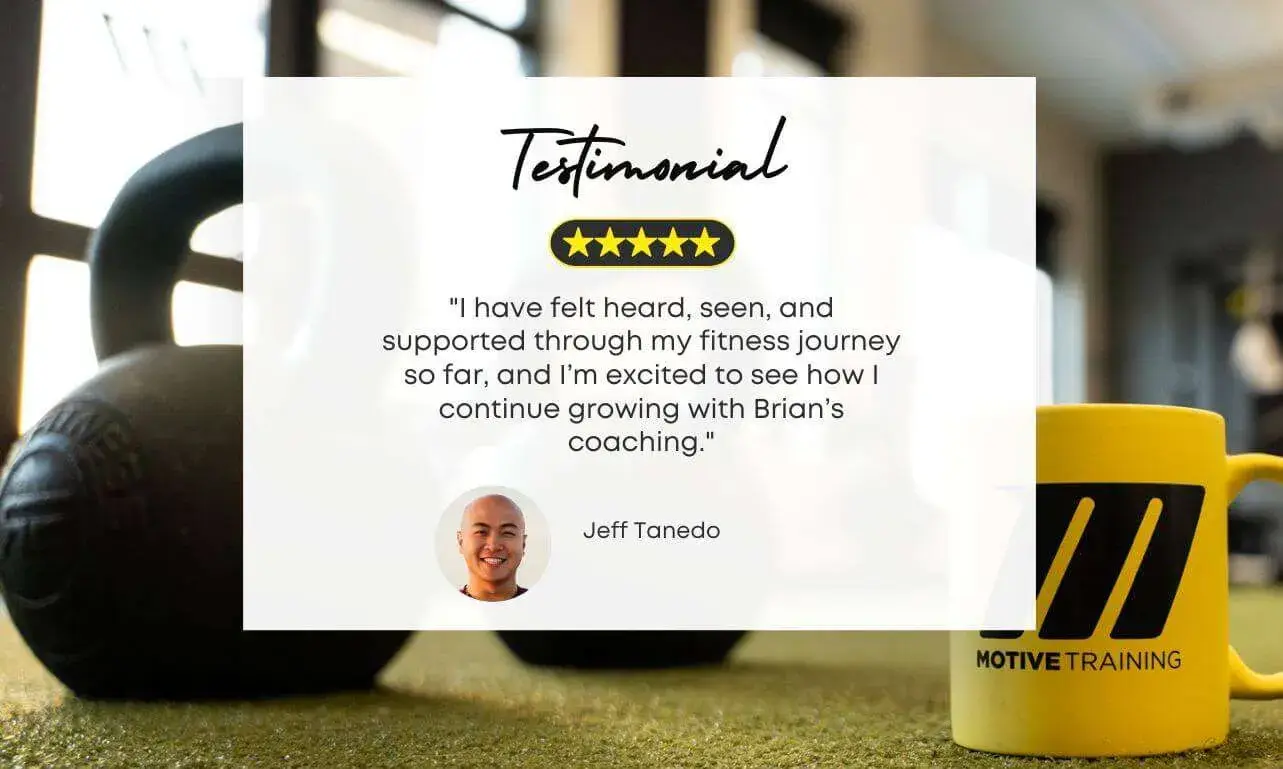
”He helped me accomplish those initial goals and empowered me to go beyond them”
Jeff is a pediatric researcher and martial artist who came to Motive in early 2023 wanting to reduce pain from training and make progress toward his calisthenics goals. The thing worth noticing in his testimonial is the feedback loop. The program he’s on gets adjusted every few weeks based on his responses, his messages after solo workouts, and what’s coming back from his training data. That ongoing calibration is what separates a program from a plan. The other thing worth noticing is that his dance and martial arts practice got better without being trained directly. When your joints move better and your nervous system has more control, the benefits don’t stay inside the gym.
I recently signed up with Motive Training and started working with Brian Murray, and my experience has been outstanding. My initial goals ranged from reducing pain from training to supporting my calisthenic goals. Right off the bat, Brian worked with me to understand these goals and the limitations I had been experiencing so he could personalize my workout plan.
He doesn’t just set it and forget it, either. After my solo workouts, I sometimes message Brian with questions, and he will either provide clarification or suggest changes to the plan to accommodate my concerns and encourage further development. He uses my feedback and my stats to create a new plan every few weeks, so I don’t get physically and mentally fatigued from the workout. Needless to say, Brian helped me accomplish those initial goals and empowered me to go beyond them.
One of the things that keeps me coming back is how much I keep learning from Brian. He is incredibly knowledgeable and experienced. He’s also able to convey that information concisely, translating to immediate changes in how I move and function. As a dancer and a martial artist, I have found my practices improved by the wisdom I’ve gained from working with him, even though we don’t train those things specifically. Through some of the exercises he’s coached me through, I’ve internalized methods to understand my body’s strength and range of motion. As a result, I’ve begun to train myself out of bad habits during the various movement arts I take on.
In the rare instances that I have a question that Brian can’t answer, he has no problem admitting so and either does more research to come up with an answer later or works with me to find someone who can. I have felt heard, seen, and supported throughout my fitness journey so far, and I’m excited to see how I continue growing with Brian’s coaching.
— Jeff T.
”I have made significant progress not only with the pain but my performance has improved as well”
Fernando plays competitive soccer three to five times a week. By the time he found Motive, he was dealing with pain across his ankle, knee, hips, and lower back, the kind of accumulated load that builds up when you’re training at that volume without a mobility strategy supporting it. Three months in, the pain came down and the performance went up. That pairing isn’t a coincidence. When you address underlying joint capacity rather than just managing symptoms, the body can do more with less strain.
I play soccer 3-5 times a week and was dealing with terrible pain in my ankle, knee, hips, and lower back. Needless to say, I was struggling in the mobility and flexibility department. I started working with Brian and the Motive Training team in March earlier this year. It is now June, and I have made significant progress not only with the pain but my performance has improved as well! Brian customizes my sessions and understands what my specific needs are. If you are considering one-on-one coaching, I recommend scheduling a call with them at least to see if it is a good fit!
— Fernando A.
”Motive are the only people I trust with my overall anatomical and physiological health”
Thomas came to Motive with neck, shoulder, back, and hip pain. His brother, a chiropractor, referred him specifically because of our focus on movement quality and joint health rather than aesthetics. His original plan was to do three months, learn some good exercises, and then move on to a regular gym. Seven months later, he was still going, which is what happens when training is genuinely responsive, when every session starts with how you feel that day and gets built from there. Thomas is also a good example of a gap Motive is particularly well-suited to fill. Standard medical care gets people out of acute pain. It doesn’t always build the movement quality needed to stay out of it.
I have been training at Motive since September, and the experience has been phenomenal! I have neck, shoulder, back, and hip pain, so the “typical” personal trainer wasn’t going to cut it. My brother, a chiropractor, recommended Motive based on their focus on movement, flexibility, and overall health, not just losing weight and gaining muscle. I have lost weight and gained muscle, BUT most importantly, my neck, shoulders, back, and hips are mostly pain-free. I can work, live, and keep up with my four-year-old daughter significantly better than before training.
I originally signed on for three months of training to alleviate my pain and get in shape for ski season. I figured I would learn some good workouts, and then when the three months were completed, I would join a gym and apply what I learned at Motive. No way! I’m in seven months and still going strong. Every training session, my trainer asks how I’m feeling, what’s sore, what hurts, and what my goals are, and she develops and adjusts my training regimen specific to my needs that day. If I’m having pain or am tight, we stretch more. If I let her know I want to look good for a beach vacation, she caters my workout to that.
There’s no way I would be getting the results I’m getting if I was trying to wing it on my own and guessing at what will get me results. I hate, hate, hate working out, but I know I have to do it, and if I have to do it, Motive are the only people I trust with my overall anatomical and physiological health.
— Thomas P.
What these three have in common
Jeff wanted to move better as an athlete. Fernando wanted to play through a full season without breaking down. Thomas wanted to keep up with his four-year-old daughter. Different goals, different bodies, different starting points, with the same underlying problem. They needed a trainer who would actually look at how they move and build something specific from that.
That isn’t a revolutionary idea. It’s just harder than handing someone a generic program, and most trainers don’t invest in the education required to do it well. The assessment and the joint-by-joint approach are the foundation every Motive program is built on, for competitive athletes, for people dealing with chronic pain, and for people who are done starting over.
If you want to talk through what that would look like for you, we’re easy to reach.
Written by

Brian Murray, FRA, FRSC
Founder of Motive Training
Motive Training is a coaching studio in South Austin built around assessment, joint health, and strength you can use. Train with us in the studio, come to a KINSTRETCH class, or work through the progressions in KINSTRETCH Online.