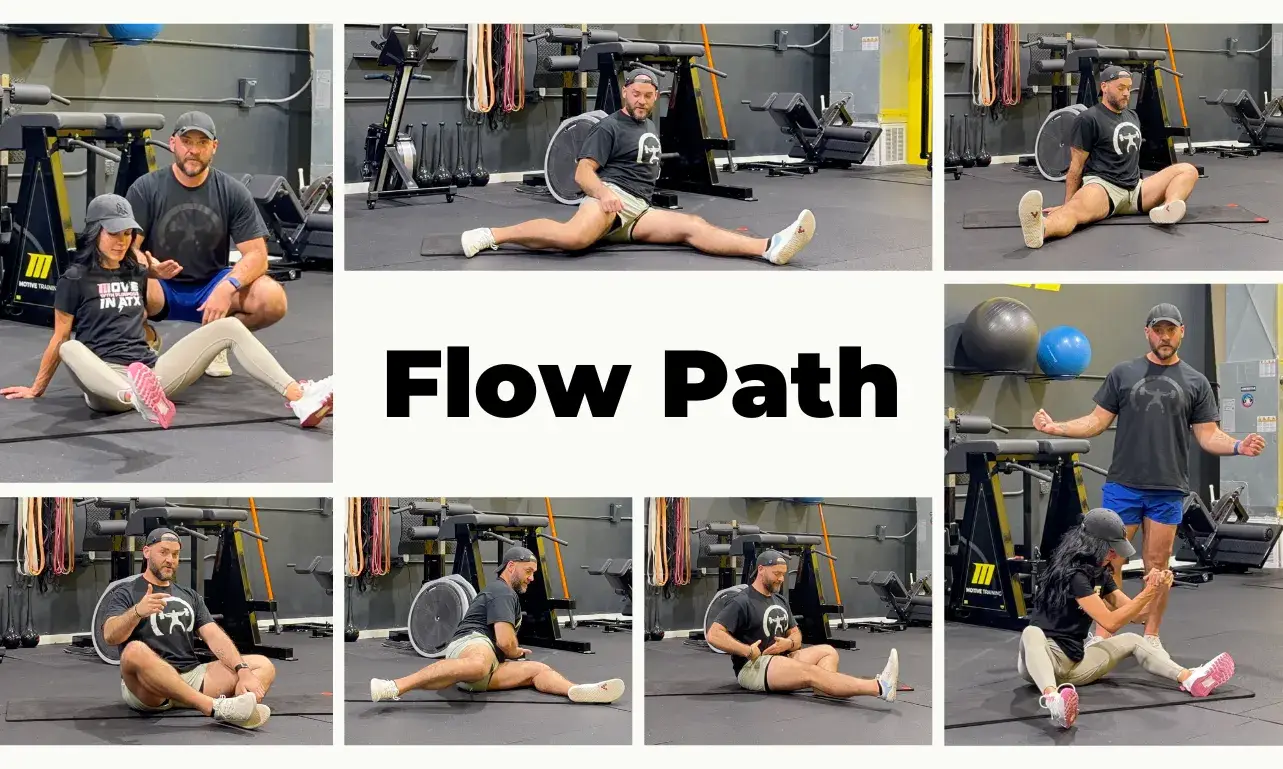
The positions in KINSTRETCH are not the point. That sounds like a strange thing to say about a practice that is built around positions, but stick with it. The positions are reference points. What matters is what you can do with your joints as you move between them.
That distinction is the foundation of the isometric movement path, which is the flow-based format we use in our advanced and flow-specific KINSTRETCH classes. If you have taken a standard class with us, most of your work has happened in a single position: get into 90/90, do your PAILs and RAILs, exit, move to the next joint. That structure is intentional. It lets you focus load at a specific angle without the complexity of managing transitions. But it also means the angles between positions largely go untrained.
The isometric movement path closes that gap.
What the movement path actually trains
The name tells you a lot. Isometric means you are generating muscular tension without producing movement. A path means you are moving through a range. So the movement path is the practice of producing tension continuously while the body travels from one position to another. You are not relaxing between positions. You are not passively dropping into a new base. The work is happening the whole time.
In practice, this looks like flowing from a butterfly position into a figure four, then into a half-90, then drawing back to your starting point, all while keeping the working hip loaded. The joint is being asked to produce tension at angles it has rarely, if ever, been loaded. That is the point.
The reason this matters is mechanical. Most people have a wide discrepancy between how much passive range they have and how much of it they can actually use under tension. The fact that you can get into a position does not mean you own that position. More importantly, the fact that you can get between two positions does not mean you control what happens in between them. The path specifically addresses that second problem.
When you stay active through a transition, the nervous system starts to learn the angles it had previously been treating as dead zones. What reads as unfamiliar becomes practiced. That is how borrowed range becomes your own.
The positions used in the path
Our current flow path sequence draws from four bases. These are not arbitrary. Each one creates a different demand on the hip, and the transitions between them compound that demand.
The bear sit is a symmetrical starting position with both legs bent in front of you. From there, the trail leg lifts and migrates toward internal rotation as you settle into a 90/90. This is the bear sit to 90/90 transition: the first pattern most people learn, and a more demanding one than it looks. The lift-off requires you to generate height on that foot while staying tall in your trunk, not collapsing into your obliques, not letting the weight shift dump you out of your hip.
The butterfly to figure four works an external-to-internal rotation cycle on the working leg. You lift from the foot, not just the knee. The foot and the knee travel together. As you rotate internally and draw the knee toward your chest, you are chasing the inner thigh and hip flexor, fighting to keep tension in the hip rather than just getting the leg into position. The return out of figure four into butterfly is not passive either. You lift the leg, find the quad, and fight for external rotation on the way back. The non-working leg is largely irrelevant; if anything, pressing it into the floor adds irradiation and makes the working side harder.
The figure four to half-90 is where most people start to feel the limits of their hip internal rotation. The half-90, sometimes called a hurdle position, asks the trail leg to arrive in internal rotation with the shank vertical and the opposite leg extended. Getting there cleanly requires significantly more internal rotation control than simply sitting in 90/90 does. For most people, it also requires hands on the floor, at least initially. That is fine. The goal is to get to the position with integrity, not to perform it cleanly at the expense of what is actually happening in the joint.
The butterfly to middle split position maxes out hip abduction. The width itself is not really what is being tested. What is being tested is how far you can actively drive both hips apart from a controlled position, rather than how far gravity and momentum can carry you there passively. Going wide passively is easy. Doing it while producing tension in the working hip, maintaining height in the trunk, and controlling the return is a different problem entirely. The cramping that people often feel on their first attempt in this position is the hip flexor encountering load it has never had to manage in that range. It is normal. Work through it where you can.
What the path has that individual positions don’t
A useful way to think about this: if standard KINSTRETCH trains you at specific coordinates in your range, the movement path trains you along the routes between those coordinates. Both are necessary. The coordinates give you reference and depth. The routes give you continuity.
There is also a sequencing principle embedded in the path that is easy to miss. The positions connect. The way you exit one shapes your entry into the next. A bear sit to 90/90 transition ends at the same place a 90/90 to figure four transition begins. A figure four position connects to the half-90 directly. Once you understand the underlying logic, you can start building your own sequences rather than just executing a fixed drill. That is the longer-term skill being developed.
For a lot of people who have trained in our standard classes, the positions themselves will feel familiar. What will not feel familiar is sustaining tension through the travel between them. Expect that to be the challenge. The positions themselves might not feel difficult. The requirement to stay loaded throughout the path is what reveals where the gaps actually are.
Where to find this work at Motive
The isometric movement path shows up most consistently in our KINSTRETCH Online classes, specifically in the flow and advanced formats. It is a different structure than the single-joint focused work we do in foundational classes, and for most people it is worth building the base positions first before approaching the path seriously.
If you are newer to KINSTRETCH or you are not yet comfortable in 90/90, figure four, or butterfly, start there. You can book a movement assessment to get a clearer read on where you are in each of these positions before you start trying to flow between them. The path will teach you things about your hips that individual position work will not. But it asks more of you, and it will be more productive once the base positions feel like something you already own.
Our online programming includes both formats. If you have been doing the foundational work and you want to see what happens when you have to hold it through the transitions, the flow classes are the place to find out.
Written by

Brian Murray, FRA, FRSC
Founder of Motive Training
Motive Training is a coaching studio in South Austin built around assessment, joint health, and strength you can use. Train with us in the studio, come to a KINSTRETCH class, or work through the progressions in KINSTRETCH Online.